5 Ad Tech & MarTech Trends for 2017: What Industry Insiders Predicted
Over the course of 2016, a series of interviews with executives, analysts, journalists, and founders across Ad Tech and MarTech surfaced a consistent set of expectations for the year ahead. Five themes came up repeatedly — and taken together, they paint a clear picture of where the industry was heading going into 2017.
5 Trends That Shaped Ad Tech & MarTech in 2017
1. Mergers and Acquisitions, Consolidation, and Tech Stacks
M&A activity in Ad Tech and MarTech is nothing new, but 2016 was a particularly lively year. Some of the most prominent deals included:
- Xaxis acquired Triad Retail Media
- Criteo acquired HookLogic
- Adobe acquired TubeMogul
- Salesforce acquired Krux
Most observers expected that pace to continue into 2017.
"We saw Adobe buy TubeMogul last week, so you'll see a lot more of that type of acquisition, with the major martech/cloud names buying scaled DSPs." — Ari Paparo, CEO at Beeswax
Seth Ulinski, Senior Analyst at Technology Business Research Inc. (TBR), saw a structural reason behind the trend:
"Enterprise vendors will remain acquisitive, as it typically makes more sense for them to purchase a vendor's tools than try to develop them internally given the speed and innovative nature of the market."
Ultimately, consolidation was expected to pull the Ad Tech and MarTech worlds closer together, giving rise to a new era of integrated tech stacks.
2. AI and Machine Learning to Make Progress
Artificial intelligence and machine learning were generating significant buzz across the industry — from Google's consumer products to applications in Ad Tech and MarTech.
Scott Brinker, founder of chiefmartec.com, framed the opportunity plainly:
"Machine learning has reached a level of maturity where it's being applied in more and more practical use cases in marketing. The promise is that software intelligence will help relieve some of the burden from us of managing the sheer scale and complexity of modern marketing."
Peter Messmer, Director of Growth at an e-commerce remarketing platform, already had specific use cases in mind:
"One fairly basic example of this (AI) could be the potential to create a model of your email database that reacts like each real subscriber does, then sending them hundreds (or more) of variations of test emails to find the highest possible converting email. Or even the potential to send each a different highly personalized email."
Brinker added a note of measured optimism: "It's got a long ways to go, but it's progressing quickly. Definitely a trend to watch in 2017."
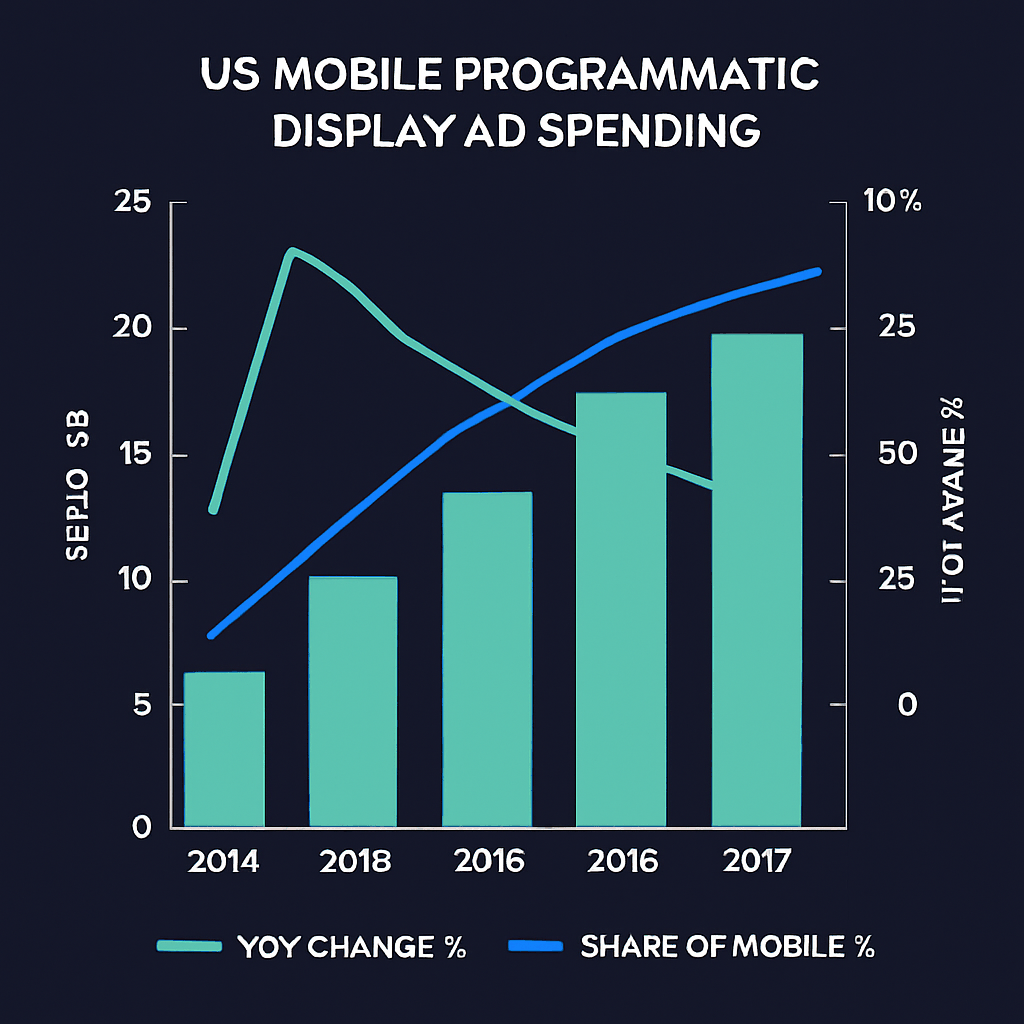
3. Mobile Programmatic Ad Spend to Hit New Highs
Robert Brill, founder of BrillMedia.co, put it directly:
"Every year for the last five years has been the year of mobile. We are definitely in the period of mobile and that's not going anywhere anytime soon. In 2017, three fourths of the $32B programmatic spending is expected to run on mobile devices."
eMarketer data supported that outlook, projecting that mobile programmatic ad spend would surpass desktop for the first time.
Lindsay Rowntree, head of content for ExchangeWire, also saw broader smartphone-driven opportunities on the horizon:
"We're close to living in a world where every newspaper and out-of-home (OOH) ad is brought to life with a smartphone. What's more, the sheer success of Pokemon Go proves that we'll soon be looking through our phones to walk down the street and brands will be able to capitalise on that."
She summed it up with characteristic directness: "Mobile is exciting, so much so that it's almost scary and it's still so new — we haven't even experienced the start of it yet."
4. Server-Side Header Bidding to Keep Growing
2016 saw a meaningful shift toward server-side header bidding as publishers and platforms looked to address the page latency problems created by traditional client-side implementations.
Reports from early December 2016 indicated that Amazon was planning to announce its own server-side header bidding solution, while around the same time Purch was pursuing server-to-server connections as an alternative to conventional header bidding entirely.
The expectation heading into 2017 was straightforward: more publishers and platforms would adopt server-side implementations, driven by improvements in page latency, higher yields for publishers, and better overall campaign ROI.
5. Privacy and Data Ownership
The regulatory environment around data privacy was tightening on both sides of the Atlantic.
In October 2016, the US Federal Communications Commission (FCC) introduced privacy regulations requiring ISPs to gain opt-in consent from users before selling customer data — including location, browsing history, and app usage — to media companies.
Earlier in 2016, the US Federal Trade Commission (FTC) expanded its definition of personally identifiable information (PII) to include IP addresses and device IDs. The European Union's Article 29 Data Protection Working Party had made a similar move years earlier, classifying IP addresses as personal data.
Alex Wheldon flagged the broader systemic implications:
"…privacy and data practices globally will have huge impact on the ecosystem as we know it today. Platforms and publishers are already beginning to see the effects of this, and I think it will continue."
On the horizon was the General Data Protection Regulation (GDPR) from the European Parliament and Council — scheduled to take effect on May 25, 2018, but already requiring action from Ad Tech and MarTech companies preparing for compliance.
Data ownership was also emerging as a distinct conversation. David Brown, founder and Chief Executive at Adavow, described the direction of travel:
"There are already a few organisations focused on shifting data ownership rules from companies (who collect and store customer information) back to consumers (who don't get any real value from giving away their data). The effect of this is that companies will no longer be allowed to collect and store user information — even for their customers."
Wherever you sat in the Ad Tech and MarTech ecosystem, 2017 was shaping up to be anything but a quiet year.