The True Cost of Hiring AdTech and MarTech Developers [Infographic]
When starting a new AdTech or MarTech development project — or adding features to an existing platform — the technology stack is only part of the equation. The other part, often underestimated, is the cost and time required to put the right development resources in place.
For most companies, the instinct is to hire in-house. It feels like the safest, most accountable path. But in-house hiring comes with a set of disadvantages that rarely get quantified up front: the time it takes to find the right people, the cost of onboarding, the risk of domain-knowledge gaps, and the ongoing overhead of a full-time payroll — even during slow periods.
So what does hiring in-house developers actually cost, and how long does the full process take?
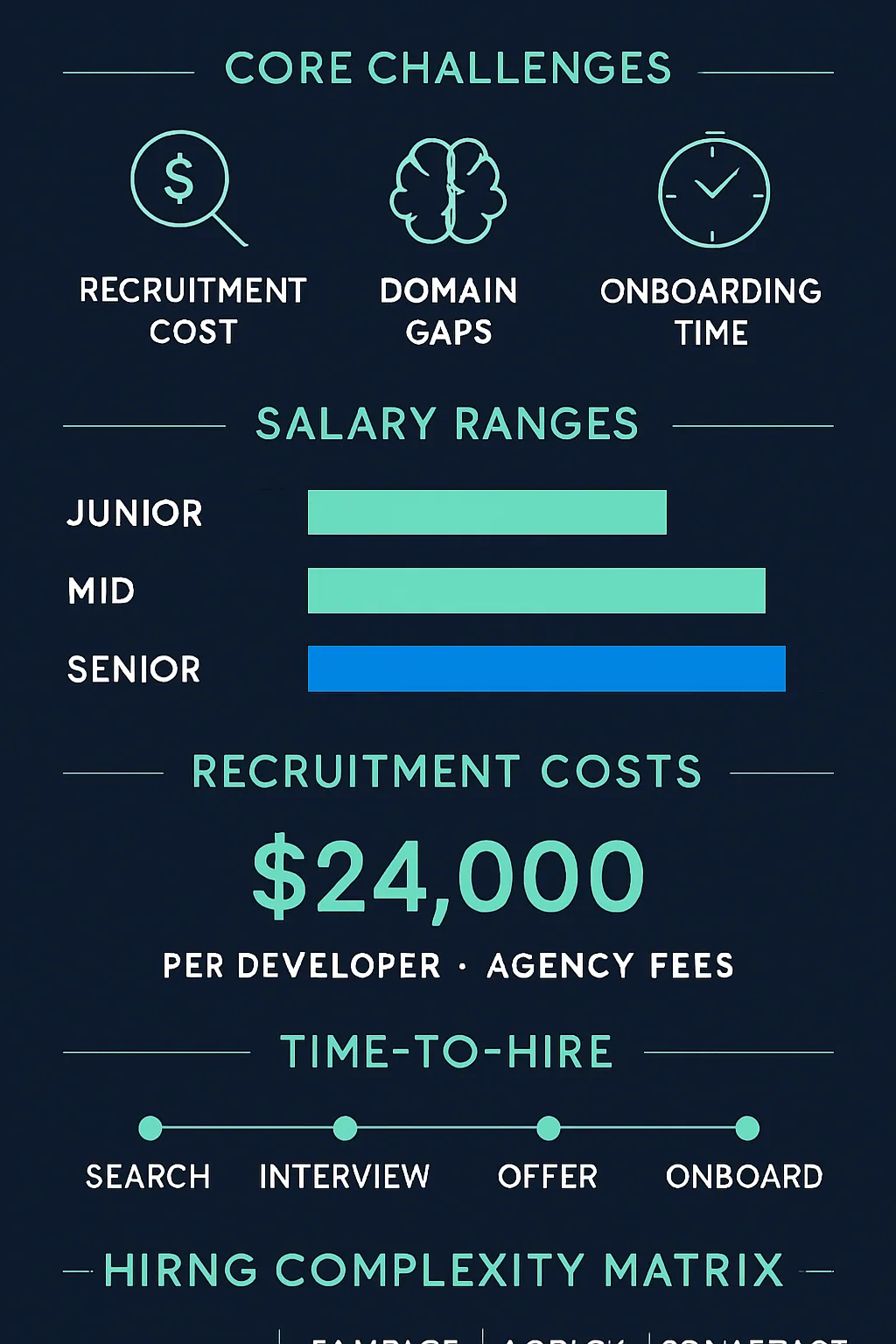
The True Cost of Hiring AdTech & MarTech Developers
The Core Problem
Whether the goal is building a new AdTech or MarTech platform or expanding an existing product, increasing development capacity is unavoidable. The main friction points are:
- Keeping recruitment costs from spiralling.
- Finding developers who already understand AdTech and MarTech — not just general software engineering.
- Ensuring projects start on time and aren't disrupted by onboarding delays, vacations, sick leave, or AdTech/MarTech training curves.
Two Main Options
Option 1: Recruit in-house developers.
Option 2: Engage a specialized AdTech & MarTech development partner — a software development firm that focuses exclusively on advertising and marketing technology, bringing domain expertise that generic outsourcing or body-leasing shops typically lack.
Cost Summary at a Glance
| Approach | Approximate hourly cost | Typical time-to-project-start |
|---|---|---|
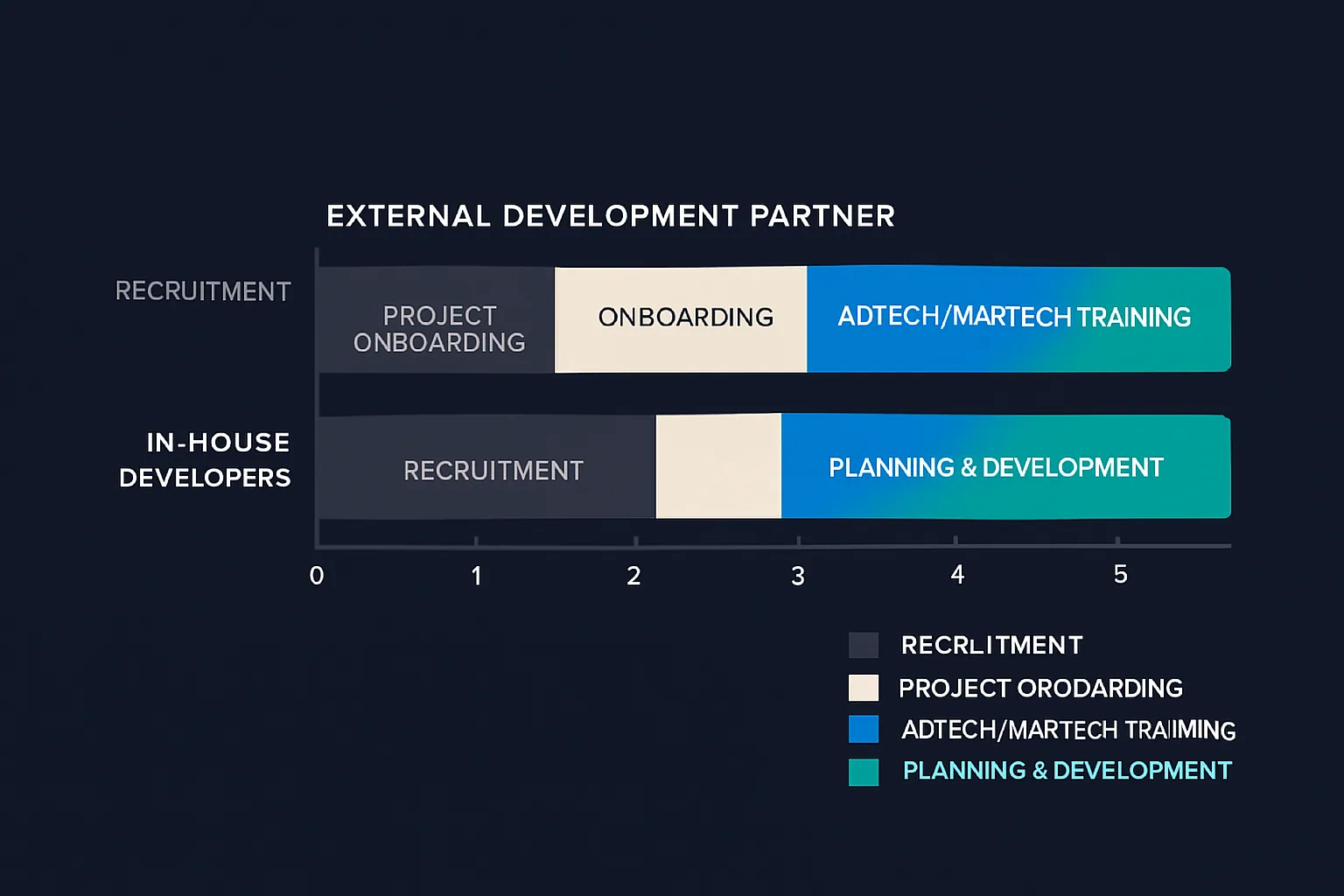
| In-house developer | $65–$86/hr | 3–6 months |
| Specialized AdTech/MarTech development partner | $65–$100/hr | Less than 1 month |
The hourly rates look comparable on paper. The time-to-start gap is where the real cost difference emerges.
Developer Salaries: What the Base Numbers Look Like
Experienced Software Engineers (5–10 years of experience) — Base Yearly Salary
Senior Software Engineers (10+ years of experience) — Base Yearly Salary
What Hiring Actually Costs: Beyond the Base Salary
A software engineer's true cost to an employer is 18% to 50% higher than their base salary once taxes, benefits, equipment, and recruitment fees are factored in.
United States
- Recruitment agency fees: 18%–25% on top of base salary. Job advertising: $199–$495/month.
- Employee-related taxes: 10%
- Retirement contributions: 3%–6%
- Equipment, perks, integrations: 2%–15%
United Kingdom
- Recruitment agency fees: 18%–25% on top of base salary. Job advertising: £160–£400/month.
- Employee-related taxes: 13.8%
- Retirement contributions: 3%
- Equipment, perks, integrations: 1%–8.2%
Germany
- Recruitment agency fees: 18%–25% on top of base salary. Job advertising: €180–€450/month.
- Employee-related taxes: 9.3%
- Retirement contributions: 3%–9.75%
- Equipment, perks, integrations: 1%–8.2%
France
- Recruitment agency fees: 18%–25% on top of base salary. Job advertising: €180–€450/month.
- Employee-related taxes: 4.8%–25.6%
- Retirement contributions: 10.45%–17%
- Equipment, perks, integrations: 1%–8.2%
True Total Costs by Market
Experienced Software Engineers (5–10 years)
| Market | Base salary | True yearly salary | With recruitment agency |
|---|---|---|---|
| New York, USA | $115,787 | $136,628–$144,733 | $163,953–$173,679 |
| London, UK | £55,612 | £65,622–£69,515 | £78,746–£83,418 |
| Berlin, Germany | €58,125 | €68,587–€72,656 | €82,304–€87,187 |
| Paris, France | €48,605 | €57,353–€60,756 | €68,823–€72,907 |
Senior Software Engineers (10+ years)
| Market | Base salary | True yearly salary | With recruitment agency |
|---|---|---|---|
| New York, USA | $143,852 | $169,745–$179,815 | $203,694–$215,778 |
| London, UK | £68,855 | £81,248–£86,068 | £97,497–£103,281 |
| Berlin, Germany | €66,748 | €78,762–€83,435 | €94,514–€100,122 |
| Paris, France | €60,036 | €70,842–€75,045 | €85,010–€90,054 |
The Time Cost of In-House Recruitment
Salary overhead is only half the story. The recruitment process itself consumes significant time before a single line of code is written.
CV screening: 1–2 hours of review per day, sustained over weeks.
Candidate search: 1–6 months to find developers with the specific skills required.
Interviews: 3–8 hours per candidate.
Interview process completion: 2–4 weeks.
Coding challenge review: 3–10 hours per candidate; another 2–4 weeks to complete this stage.
Notice period: Once a candidate accepts an offer, they may still be 1–3 months away from actually starting work.
Lost Productivity After Hire
Even once a developer is on board, they aren't immediately productive:
- Vacation entitlement: Typically 20 days per year.
- Sick days: Typically 10 days per year.
- Onboarding and training: 1–3 months before the new hire is fully contributing.
The Domain-Knowledge Problem in AdTech and MarTech
Building advertising and marketing technology isn't like general software development. Developers working in this space need a working understanding of how the digital advertising ecosystem functions — technically and commercially.
If a developer doesn't know why a DSP must respond to a bid request within 250ms, or what VAST (Video Ad Serving Template) is, the project is already operating at a disadvantage. Training developers on AdTech and MarTech fundamentals takes months. Doing that training in parallel with active development tends to produce costly mistakes, incomplete features, or products that simply don't function correctly in production environments.
What a Specialized Development Partner Offers
For companies that need to move faster and can't absorb a multi-month runway before development starts, a specialized AdTech and MarTech development partner is worth considering seriously. The advantages typically include:
1. Domain knowledge from day one
Specialized partners have teams that have built RTB platforms, data management tools, analytics systems, and reporting infrastructure. There's no training ramp on AdTech concepts.
2. Engagement flexibility
Engagements can scale up or down — from a few months to a few years — without committing to full-time headcount during periods when product development slows.
3. Faster project starts
A well-resourced partner can often assemble a team and begin within weeks, not months. They can also ensure continuity by adding developers to cover for vacations and sick leave without interrupting the project.
4. Billing aligned with actual work
Hourly billing that excludes holidays, sick leave, and non-working time means companies pay for output rather than availability. Project tracking tools (Jira or equivalent) make billable hours and sprint progress transparent.
The gap between in-house and partner hourly rates is narrow. The gap in time-to-productivity and domain readiness is not. For companies weighing these options, the infographic above captures the key numbers — but the harder question is how much a 3–6 month delay in starting a project actually costs the business.