CTV & OTT Advertising: Industry Leaders on Buying, Targeting, and Measurement [Part 1]
The connected TV (CTV) and over-the-top (OTT) advertising space is evolving fast — marked by product innovations, platform acquisitions, and a steady stream of new entrants. Yet fundamental questions remain about how CTV and OTT advertising actually works: how inventory is bought and sold, how audiences are targeted, and how campaigns are measured.
To get some grounded answers, five practitioners from across the industry — spanning demand-side platforms, attribution, programmatic buying, and ad serving — shared their perspectives on the mechanics driving the space.
Interviewees:
- Jeffrey Johnson — Senior Director, Strategic Accounts, CTV Platform at Verve Group
- Jeff Richardson — Senior Product Manager at Kochava
- Joel Cox — Co-Founder at Strategus
- Megan Sullivan-Jenks — Senior Director of Marketing & Communications at Choozle
- Paul Gubbins — VP, CTV Strategy at Publica
What Is CTV and OTT Advertising?
Definitions in this space vary, but the IAB Tech Lab provides the most widely cited framework. It defines CTV as any Internet-connected device used to view video content — encompassing smart TVs, game consoles like PlayStation and Xbox, and streaming devices like Roku, Chromecast, Amazon Fire Stick, and Apple TV. Laptops, desktops, smartphones, and tablets are explicitly excluded from the CTV definition. For OTT video, the IAB Tech Lab points to services such as Netflix, Roku, Hulu, and Sling as representative examples.
In September 2021, the Media Rating Council (MRC) published its own definition, taking the position that CTV is best understood as a subset of OTT rather than as a parallel, separate category. In practice, the MRC's boundary between CTV and non-CTV devices aligns closely with the IAB Tech Lab's — smart TVs and Internet-enabled TV devices qualify; laptops, phones, and tablets do not.
How Does CTV and OTT Advertising Differ From Traditional TV?
With OTT and CTV advertising, you can reach further than with traditional linear television. The audience is made up of a younger, more tech-savvy cord-cutting segment. The increase of OTT and CTV viewership provides more significant ways to engage at the perfect time with your target audience. CTV and OTT marry together the precision of digital with the premium television experience users have come to expect.
— Jeffrey Johnson, Senior Director, Strategic Accounts, CTV Platform at Verve Group
What Does the CTV/OTT Advertising Landscape Look Like?
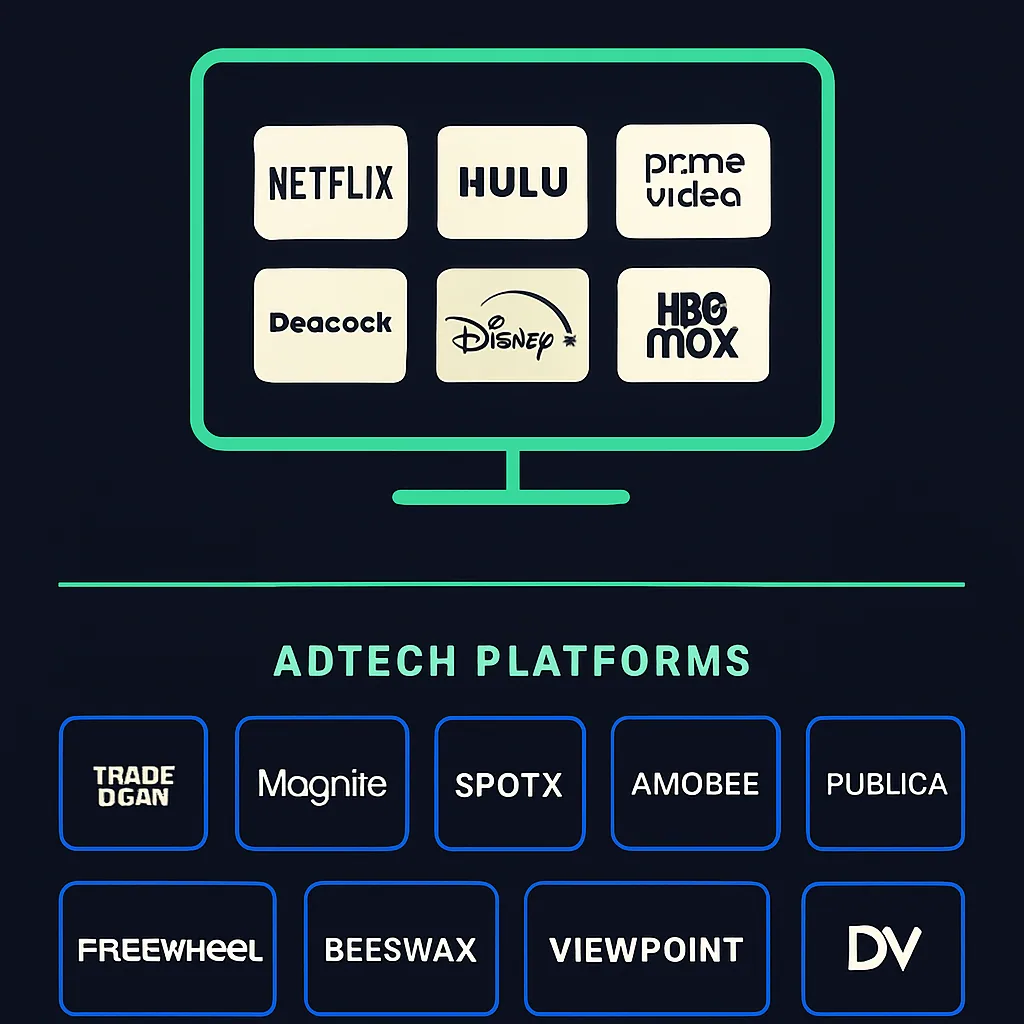
The CTV/OTT advertising ecosystem comprises connected TV devices, OTT streaming services, and a range of AdTech companies spanning ad servers, DSPs, SSPs, and data providers.
How Are CTV and OTT Ads Bought and Sold?
CTV ads are bought and sold through real-time bidding (RTB) — an automated auction connecting buyers and sellers. Programmatic, at its fundamental nature, is the use of automation and data. Programmatic RTB enables buyers to connect audience-targeting data with CTV ad inventory and attribution solutions. We're seeing programmatic bring together disparate data sets with inventory, ultimately delivering a more valuable ad impression for both consumers and advertisers.
That said, it's important to note that not all CTV inventory is purchased via programmatic RTB. Some is still bought through direct relationships, much like traditional broadcast television.
— Joel Cox, Co-Founder at Strategus
What Targeting Is Available for CTV & OTT, and What Role Does Contextual Play?
Direct buying generally provides access to a very limited demographic slice of a publisher's subscriber base. But when a campaign is connected programmatically, you unlock almost every digital targeting option available in a traditional digital ecosystem.
Programmatic CTV can be thought of as the best of television combined with the best of digital — precision targeting alongside a household living-room experience. Campaigns can incorporate the same data points used in mobile or desktop environments: demographic signals, automatic content recognition (ACR) data, and location data. For example, ACR and location data together can allow a marketer to identify consumers who visited a car dealership or a restaurant and then connect those behaviours to active campaign targeting.
Contextual targeting has long served as a proxy for audience adjacency. The classic example: a major razor brand advertising during sports broadcasts, on the logic that men watch sports, men shave, therefore — run the ad. The reasoning is straightforward, but it has its limits. Sports audiences aren't exclusively male, and audiences in general don't confine themselves to neat content categories.
Because programmatic CTV tells you who is actually on the other side of the screen, it doesn't matter whether that viewer is watching sports or something a marketer would never have predicted. The data enables targeting based on numerous factors, independent of content context.
— Joel Cox, Co-Founder at Strategus
What Role Does Data Play in CTV and OTT?
Data is enabling new advertisers to enter TV advertising for the first time, and enabling streaming publishers to grow their share of budgets away from traditional TV, social, and display platforms.
First-party data activation is, however, relatively new territory for many streaming publishers. GDPR and CCPA still apply in the CTV world, and a new generation of consent management platforms (CMPs) has emerged to help smart TV manufacturers and streaming apps collect the appropriate viewer consent for data-driven targeting.
Companies like LiveRamp have built out robust first- and third-party CTV data marketplaces for both buy and sell sides. Many publishers have been quick to take advantage of LiveRamp's CTV offering to increase the yield of their streaming deals — whether through first-party data activation or the application of third-party data to their private marketplace deals.
— Paul Gubbins, VP, CTV Strategy at Publica
Data is the currency of digital, which puts CTV and OTT near the top of the advertising ecosystem's priority list. That said, CTV and OTT can run into challenges — particularly around cookie-to-IP address matching, which can limit the scale of inventory available for IP-based audience targeting.
That gap creates an opening for providers with automatic content recognition (ACR) data. ACR data can be segmented in many ways, including to target viewers who haven't been exposed to a given ad on linear TV — effectively boosting reach. Conversely, advertisers can use ACR data to retarget users who have seen a particular linear TV ad. Data will continue to be a central driver of programmatic CTV growth.
— Jeffrey Johnson, Senior Director, Strategic Accounts, CTV Platform at Verve Group
How Are CTV and OTT Ads Measured?
CTV and OTT video campaigns use a mix of familiar digital metrics — impressions, geolocation, CPM — alongside others specific to the channel.
The first thing to understand is that CTV is primarily an awareness-driven campaign type. Due to how most CTV devices function, direct conversions aren't readily accessible at the point of exposure. This is where cross-device tracking becomes valuable: by linking viewers to the devices they use across a household, it becomes possible to attribute CTV impressions to conversions that occur later on another device.
Win rate is another important metric to monitor. It measures the number of impressions served out of those bid on. Win rate reveals whether a campaign is reaching enough of its target audience, whether spend is pacing correctly against budget, and whether base bids are competitive enough to win needed inventory.
Video completion rate (VCR) measures how often a video plays to the end. VCR is typically high for CTV because most CTV environments don't offer a skip option. However, as different device types are added to a CTV campaign — moving beyond pure CTV into adjacent inventory — VCR is liable to decline. Testing ad placements and deal packages helps identify which spots drive the strongest completion rates.
Finally, ad frequency deserves careful attention. If the targeted audience is small but served impressions remain high, there's a real risk of over-saturating that audience — leading to disengagement or brand resentment.
— Megan Sullivan-Jenks, Senior Director of Marketing & Communications at Choozle
Why Is Supply-Path Optimization (SPO) Important for CTV & OTT?
When running programmatic OTT and CTV campaigns, supply-path optimization allows marketers to narrow their ad spend to specific publishers or platform partners within the programmatic exchange — the ones they want to prioritize and build longer-term relationships with.
SPO gives the marketer some control back from the programmatic algorithm, letting them dictate the preferred supply path. It helps ensure brand safety, avoid unwanted overlap in the media mix, maximize efficiency, and mitigate potential fraud. It's worth asking any programmatic OTT and CTV partner whether SPO is available.
— Jeff Richardson, Senior Product Manager at Kochava