CTV & OTT Advertising: Industry Leaders on Trends, Challenges, and What Comes Next
Trends, challenges, and opportunities are constants in programmatic advertising — and right now, connected TV (CTV) and over-the-top (OTT) are where most of the action is happening.
What impact has the COVID-19 pandemic had on the space, and what does the near-term future look like for CTV and OTT advertising? A cross-section of industry practitioners shared their perspectives in this second instalment of an interview series focused on the sector.
Interviewees:
Anna McMichael — Head of Partnerships at VlogBox
Jeffrey Johnson — Senior Director, Strategic Accounts, CTV Platform at Verve Group
Daniel Elad — Chief Strategy Officer at TheViewPoint
Paul Gubbins — VP, CTV Strategy at Publica
Joel Cox — Co-Founder at Strategus
Vanessa Delgado — Senior VP, Business Development at MetaX
Itay Droog — Account Development Director at Amobee
Table of Contents
- What Are Some of the Main Challenges Facing CTV and OTT?
- What Are the Main Trends in the CTV and OTT Advertising Industry?
- How Has COVID-19 Impacted the CTV/OTT Industry?
- What Are the Benefits of CTV & OTT Advertising for Brands?
- What Is the Future of CTV and OTT Advertising?
What Are Some of the Main Challenges Facing CTV and OTT? {#challenges}
1. Ad Fraud
Like other programmatic markets, CTV/OTT is vulnerable to ad fraud. These platforms tend to show lower fraud rates than the broader programmatic ecosystem, but the absence of robust quality regulations and standards still leaves significant exposure.
Named fraud schemes — DiCaprio, Monarch, ParrotTerra, ICEBUCKET, and others — have cost industry participants millions. StreamScam, uncovered by Oracle Moat, allowed fraudsters to steal over $14.5 million in ad spend before it was shut down.
2. A Lack of Premium Supply
Smaller CTV and OTT publishers face steep competition from Google, Apple, Facebook, and Amazon. Add the entrenchment of closed walled-garden ecosystems and ongoing market consolidation, and the supply picture becomes increasingly difficult to navigate for independent operators.
3. Intermediaries and Hidden Fees
Because CTV's programmatic presence is still relatively new, publishers frequently deal with multiple middlemen — and the commission layers that come with them. It's estimated that only 40% of ad spend at best actually reaches media owners, given the number of intermediaries involved. At the same time, some marketers do benefit from the market's relative immaturity: 24% of them cite cost-effective CPM as the primary reason they've moved toward CTV advertising.
4. Market Fragmentation
Each CTV platform operates its own content categorization and delivery algorithms, which affects targeting accuracy and inventory visibility. A practical workaround is to consolidate activity on platforms or networks that combine broad direct partnerships with diverse audience access — rather than trying to operate across every fragmented corner of the market.
5. Measurement Difficulties
With over 1,000 OTT services in existence, and an average U.S. household using approximately 3.8 different services (per Ampere Analysis), unified measurement standards remain elusive. Device IDs don't map cleanly to the actual viewers using those devices, making cross-channel attribution especially difficult. Emarketer research confirms cross-channel attribution ranks among the most important factors for marketers evaluating ad measurement effectiveness — which underscores how critical it is to develop standardized attribution mechanisms for the CTV ecosystem.
— Anna McMichael, Head of Partnerships, VlogBox
CTV and OTT are still nascent channels, which means a shallow inventory pool relative to app and web environments. Limited supply creates fierce competition among demand partners for coveted audiences, pushing CPMs upward and resulting in lower bid use rates for programmatic buyers. When premium inventory sells out, advertisers may end up settling for less-established supply.
Measurement shortcomings and the comparative lack of addressability — relative to other programmatic channels — are additional friction points. If they aren't resolved with the right tools, they could constrain the industry's growth trajectory.
— Jeffrey Johnson, Senior Director, Strategic Accounts, CTV Platform, Verve Group
What Are the Main Trends in the CTV and OTT Advertising Industry? {#trends}
Since pandemic lockdowns began, Connected TV viewing surged globally, with audiences binge-watching streaming content at unprecedented scale. The trend started in the U.S. but has been gaining momentum in the EU, LATAM, and APAC. Entertainment and sports content has increasingly shifted to streaming, and that trajectory is unlikely to reverse.
Meanwhile, OTT platforms that originally pursued pure subscription models have started either adding ad-supported tiers or moving toward bundling. The sheer volume of streaming services available has pushed consumers toward more cost-effective options, which opens the door for ad-supported inventory.
On the supply side, a substantial amount of premium inventory entered programmatic pipes in 2021 as established programmers and advertisers discovered the advantages of header bidding and intelligent automation. The imbalance between CTV supply and demand is gradually improving — though most of the growth is materializing through private marketplace deals and programmatic guaranteed arrangements.
On the creative side, consumers increasingly exhibit ad fatigue, making it harder to build genuine connections. The response will likely be more interactive ad units: games, quizzes, augmented reality elements, and shoppable QR codes that extend engagement beyond the ad's runtime. Automatic content recognition (ACR) in smart TVs and AI-driven personalization will also become more sophisticated, pushing the ecosystem toward context-based data strategies.
— Daniel Elad, Chief Strategy Officer, TheViewPoint
Several intersecting trends are reshaping CTV right now:
- Increased uptake of unified auctions by CTV publishers
- Rising adoption of server-side ad insertion (SSAI) across streaming apps
- Growing buy-side practice of supply-path optimization (SPO)
Forrester data shows smart TV penetration has reached 56% in the U.S., 63% in the UK, 57% in Australia, and 76% in China. That reach means FAST (free ad-supported streaming TV) and AVOD publishers are attracting more advertiser interest than ever, as cord-cutting accelerates.
Header bidding has enabled streaming publishers to rapidly increase competition for their inventory, which is why more are moving away from exclusive reseller agreements and sequential demand waterfalls. SSAI has proven its value on two fronts: improving advertiser controls and user viewing experience, while also playing a key role in eliminating bad actors via initiatives like Ads.cert 2.0 from the IAB Tech Lab, which uses cryptographic signatures to verify genuine inventory.
U.S. CTV ad spend was expected to increase 48% year-over-year in 2021, topping $13.4 billion in total — with $6.7 billion specifically attributed to programmatically purchased CTV ads. That level of investment creates a large number of supply paths, and an equally large number of opportunities for streaming publishers to capture those budgets. SPO is consequently becoming a central strategy for buy-side players trying to identify the most direct and efficient route to premium CTV publishers.
There has been speculation about CTV inventory scarcity in Q4 as upfront buyers lock up BVOD supply. But the more significant growth area may actually be free ad-supported streaming. The consumer trend toward FAST services — driven partly by SVOD subscription fatigue — is real and playing out globally.
— Paul Gubbins, VP, CTV Strategy, Publica
How Has COVID-19 Impacted the CTV/OTT Industry? {#covid}
COVID-19 didn't fundamentally change the CTV/OTT industry — but it unquestionably accelerated it.
During lockdowns, nearly 300 million Americans were within arm's reach of a smart TV. Streaming usage surged, and post-pandemic levels remain significantly higher than pre-pandemic baselines. The crisis also accelerated adoption among brands and marketers who might have taken longer to discover CTV as a channel.
— Joel Cox, Co-Founder, Strategus
What Are the Benefits of CTV & OTT Advertising for Brands? {#benefits}
CTV is here to stay. The challenges in this channel are real, but the benefits consistently outweigh them — and most obstacles will be addressed as the industry matures, much like every other media format that came before it.
Connected TV blends the best of online and offline advertising: precision targeting capabilities of digital combined with the immersive, high-attention environment of the living room screen. It also offers meaningful contextual signals — behavioural data, geolocation, interest verticals, language, time-of-day — enabling better brand experiences for audiences that are generally more receptive than they are when viewing traditional video on other devices. On-demand viewing means consumers are often in a more open mindset when they encounter advertising.
The graph below shows video completion rates across different devices and environments:
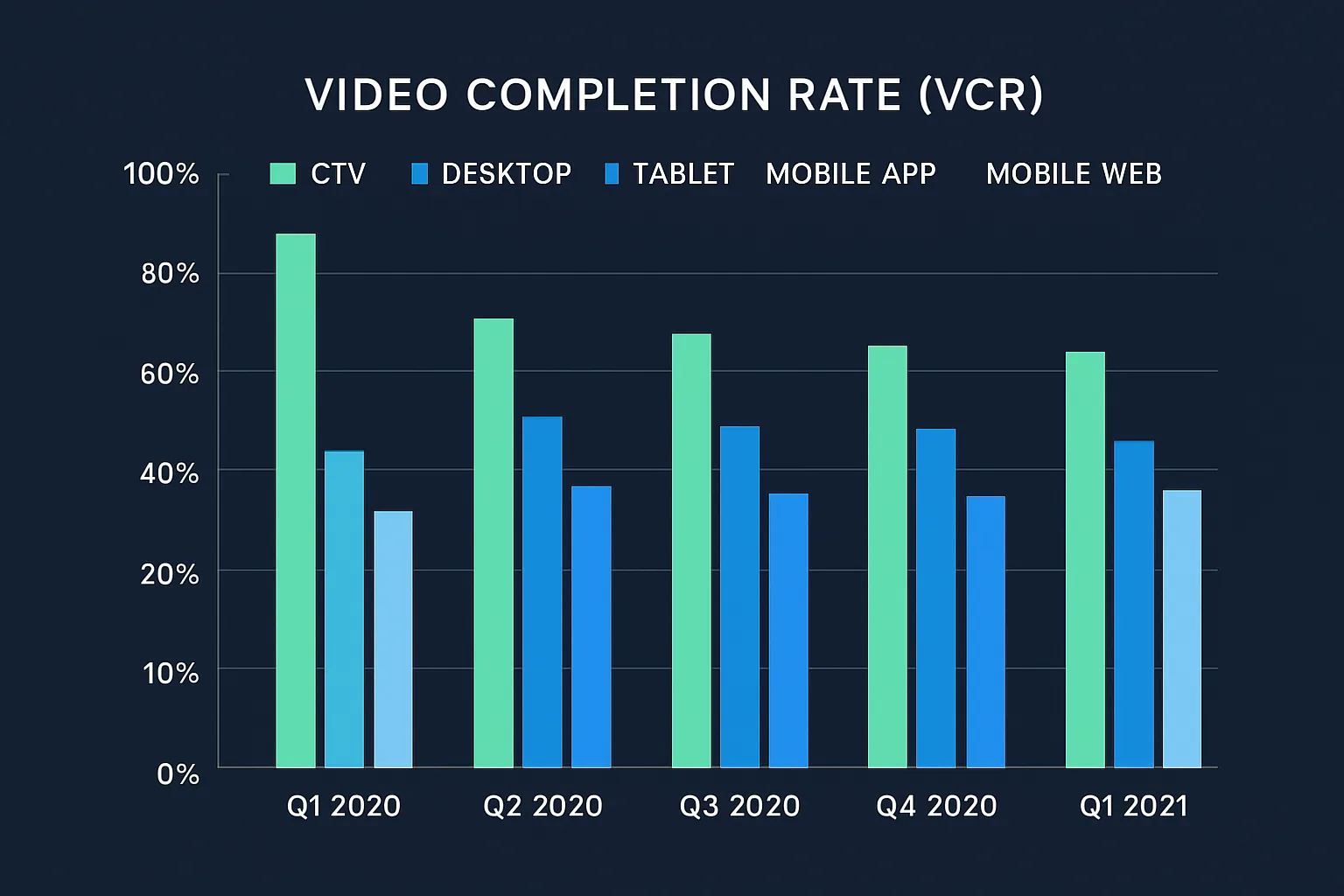
Video Benchmarks Q1 2021 by Extreme Reach
CTV leads all channels in video completion rates (VCRs) and average completion rates, with 100% viewability. In mature markets, it also delivers strong click-through rates, responses, and conversions — all trackable in real time.
Interactive creative formats add another dimension: the time-earned metric — the incremental seconds a consumer engages with interactive ads — is exclusive to this format and represents genuine attention, not a passive impression. New creative possibilities on CTV will change how audiences engage with brands, and the IAB's CTV Creative Best Practices Guide is a useful starting point for anyone looking to explore that space.
— Vanessa Delgado, Senior VP, Business Development, MetaX
What Is the Future of CTV and OTT Advertising? {#future}
Nielsen's research continues to show a decline in linear TV viewing — both a cause and effect of broadcasters' growing investments in ATV and CTV streaming content, backed by the promise of digital monetization. Premium content owners are actively working to unify, standardize, and scale their inventory and data offerings, packaging them into attractive but controlled environments for media buyers.
On the buy side, TV negotiations are increasingly driven by a combination of editorial instinct and data science. Advertiser expectations around audience targeting and measurement have moved from "nice to have" to table stakes.
North America currently leads global ATV ad spend, and the innovation happening there is expected to be replicated across European markets as agencies pursue unified access to scalable, measurable premium TV content. Such a solution would address the fragmented ecosystem of broadcaster offerings and tools that both local and pan-European buyers must navigate today.
Looking ahead, the future of ATV/CTV programmatic is best understood as a shared ecospace — one where European broadcasters offer exclusive access to premium TV audiences and inventory, at scale, through secured and approved private marketplaces. This structure gives broadcasters control over data sharing while giving media buyers the ability to run addressable campaigns across digital formats and environments with a cross-screen strategy.
This isn't an off-the-shelf outcome. It will require independent stakeholders from both the buy and sell sides to collaborate on these "secured gardens," where media buyers can discover and negotiate deals on newly available premium content.
— Itay Droog, Account Development Director, Amobee