Innovation Drives MarTech Growth
Another year, another edition of Scott Brinker's now-legendary MarTech landscape infographic — and it's bigger than ever.
Should anyone be surprised? Each passing year pulls more vendors into the field, riding waves of new innovation. 2016 is no exception.
This piece dives into some of the key innovations driving growth and opening new frontiers in the MarTech ecosystem.
Innovation for Pressing Needs
Marketing has arguably thrived on technical innovation more than any other business sector since the early internet age — and that momentum is what produced the sprawling ecosystem we navigate today.
Why does innovation take hold so quickly in this space? Neeraj Agrawal of Battery Ventures — whose portfolio includes Marketo, Optimizely, Tealium, and Bazaarvoice — put it well:
"[…] in digital marketing, we believe marketers will pick the best product, even if developed by an emerging start-up. Why? If a product can improve conversion rates on a website by even a few percentage points, that represents a huge improvement."
Even incremental improvements carry real margin impact, which means innovation — however niche — has a genuine shot at rapid adoption.
One of the most telling features of this year's MarTech infographic is the expanded section devoted to data. That emphasis reflects reality: data management has become a central, often painful challenge for marketing teams.
The core problem is fragmentation. With the average company running around 40 cloud-based marketing applications, actually making data work across all of those platforms is no small feat.
Mobile compounds that challenge further.
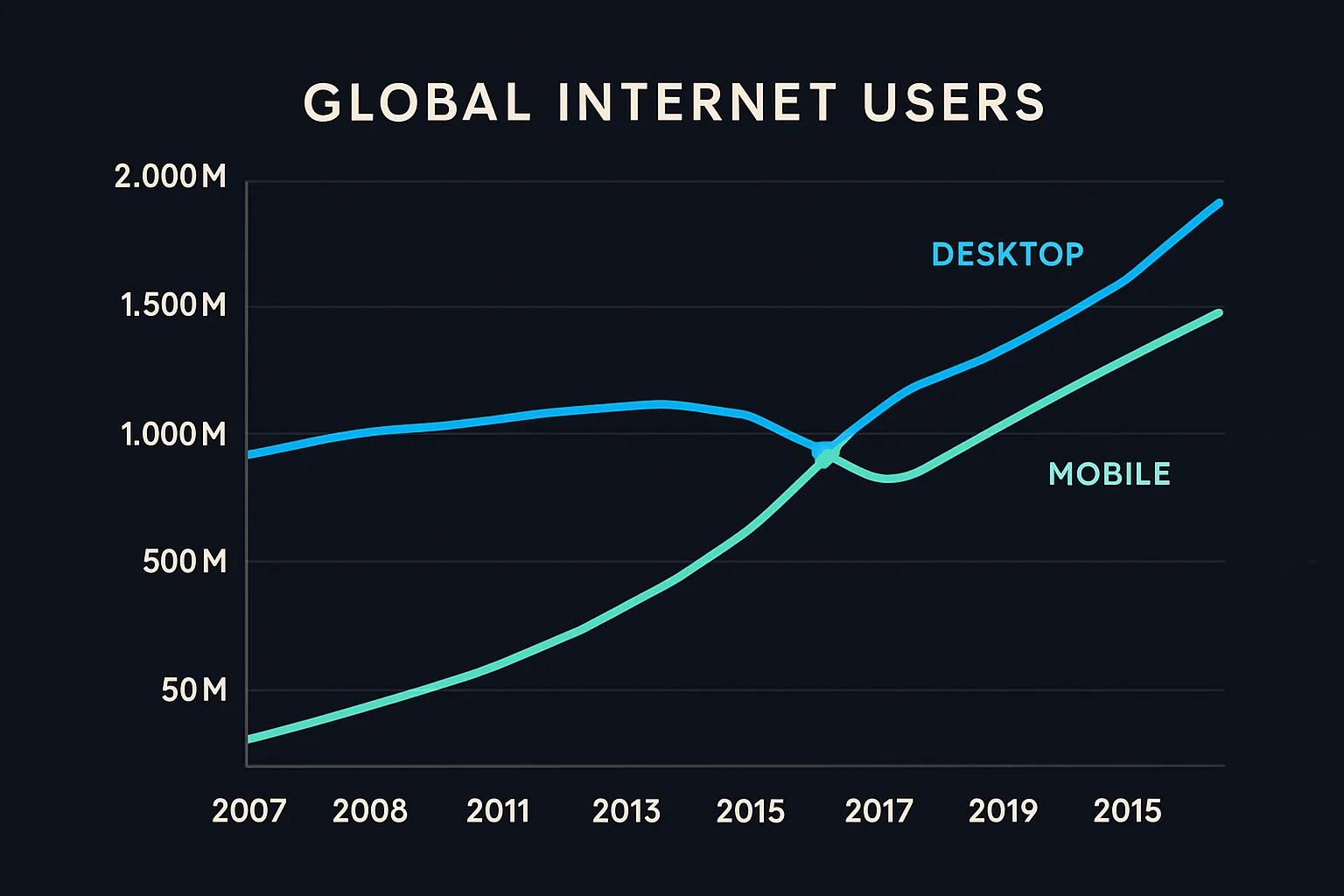
Over the past four years, mobile internet usage overtook desktop globally, and the gap continues to widen. Reaching consumers in motion has never mattered more.
For a deeper look at mobile marketing numbers, The Marketing Helpline's blog post aggregates over 160 relevant statistics.
Predictive Marketing with Machine Intelligence
The value of data to digital marketers is well established. The continued growth of data management platform (DMP) vendors signals that enterprises are getting more serious — not just about collecting data, but about actually acting on it.
That drive for actionable data is fuelling a wave of machine learning integration across marketing platforms. The goal: build on data layer infrastructure so that customer data isn't just gathered and integrated, but activated — enabling real-time engagement and smarter next-action decisions.
Processing and responding to that data manually, though, is a genuine burden. Consider the task of selecting relevant content and distributing it via email to even a few hundred customer segments. At scale, it's unworkable without automation.
That's where machine learning algorithms, combined with cloud-based automation, come in.
AgilOne is one vendor that has built predictive models on complex algorithms into its platform:
1. Behaviour clustering: Audiences are segmented by purchase count, visit frequency, promotion code usage, and other behavioural signals. The result is more personalized campaigns that stay relevant to each segment.
2. Predicted lifetime value: Using inputs like geolocation, gender, and social media activity, algorithms surface which customers are likely to be high-value — letting marketers prioritize accordingly rather than spreading effort evenly.
3. Real-time recommendations: Predictive modelling helps identify the right moment to pitch an upsell, a cross-sell, or any offer at all — putting the right product in front of the right person at the right time.
The mainstreaming of predictive intelligence is visible at the platform level too. Salesforce announced development of predictive machine intelligence features for its Marketing Cloud, and Google's Prediction API offers customer sentiment analysis and message routing capabilities, among other functions.
Vendors like Sailthru, Lytics, and AgilOne go a step further — they don't just assign predictive scores to segmented audiences, they help marketers serve highly targeted content to those audiences automatically. The efficiency gains have real implications for ROI and revenue growth.
Location, Location, Location
Place has always been one of marketing's four Ps, and it hasn't lost its relevance in the digital age — if anything, mobile has made location-based marketing more powerful than ever.
Google leads the way with technology that uses WiFi signals, GPS data, and point-of-sale checkout information to estimate how many online or in-store transactions stem from a physical store visit. Connecting a mobile user's location to a conversion event — catching them at that micro-moment of intent — is a meaningful capability.
But Google isn't the only player worth watching here.
Swirl Networks was recognized as one of the most innovative product companies in the Best in Biz Awards for its beacon marketing platform. Beacons use WiFi or Bluetooth signals to connect brick-and-mortar retailers with shoppers while they're physically in-store — and the applications go well beyond mobile checkout.
Swirl's platform can:
- Deliver promotions in real-time as customers move through a store
- Offer rewards to customers who visit specific areas (like a dressing room)
- Generate richer behavioural and sentiment data about in-store shopping patterns
The platform also incorporates a programmatic ad exchange and a third-party app network, allowing retailers to partner with other brands looking to capture valuable micro-moments as shoppers pass through.
The Stream Keeps Flowing
As Neeraj Agrawal noted, marketers are always hunting for an edge — and that competitive pressure ensures the pace of innovation in MarTech isn't about to slow down.
Cloud-based marketing automation has made it easier than ever to put sophisticated tools in the hands of a broad range of users. The barrier to entry for adopting the latest technology keeps dropping, which only accelerates the cycle.
Which means Scott Brinker's annual infographic isn't getting smaller any time soon.