The State of Influencer Marketing in 2023
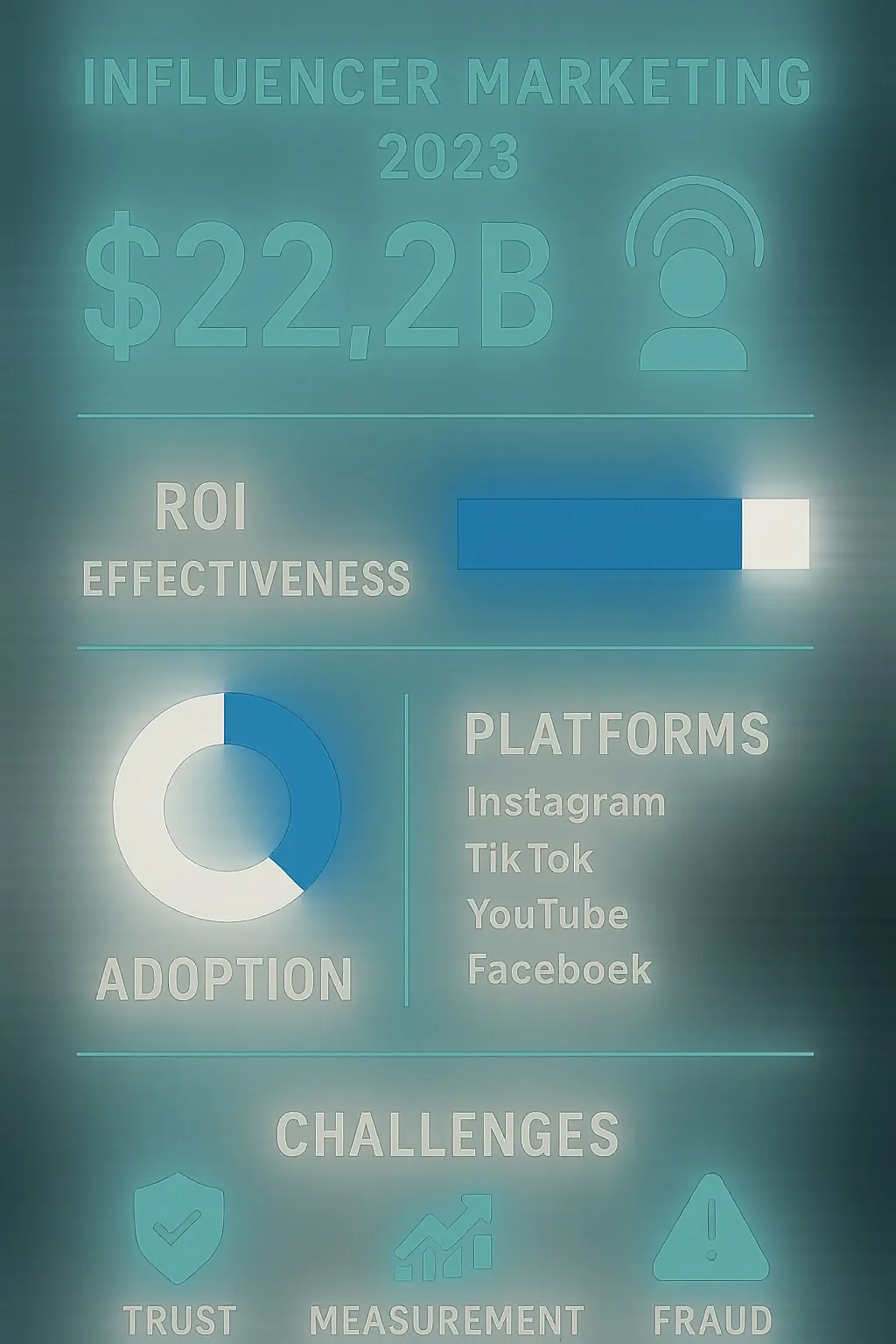
Influencer marketing has grown into a significant channel for brands over the past several years — but like any maturing medium, it's working through a set of structural growing pains. The infographic below maps out where the industry stands: how large it's getting, what genuine value it delivers for advertisers, and where technology vendors still have meaningful problems to solve.
The State of Influencer Marketing in 2023
The Popularity of Influencer Marketing
Paying social media users to promote products may still seem extravagant in some circles, but the market data tells a different story. The global influencer marketing market is expected to reach $22.2 billion by 2025.
Research from gen.video and Geometry Global's The Influence of Influencers report found that social media users are more likely to choose travel destinations or purchase electronics, clothing, food and beverage, and health and beauty products after seeing them promoted by influencers.
A few other figures that illustrate how mainstream this channel has become:
- 90% of social media users view social media influencers as trusted sources — and that trust translates into measurable sales lift.
- More than 70% of brands now use influencers as part of their marketing mix.
- 86% of marketers identify building brand awareness as the most important objective of influencer campaigns.
- Beyond awareness, influencer marketing is used to reach new or targeted audiences (74%), improve brand advocacy (69%), and increase sales (46%).
The Benefits of Influencer Marketing for Brands
Engaged and Loyal Audiences
Traditional and digital advertising can generate reach, but sustaining genuine engagement at scale is harder. Influencer marketing addresses that tension by meeting audiences where they're already paying attention — actively consuming content they chose, rather than passively tolerating an ad.
That openness allows brands to get creative: competitions, unboxing formats, product integrations, and other approaches that would feel forced in a display or broadcast context can land naturally through an influencer's voice.
A More Natural Path to Target Audiences
There's a meaningful difference between a corporation delivering an advertising message and a trusted individual making a personal recommendation. Influencer marketing sits closer to the latter.

The underlying logic is straightforward: reach key audiences through individuals who are already respected within those communities, and the message carries more weight. Because established influencers understand their own audiences well, they can help brands shape campaigns that actually resonate — not just reach.
With the right tools, influencers can produce high-quality content in video, audio, or image formats that a brand's internal team might struggle to replicate at that level of authenticity.
Credibility and Consumer Trust
Influencers are perceived as subject-matter experts within their niches. Their followers trust their opinions, which means product recommendations carry a different kind of authority than branded advertising.
The numbers reflect this: 80% of consumers complete a purchase after seeing an influencer recommend a product on social media. And more than 50% of consumers prefer word of mouth and social media communications as their primary ways of learning about new brands.
Content Strategy Support
Maintaining a steady stream of fresh, engaging content is a persistent challenge for most marketing teams. Influencers can help fill that gap — they're practiced at producing content that presents products or services in a new light without it feeling forced.
More than 90% of consumers engage with influencers on a weekly basis across Instagram, YouTube, TikTok, and Snapchat. That's a significant audience actively seeking the kind of content influencers specialize in.
SEO and ROI Lift
Analysis from QuickSprout suggests that social media activity — mentions, shares, and inbound links driven by influencer campaigns — can directly or indirectly improve a brand's search engine performance.
Active influencer programs keep brand profiles moving: new followers, recurring mentions, and product recommendations all contribute to organic visibility. When a follower discovers a product through an influencer and visits the brand's website, that translates into web traffic that compounds over time. For brands of any size, that incremental visibility tends to accelerate purchase decisions and push ROI higher than many conventional channels.
Impact on Purchase Decisions
Influencer recommendations affect the full marketing funnel. According to the Digital Marketing Institute, 49% of respondents said they made a purchase because of an influencer's referral — and among teenagers, that figure climbs to 70%. The same research shows 40% of people purchase a product or service after seeing it on YouTube, Facebook, or Instagram.
Think with Google data reinforces this: six out of ten users will make a purchase based on their preferred content creator's recommendations.
The Main Technological Threats Facing Influencer Marketing Platforms
Influencer Fraud
Influencer fraud covers two related problems: fake influencers and fake followers.
Fake influencers are accounts built around stock photos and artificially inflated follower counts. On the surface, their profiles can look nearly identical to legitimate creators — high-quality imagery, consistent posting, healthy engagement numbers. The difference is that a substantial share of their following is made up of bots or purchased accounts.
Since follower count is often the primary metric brands use to evaluate influencer partnerships, some creators game that number to secure more valuable deals. The result is wasted spend and eroded trust across the broader market — a dynamic that closely mirrors display advertising fraud.
The scale of the problem is significant. According to the State of Influencer Marketing 2020: Benchmark Report, 68% of marketers cite fake followers as their main challenge, up from 63% in 2019.
Research by Points North Group found that one large cosmetics brand spent $600,000 on impressions that were either unseen or consumed by fake followers. In a separate investigation, anti-fraud firm Sway Ops found that a single #sponsored Instagram post contained over 50% fake engagements — only 20,942 of 118,007 total comments came from real accounts.
Additional fraud statistics worth noting:
- Fake influencer follower fraud cost companies $81 billion in 2022.
- The total cost of digital ad fraud worldwide is projected to reach $100 billion by 2023.
- Up to 20% of mid-level influencers — those with 50,000 to 100,000 followers — are estimated to be fraudulent.
Measuring ROI
There's still no simple, standardized method for measuring an influencer's real impact on a campaign. Without that, neither brands nor marketers have a reliable way to value influencer relationships or price campaigns with confidence.
The challenge is tracking the full journey from first exposure through to conversion — and the technical environment makes this harder than it should be.
Influencer Intelligence's Influencer Marketing 2020 report found that 84% of marketers feel proving the ROI of influencer marketing is genuinely difficult. The main friction points are:
- Brand awareness campaigns are inherently difficult to measure with precision.
- Instagram posts can't include clickable links, which eliminates click-through attribution entirely.
- When an influencer includes a URL that requires manual copy-pasting, no referrer data is passed — the visit registers as direct traffic in the brand's analytics rather than being attributed to the influencer.
- On other platforms, referrer information is lost when users tap links inside mobile apps that open in a browser.
- Users who discover a product through an influencer often search for the brand on Google separately, causing the search channel to receive the conversion credit instead.
One viable path forward is building measurement frameworks similar to those used in TV and radio — time-based attribution models that can account for indirect exposure rather than requiring a clean clickthrough chain.
Campaign Automation
Managing influencer campaigns manually is genuinely labour-intensive. The workflow spans social listening, content analysis, influencer discovery, outreach, contract negotiation, and performance evaluation. According to 72% of marketers, setting up an influencer marketing campaign is a manual and time-consuming process that is well-suited for automation. A further 67% say that finding the right influencers is one of their primary pain points.
The tasks most in need of automation include:
- Finding genuine, vetted influencers.
- Managing outreach and ongoing communications.
- Handling contracts and compliance documentation.
- Processing payments at scale.
Platforms that build reliable automation around these workflows are in a strong position to reduce operational overhead for brands and agencies running campaigns at volume.
Seizing the Opportunity
The challenges facing influencer marketing — limited measurement transparency, fraud risk, and operational inefficiency — are fundamentally solvable technology problems. That's the opportunity for vendors in this space.
The AdTech and MarTech industries have seen significant vendor proliferation, but most new entrants lack a clear point of differentiation. The platforms that stand out are those that build features addressing real, painful problems rather than layering on surface-level improvements.
Influencer marketing is no different from other emerging channels in that respect: the vendors that identify the specific friction points, invest in genuine technical solutions, and bring those to market clearly are the ones most likely to capture meaningful market share as the industry continues to grow.