A Timeline of Apple's Privacy Changes in Safari and iOS [Infographic]
Over the past several years, Apple has taken an increasingly firm stance on user privacy, rolling out a steady stream of changes to Safari, iOS, and its broader ecosystem. The cumulative effect on the AdTech and MarTech industries has been substantial.
The infographic below traces the major milestones in that timeline.
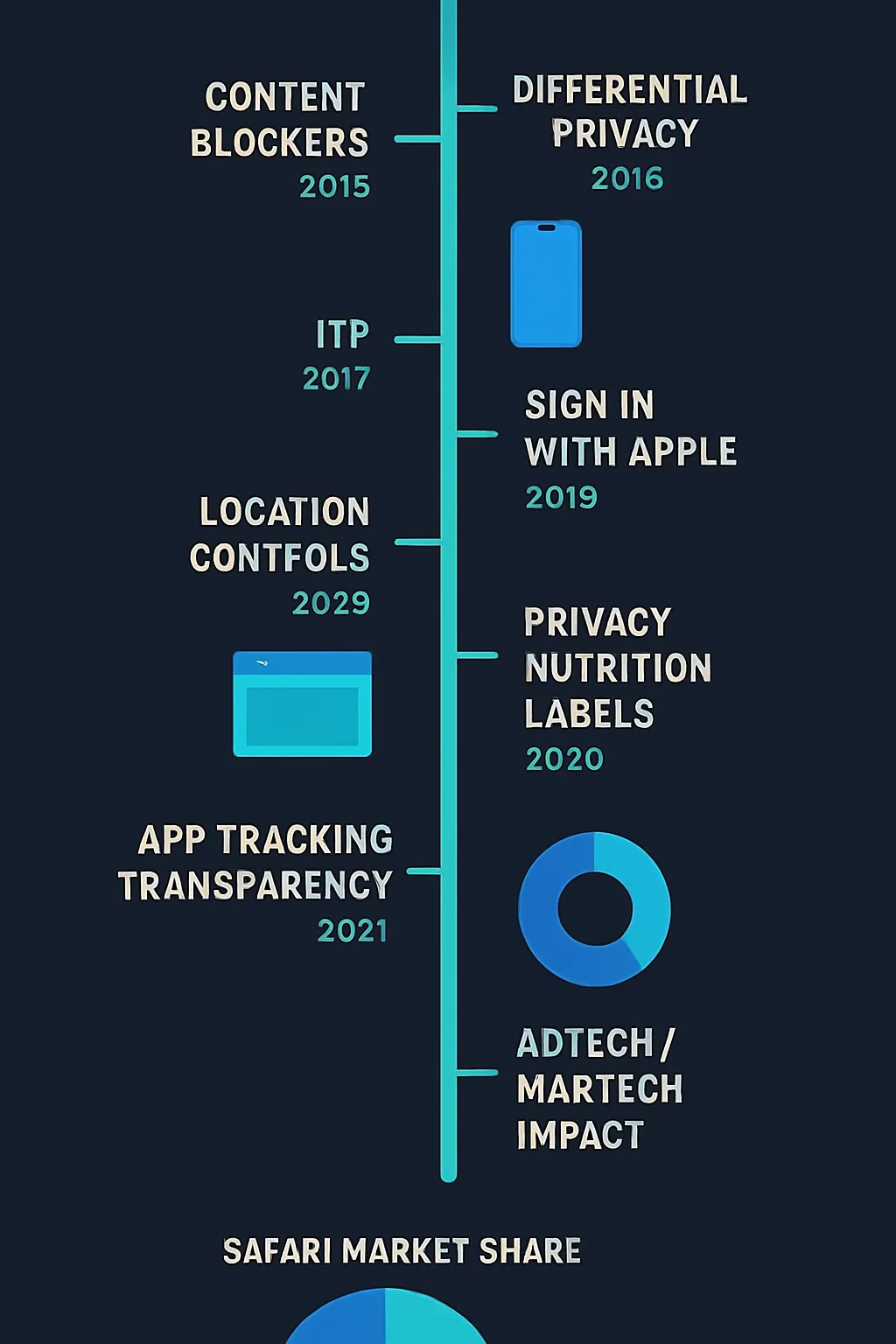
A Timeline of Apple's Privacy Changes to Safari and iOS
September 16, 2015: Apple introduced Content Blockers in iOS 9, allowing users to install third-party apps capable of blocking ads, tracking scripts, and other elements that slow page loads in Safari.
June 5, 2017: Apple announced Intelligent Tracking Prevention (ITP), a new privacy feature built into Safari. ITP was officially released in September 2017 alongside Safari 12 and iOS 11.
February 21, 2018: WebKit released the Storage Access API, available in Safari 11.1 on iOS 11.3 beta and macOS High Sierra 10.13.4 beta, as well as in Safari Technology Preview 47+.
March 14, 2018: ITP 1.1 was announced, set to ship in Safari 11.1 on iOS 11.3 beta and macOS High Sierra 10.13.4 beta, and in Safari Technology Preview.
June 4, 2018: ITP 2.0 was released.
February 21, 2019: ITP 2.1 was announced and released alongside the beta versions of iOS 12.2 and Safari 12.1 on macOS High Sierra and Mojave.
April 11, 2019: WebKit released its Link Click Analytics and Privacy feature.
April 24, 2019: ITP 2.2 was announced, available in the beta releases of iOS 12.3 and Safari on macOS Mojave 10.14.5.
May 22, 2019: WebKit announced Privacy Preserving Ad Click Attribution for the Web — a new attribution method in the early stages of being proposed as a standard through the W3C Web Platform Incubator Community Group (WICG).
September 23, 2019: ITP 2.3 was announced and included in Safari on iOS 13, iPadOS beta, and Safari 13 on macOS Catalina, Mojave, and High Sierra.
December 10, 2019: WebKit released a series of ITP updates in Safari on iOS and iPadOS 13.3, and in Safari 13.0.4 on macOS Catalina, Mojave, and High Sierra.
March 24, 2020: WebKit shipped full third-party cookie blocking in iOS 13.4, iPadOS 13.4, and Safari 13.1 on macOS — a significant escalation from earlier ITP iterations.
June 2020: WebKit announced the upcoming App-Bound Domains feature, set to ship with iOS 14 and iPadOS 14, aimed at strengthening user privacy during in-app web browsing.
June 2020: At its Worldwide Developers Conference (WWDC), Apple announced a series of privacy changes across iOS, iPadOS, and tvOS. A central change was to how the mobile identifier (IDFA) is accessed by app developers, AdTech companies, and mobile measurement platforms (MMPs). The change was originally scheduled to take effect with the iOS 14 release in September 2020, but Apple delayed it until early 2021.
November 12, 2020: WebKit announced a CNAME-cloaking defence feature coming to ITP in Safari 14 on macOS Big Sur, Catalina, and Mojave, as well as iOS 14 and iPadOS 14. Under this update, all cookies created by a third-party CNAME-cloaked HTTP response would be set to expire in 7 days.
June 7, 2021: Apple announced further privacy changes arriving with iOS 15, iPadOS 15, macOS Monterey, and watchOS 8. New iCloud+ features included Private Relay, Mail Privacy Protection, and Hide My Mail. The release also brought updates to Intelligent Tracking Prevention and SKAdNetwork, along with a new App Privacy Report.
The Impact of Apple's Privacy Changes on AdTech and MarTech
Apple's privacy changes to Safari and iOS make it substantially harder to identify users across different websites and mobile apps. Cookie-based and IDFA-based approaches that once powered a range of AdTech activities no longer offer the same scale.
The activities most affected include:
- Behaviourally targeted advertising
- Frequency capping
- Campaign measurement
- Attribution
- Fraud detection
Numerous alternative solutions have been proposed to handle these activities without third-party cookies or the IDFA, but none yet replicate the reach those identifiers provided.
What to Expect From Apple Going Forward
Apple's privacy trajectory has been consistent and deliberate — each iteration of ITP has tightened restrictions, and the pattern shows no sign of reversing. Whenever AdTech and MarTech vendors have developed workarounds to maintain functionality in Safari, Apple has moved to close those gaps and further restrict cross-site tracking.
The same dynamic is expected to play out with the IDFA. As probabilistic alternatives and fingerprinting techniques gain traction, Apple has historically responded with additional enforcement measures. The reasonable expectation is that the pressure on identifier-based AdTech will continue to intensify.