The Walled Gardens of AdTech [Infographic]
The internet was supposed to be open — a level playing field where anyone could participate on equal footing. The reality of digital advertising tells a rather different story, one that bears a striking resemblance to a game of Monopoly.
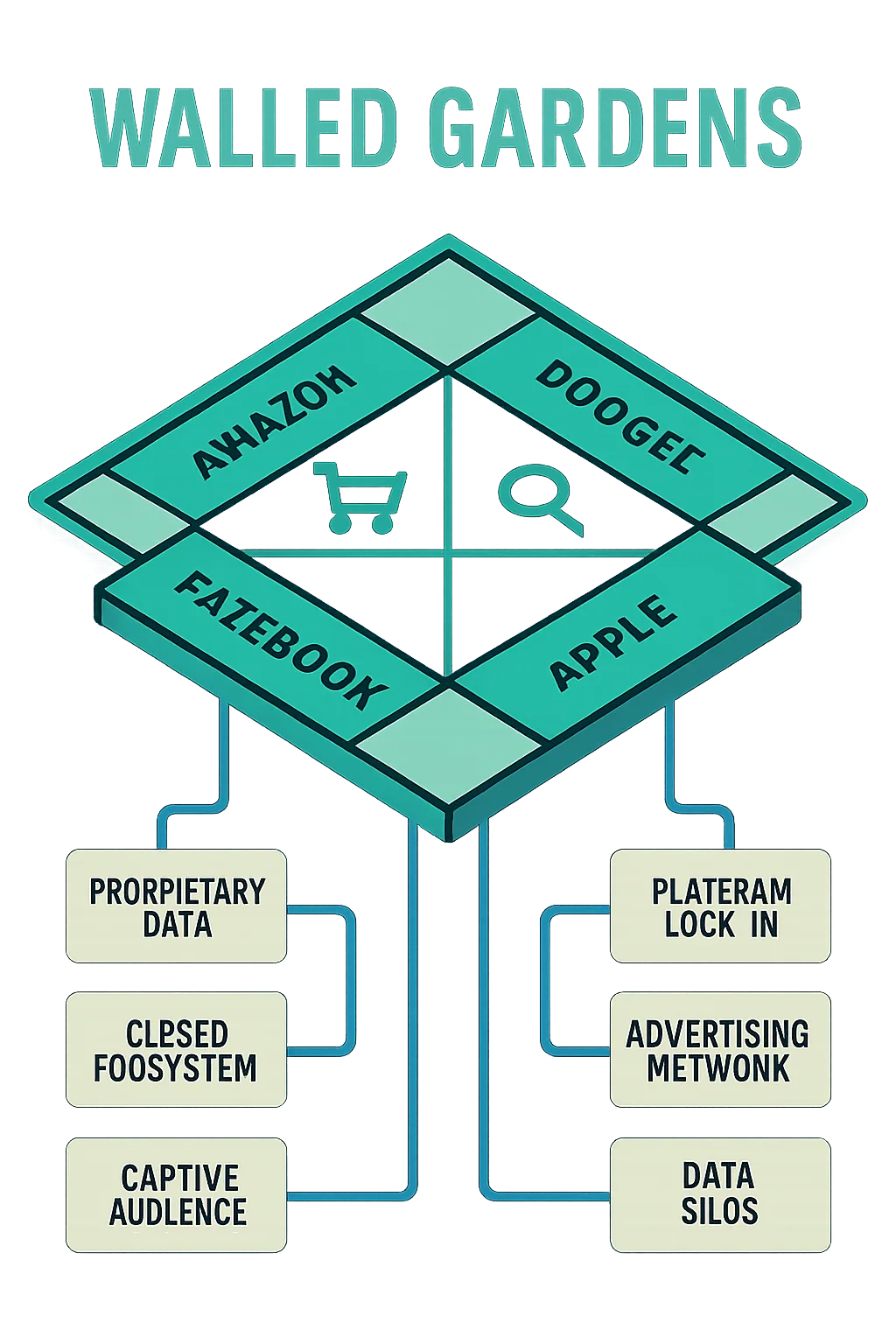
The concept of the walled garden sits at the centre of that story. Four major players — Amazon, Facebook, Google, and Apple — have each constructed ecosystems designed to keep users, advertisers, and data firmly within their walls. The infographic below maps out how each player has built and defended their territory.
Amazon
E-Commerce Platform
Amazon's e-commerce platform accounted for nearly 50% of all US online retail sales in 2018. That translates into an extraordinary volume of purchase intent and transaction data. Google and Facebook know what users search for and click on; Amazon knows what people actually buy, who they buy it from, and how frequently. That distinction makes Amazon uniquely compelling to retailers and consumer brands.
Devices
Amazon's hardware lineup — Kindle, Fire TV Stick, Echo — functions primarily as a gateway into the broader Amazon ecosystem. The strategy is deliberate: sell devices at break-even prices, then monetize through downstream Amazon purchases. It works. According to a Consumer Intelligence Research Partners study, Amazon hardware owners spend roughly twice as much on Amazon per year ($1,450) compared to other shoppers ($725).
Analytics
Amazon's Brand Analytics tool surfaces conversion and keyword data, including insights tied to its own Amazon Basics private-label line. The availability of that data has been a point of tension with third-party merchants, some of whom have alleged that Amazon leverages its analytics position to favour its own products.
Advertising Products
Amazon's DSP allows advertisers to reach Amazon shoppers across Amazon-owned sites, the broader web, and mobile apps. For a long time, Amazon kept its proprietary shopper data largely locked away. Opening it up to advertisers serves a dual purpose: it softens the platform's anti-competitive image while simultaneously giving brands a strong incentive to increase ad spend on Amazon.
Sizmek Acquisition
Amazon's acquisition of Sizmek's ad server and dynamic creative optimization (DCO) tool strengthened its case as a credible third contender to the Facebook–Google duopoly. With Sizmek technology in the fold, Amazon can enable brands and advertisers to serve personalized messages to consumers across the web, informed by their search and purchase history on Amazon.
Amazon Web Services
AWS has become foundational infrastructure for the broader internet economy, including large parts of the AdTech ecosystem. It serves as the backbone for major consumer platforms including Netflix, Instagram, Spotify, Vine, and Airbnb, among many others. That reach gives Amazon a structural presence well beyond its own retail and advertising surfaces.
Social Media Platform
Facebook's core asset is its store of user behavioural data — actions, interests, connections — which feeds its audience segmentation, recommendation engine, and lookalike modelling. Crucially, Facebook owns the inventory it sells. There is no revenue share with external publishers, and the platform has full control over ad slot pricing. When you own both the data and the real estate, you hold a very strong hand.
Facebook Ad Manager
Facebook Ad Manager programmatically sells only Facebook inventory — ad formats that appear exclusively on Facebook properties. Facebook provides no DMP or DSP integration capabilities and does not support cookie matching. Advertisers who want to reach Facebook audiences must do so through Facebook's own tools. This appears to be a deliberate structural choice to keep inventory and audience data inside the walled garden.
Audience Network
Facebook's Audience Network extends the platform's targeting capabilities beyond its own properties, allowing advertisers to reach Facebook-defined audiences on third-party mobile apps and websites. It applies the same people-based targeting model used in the News Feed, relying on Facebook's first-party data to match ads with audience interests at scale.
With approximately 1 billion monthly active users, Instagram is a major ad revenue driver for Facebook. Brands run Instagram campaigns through the same Facebook Ad Manager interface, further consolidating advertiser activity within Facebook's ecosystem.
Devices
Facebook doesn't manufacture hardware, but it doesn't need to. The Facebook app is installed and actively used on nearly every device category its users own. That cross-device presence enhances ad delivery reach and enables broader user data collection without any hardware investment.
Apple
Safari
Safari is the world's second-most-popular browser, holding a global market share of around 15%. Unlike Google, Apple doesn't own a search engine — Google pays to remain the default on Safari and on iPhones more broadly. In 2014, that arrangement reportedly generated around $1 billion for Apple (paid by Alphabet), reflecting just how valuable Apple's default search position is to Google's ad business.
Operating Systems
Apple's operating systems — macOS, iOS, watchOS, tvOS — are widely regarded as polished and reliable, but they are deliberately designed to deepen ecosystem lock-in. Apple devices come pre-loaded with Apple's own applications and services, and interoperability with non-Apple hardware is intentionally friction-heavy. Once in the ecosystem, the cost of switching is high.
App Store
Apple monetizes its App Store traffic partly through Apple Search Ads, which appear at the top of search result listings with a light blue background and an ad icon. Unlike the other walled garden players, advertising is not Apple's primary revenue mechanism — but the App Store's massive traffic makes even a modest ad product worth developing.
Devices
Apple's hardware has a closed architecture. Apple controls who can write apps for its operating systems and who can manufacture devices that run them. Each product is designed to integrate seamlessly with others in the lineup, reinforcing the overall ecosystem and raising the switching cost for users.
App Analytics
App Analytics is Apple's native analytics platform, accessible directly from App Store Connect. Announced at WWDC in 2014 and launched in 2015, it gives developers visibility into app discovery and performance metrics.
Chrome
Chrome is the most popular web browser worldwide, with a global market share of around 65%. Google Search is the default — enabling Google to serve search ads to the vast majority of the world's browser users and to collect and refine search data at an enormous scale.
Android
Android is Google's mobile operating system, available free to device manufacturers like Samsung and HTC. But "free" comes with conditions: Android requires users to log into a Google account to download apps from Google Play and to access core Google services including YouTube, Maps, and Gmail. That login requirement gives Google persistent identity-linked data across the mobile ecosystem.
Google Account and Applications
Advertising accounts for approximately 84% of Alphabet's total revenue. To sustain that business, Google needs continuous, high-quality user data — which it collects through its Google Account infrastructure and consumer-facing applications. Across Google Search, YouTube, and Maps, billions of logged-in users generate behavioural signals that power Google's ad targeting.
Advertising and Marketing Products
Google's real competitive moat is its end-to-end presence in digital advertising infrastructure. First-party data collected across Google's consumer products flows into its advertising and marketing stack. Google holds an estimated 36% share of total US digital ad spend — a dominant position in an otherwise fragmented market.
Devices
Google has extended its ecosystem into hardware through products like the Google Pixel smartphone and Google Home smart speaker. By tying these devices tightly to Google services, the company makes it more likely that Android users will stay within the Google ecosystem rather than migrate to Apple or Amazon hardware.
Search Ads
Search advertising remains the core engine of Google's revenue. Every query entered into Google Search is a potential ad impression. Users can technically switch the default search engine in Chrome, but almost none do — making Google Search advertising one of the most durable and defensible ad products in the industry.