Why Companies Are Building Their Own RTB Bidder or DSP
Global programmatic advertising spending is expected to reach USD 724 billion by 2026, according to Statista. The DSP market alone was valued at USD 20.77 billion in 2022 and is projected to reach USD 92.12 billion by 2029 — and that projection doesn't account for the wave of new entrants currently sizing up the space.
Players from retail, media and entertainment, telecommunications, and gaming are all weighing the decision to build their own demand-side platforms. What's driving that interest? This post examines the main motivations.
Key Points
- A demand-side platform (DSP) is an AdTech platform for ad buyers — brands and ad agencies — to purchase ad inventory on an impression-by-impression basis.
- DSPs connect to ad exchanges and supply-side platforms (SSPs), and pull in data from data management platforms (DMPs) and customer data platforms (CDPs) to sharpen targeting.
- Core advantages of DSPs include automated ad buying, scalability, cost-effectiveness, and precise audience targeting.
- Key market drivers include the demise of third-party cookies, new and emerging digital channels, new ad format development, a shift toward contextual and content-driven advertising, and evolving regulatory requirements.
- Companies can enter the DSP market by acquiring an existing DSP, renting one (e.g., a white-label solution), or building their own.
- Reasons to build a custom DSP include capitalizing on first-party data assets, cutting media costs, gaining tech stack autonomy, and solving measurement challenges. Building also enables demand path optimization, exchange-bias avoidance, niche vertical coverage, and stronger ad fraud and brand safety controls.
- Among new DSP entrants, the leading industries are retail, telecommunications, publishing, media, and entertainment.
What Is a Demand-Side Platform, and What Is It For?
A demand-side platform (DSP) is an AdTech platform for ad buyers — brands and agencies — to purchase ad inventory on an impression-by-impression basis. Buyers configure advertising campaigns and programmatically bid on precisely targeted placements across video, display, in-game, and other formats.
To run the buying process end-to-end, DSPs connect to:
- SSPs and ad exchanges — to access and purchase ad inventory.
- Data management platforms (DMPs) — to build richer audience views and more personalized messaging.
- Customer data platforms (CDPs) — to track and manage the customer journey more effectively.
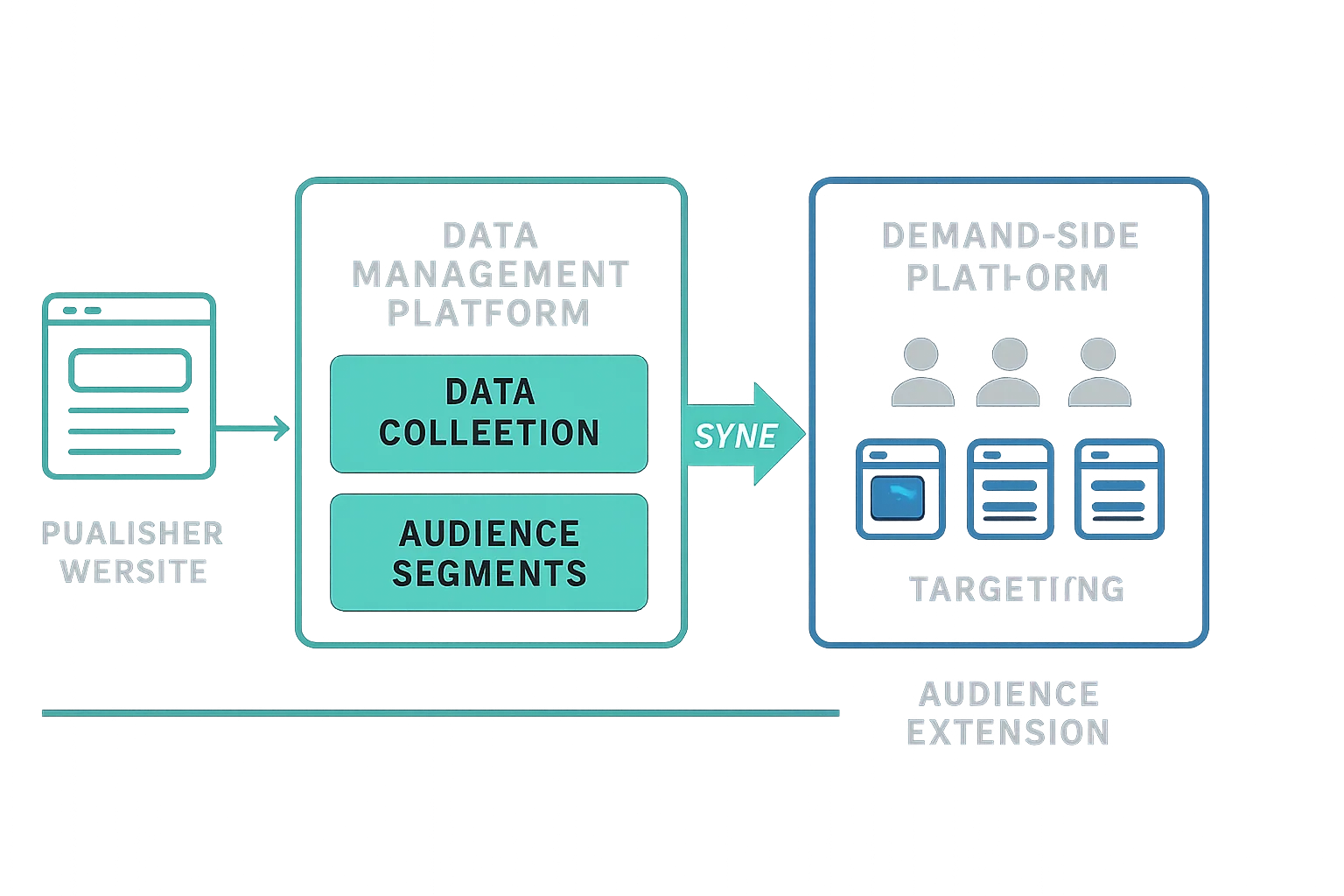
An example of integration between a DSP and a DMP for audience extension. The DMP collects data about a publisher's visitors, creates audience segments, and syncs them with the DSP — allowing advertisers to reach those audiences across different websites.
The most common buying mechanism is real-time bidding (RTB): a live auction in which DSPs bid on impressions offered by ad exchanges and SSPs.
Key DSP Functionalities
DSPs streamline the procurement of ad impressions across multiple supply sources. By automating the process, they improve efficiency and targeting precision while keeping costs manageable.
Some DSPs also incorporate artificial intelligence and machine learning. Not every DSP uses these technologies, but a growing subset applies AI and ML to optimize ad placement and pricing — analyzing data patterns and user behaviour to guide advertisers toward placements most likely to drive engagement and conversions.
In practice, DSPs:
- Manage ad inventory: Advertisers set up campaigns, buy inventory from multiple publishers, and optimize performance through a single interface.
- Track and optimize in real time: Advanced analytics tools let advertisers monitor performance, make data-driven decisions, and adjust campaigns on the fly.
- Bid in real time: Working alongside SSPs, DSPs participate in real-time auctions across multiple ad exchanges, broadening access to quality ad inventory.
Key DSP Advantages
DSPs automate ad buying, freeing marketers from manually negotiating with individual publishers. Beyond automation, the main advantages are:
- Scalability: Connections to SSPs and ad exchanges provide broad access to diverse ad inventory.
- Cost-effectiveness: Real-time bidding and automated decision-making allow DSPs to determine the optimal bid for each impression dynamically.
- Precise audience targeting: Leveraging data, AI, and ML, DSPs support targeting across behavioural, demographic, device, contextual, lookalike, in-market, and retargeting dimensions.
Key DSP Market Drivers
The DSP landscape is being reshaped by several forces — from an expanding pool of first-party data to tightening privacy regulations and the collapse of third-party cookie-based targeting.
The Demise of Third-Party Cookies
Third-party cookies have long underpinned audience targeting and retargeting in digital advertising. Their phase-out, driven by privacy concerns and regulatory pressure, is disrupting established DSP workflows — but it's also opening the door for platforms that can offer compelling alternatives.
DSPs positioned to leverage first-party data and alternative identity solutions — including UID 2.0, FLEDGE, and the Topics API — are well placed to absorb demand from advertisers searching for cookieless targeting approaches.
New Ad Format Development
Since the first display ad appeared in 1994, ad formats have proliferated across computers, mobile devices, audio services, and television. Wherever audiences go — gaming environments, streaming TV, retail media sites — ad formats follow.
DSPs are designed to buy inventory across all of these formats in near-real time, giving advertisers the flexibility to run modern, multi-format campaigns.
Contextual and Content-Driven Advertising
With individual user tracking increasingly constrained, contextual advertising is regaining prominence. Contextual targeting places ads based on the content of the page rather than personal data about the viewer. DSPs that can effectively support contextual targeting and dynamic content optimization are likely to see growing demand from advertisers prioritizing privacy-friendly reach.
Regulatory Compliance and Ad Verification
As the ad environment grows more complex, brand safety and ad fraud have become top-tier concerns. DSPs offering robust verification tools and ensuring brand-safe placements are increasingly preferred by advertisers protecting both brand reputation and campaign budgets.
Build, Rent, or Acquire a DSP?
There are three ways to enter the DSP market: build a custom DSP from scratch, rent an existing white-label solution, or acquire an established DSP vendor. Each path carries its own trade-offs.
Comparing the Options
| Building a DSP | Renting a DSP | Acquiring a DSP | |
|---|---|---|---|
| Pros | • Complete control: Building a custom DSP provides complete control over the platform's features, functionalities, and user experience. • Scalability and flexibility: A custom-built DSP can be designed to scale as the company's business grows, accommodating increases in traffic and demand. • Data ownership: Building a DSP ensures full ownership and control of data, which is crucial for leveraging first-party data assets. • Competitive advantage: A unique, customized DSP can provide a competitive advantage in the market, differentiating the company from other players. |
• Easy entrance: An existing DSP can be a cost-effective way to enter the market without the need for a substantial upfront investment, making it a viable option for smaller companies or those testing the market. • Advanced features: This route can grant access to advanced features and functionalities that might be time-consuming or expensive to build from scratch. • Vendor support: Using an existing DSP means you can rely on the vendor for maintenance, updates, and technical support. |
• Speed to market: A company can enter the market and start serving advertisers quickly. • Established infrastructure: The company leverages an established infrastructure, including technology, ad exchange integrations, and data partnerships. This can provide a head start and reduce the initial setup complexity. • Existing client base: An established DSP is likely to have an existing client base, which means immediate revenue generation and access to an established market share. • Experienced team: Acquiring a DSP may also mean gaining an experienced team with domain expertise, which can be valuable in understanding the nuances of the DSP market. |
| Cons | • Time-consuming development: Building a DSP from scratch requires time and resources for development, testing, and refinement before it becomes market-ready. • Technical challenges: Developing a DSP requires specialized technical expertise and ongoing maintenance to keep the platform up-to-date and compliant with industry standards. |
• Limited customization: This option may limit the level of customization and control that the company has over the platform, as it operates within the confines of the pre-built solution. • No autonomy: The company has zero autonomy over the tech stack of a ready-to-use piece of software, meaning they have little or no control over new integrations and features. |
• High initial investment: Acquiring an established DSP will probably require a significant upfront investment. • Integration challenges: Integrating the acquired DSP with the purchasing company's infrastructure, systems, and processes can be complex and time-consuming. • Legacy issues: The acquired DSP may come with legacy issues, technical debt, or outdated technology that needs to be addressed. |
The Dominant Players
The DSP market is projected to reach USD 92.12 billion by 2029. A substantial share will flow through the dominant platforms — well-known giants such as Amazon, Facebook, and Google — but the space also includes a long tail of more specialized competitors.
Top DSP companies
Why Companies Build Their Own RTB Bidder or DSP
The decision to construct an RTB bidder or DSP is a strategic one. Whether the primary driver is cost efficiency, technological autonomy, or market expansion, the motivations are consistent across the companies pursuing this path.
For Ad Agencies
Cutting the Cost of Media
Cost reduction is the single biggest motivator for agencies building their own DSP. Over the past decade, the role of the ad agency has shifted substantially. Before the internet era, agencies were central to every aspect of brand advertising — from creative to media placement. By the late 2000s, emerging AdTech platforms began allowing brands to bypass agencies entirely and buy media directly.
Agencies have been working to re-establish their value ever since, and reducing costs is a major part of that effort.
One of the most direct levers available is eliminating the fees paid to third-party DSP vendors. Depending on the vendor, some agencies pay between 10% and 30% in commissions. On average, SSPs and DSPs collectively collect around 35% of programmatic spend. For an agency running tens of millions of dollars in annual media, that's a significant sum flowing to platform fees rather than to media.
| Media spend | Effective DSP commission | Commission paid to the DSP | Operational costs (infrastructure + engineering + operations) | Potential savings |
|---|---|---|---|---|
| $100m | 15% | $15m | $2.5m | $12.5m* |
| $50m | 15% | $7.5m | $2m | $4.5m* |
| $25m | 15% | $3.75m | $1.75m | $2m* |
| $10m | 15% | $1.5m | $1.5m | $0.0m* |
Analyzing media spend on DSP. Source: ExchangeWire
Control Over the Tech Stack
Building a proprietary RTB bidder or DSP gives agencies full ownership of their technology. That means freedom to design custom features, build specific integrations, and set a product roadmap aligned with their actual business needs — rather than waiting on a vendor to ship capabilities.
Tech stack ownership also eliminates the limitations and risks that come with dependence on third-party platforms: contract uncertainty, feature gaps, and competitive exposure all shrink when the platform is proprietary.
For Tech Companies
For AdTech companies in particular, building a DSP is often less a strategic option and more a practical necessity. Relying on a competitor's DSP creates obvious tensions around product differentiation and cedes control over integrations and feature development. A proprietary platform removes those constraints entirely.
Expanding Product Offerings
Tech companies entering the DSP space can use the investment to diversify revenue and leverage existing engineering capability in a new market segment. A server infrastructure company building a DSP, for example, bridges its technical expertise directly into the advertising ecosystem — creating a more comprehensive offering for customers already within its orbit.
Additional Motivations for Building a Custom DSP
Demand Path Optimization
Owning a DSP gives companies full visibility into the ad delivery chain — where ads are placed, who sees them, and how each impression was acquired. This transparency supports demand path optimization (DPO), helping companies reduce unnecessary intermediary costs and build more direct relationships with quality publishers.
Avoiding Exchange Bias
When using a third-party DSP, buyers may be exposed to undisclosed preferences for particular exchanges or publishers embedded in the platform's logic. Building a proprietary platform eliminates that concern, ensuring neutral access across supply sources.
Occupying Niche Verticals
AdTech is expanding into specialized domains — in-game advertising, mobile ads, streaming TV. Companies that build purpose-built DSPs for these verticals can serve advertisers in ways that general-purpose platforms often can't match, potentially delivering stronger return on ad spend (ROAS) for their clients.
A mobile-focused MarTech company, for instance, might build a mobile DSP specifically to run RTB-based campaigns across multiple ad exchanges for its client base — driven by the particular demands of mobile inventory and audience dynamics. Separately, location-based mobile advertising is another niche where a proprietary DSP allows operators to run precisely targeted campaigns against their own location data sets in ways no off-the-shelf platform would fully support.
Enhanced Security and Brand Safety
Advertisers are increasingly focused on protecting both their brand image and their ad budgets from fraud. DSPs with built-in ad fraud detection, anti-fraud algorithms, marketplace quality controls, and sensitive site blocking are a genuine competitive differentiator. Companies building their own DSP can design these capabilities in from the start, rather than relying on a vendor's generic safeguards.
Entering a Growing Market
Global digital ad spending reached USD 696 billion in 2023, with a projected 10.5% year-on-year increase. That trajectory is drawing companies from outside the traditional AdTech sector into the DSP space. The leading industries among new entrants are retail, telecommunications, publishing, media, and entertainment — each bringing proprietary audience data and distribution assets that make a custom DSP an increasingly attractive investment.