How Publishers Can Increase Revenue With AdTech
When advertising migrated to the online world in 1994, news publishers quickly adopted the ad-supported model as a way to monetize their digital properties. Since then, publishers have experimented with a range of monetization approaches — most notably subscriptions — and many now run combinations of both.
This article covers the main ways publishers, app developers, and media companies generate revenue, and how AdTech solutions including header bidding, self-serve ad platforms, customer data platforms (CDPs), and demand-path optimization (DPO) can open new revenue streams and improve yield.
Key Points
- Most publishers, app developers, and media companies rely on some combination of subscriptions and advertising to generate revenue.
- Subscription-only plans charge a recurring fee for access to content — news, educational material, video entertainment, live sports, and more.
- The advertising model benefits both sides: users access content for free while publishers generate recurring revenue.
- The hybrid model — paid subscriptions alongside advertising — is one of the most widely adopted approaches, giving publishers two independent income sources.
- Because subscription tiers are typically ad-free, the hybrid model lets publishers offer users a genuine choice: pay for an ad-free experience or receive content for free (or at a discount) in exchange for seeing ads.
- AdTech creates meaningful monetization opportunities for publishers: platforms help them manage and sell inventory, connect directly with advertisers through self-serve portals, collect and activate data for targeting and audience insights, and streamline advertiser relationships.
- The most consequential AdTech solutions for publishers today are header bidding, self-serve ad platforms, customer data platforms (CDPs), and demand-path optimization (DPO).
Subscription-Only Plans
Subscription-only plans involve charging a recurring fee for access to content — news and analysis, educational material, video entertainment, live sports broadcasts, and so on.
Solo creators, niche media brands, and large streaming services represent the most common publishers building businesses entirely on subscriptions.
Several motivations drive the subscription-only choice.
Content quality and exclusivity. Subscription publishers typically offer differentiated content — unique perspectives, deep reporting, verified sources. Packaging that content as a subscription creates a defensible "product" for monetization.
User experience. Subscriptions let publishers align monetization with a high-quality experience: fast-loading properties, clean interfaces, and — crucially — an ad-free environment.
First-party data control. A publisher's first-party data is often its most valuable asset. Sharing it across the broader programmatic ecosystem dilutes that value. Subscription publishers retain the data themselves, using it to improve the user experience and upsell subscribers to higher-tier plans.
Publishers that rely solely on subscriptions acquire first-party data at the moment of purchase. That data stays within the publisher's own stack rather than flowing to third-party ad platforms.
In practice, few publishers choose subscriptions as their only revenue model. Most make their properties available to advertisers, or run a blend of subscriptions and advertising.
Netflix and Disney both launched as ad-free, subscription-based streaming services before eventually developing ad-supported tiers — a telling shift in how even the largest media businesses view the trade-off. At the same time, subscription fatigue is real: one-third of U.S. consumers report feeling overwhelmed by the number of subscriptions they manage, which may slow the growth of paywall-only models in coming years.
Advertising Revenue
For most publishers and media companies, advertising has historically been the primary revenue stream. It is a broadly accessible model: users get free content, publishers get recurring revenue.
That said, the model is under pressure. According to the Reuters Institute's Journalism, Media, and Technology Trends and Predictions 2022, display advertising was considered an important income source by 81% of publishers in 2020 — a figure that fell to 73% by 2022. Native advertising dropped similarly, from 76% to 59% over the same period.
Online ads take many forms: banners, pop-ups, pre-roll video, native placements, and more. Publishers typically run several formats simultaneously to diversify their ad revenue.
Challenges in this model include:
- Achieving consistently high fill rates across all inventory types.
- Combating ad fraud and the revenue losses it causes.
- Navigating ad blockers and privacy settings that reduce addressable inventory.
- Collecting user data properly, segmenting audiences, and making them available to advertisers in a compliant way.
User relevance is also a revenue variable: when ads are relevant, users engage; when they are not, impressions go to waste. This puts pressure on publishers to maintain audience quality and targeting accuracy.
Hybrid: Subscriptions and Advertising Revenue
The hybrid model — combining paid subscriptions with ad-supported tiers — is the most widely adopted approach among major publishers. It allows publishers to earn from two distinct sources and gives users a real choice: pay for an ad-free experience or access content for free (or at a lower price) while seeing ads.
Publishers operating hybrid models include YouTube, The Washington Post, Business Insider, Spotify, Vimeo, Instagram, Cosmopolitan, Esquire, Food & Wine, The Diplomat, CNBC, Financial Times, Travel and Leisure, Fashion United, The Independent, Vox.com, The Guardian, and South China Morning Post.
The main challenges hybrid publishers face include:
- Building and sustaining long-term audience relationships.
- Converting users from freemium (free, time-limited access) to paid plans.
- Setting subscription prices that attract and retain subscribers while still funding content production.
- Creating unified user profiles for personalization — for example, single customer views within a CDP or CRM system.
- Managing first- and third-party data for both content personalization and ad targeting.
Comparing Revenue Strategies
Choosing the right strategy matters for long-term sustainability. The table below outlines the key trade-offs between the subscription and advertising models.
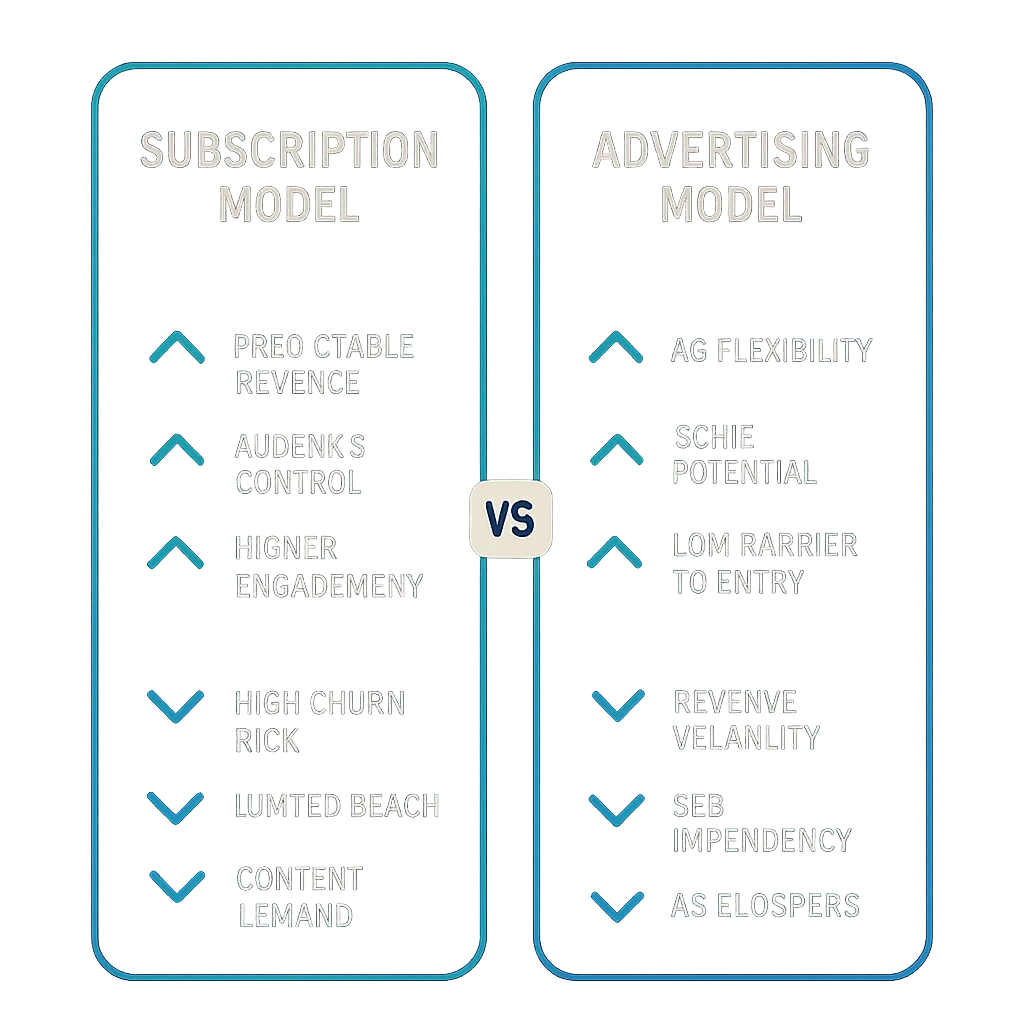
The advertising model offers greater flexibility in selecting ad partners and better potential for scaling the business. However, publishers fully reliant on advertising must invest continuously in site performance and SEO — appearing prominently in search results is essential for maintaining audience volume and, by extension, ad revenue.
The subscription model requires more upfront planning: CRM infrastructure, paywall mechanics, and cash flow management. Finding an audience willing to pay for content — and converting them — is non-trivial.
Digital advertising allows publishers to test and validate partnerships with different advertisers and optimize campaign delivery over time. Subscription models, once they reach scale, can be more predictable and less dependent on fluctuating ad market conditions.
A well-maintained site with genuinely valuable content supports both approaches: it attracts enough visitors to generate ad revenue and provides the foundation for converting readers into paying subscribers.
Opportunities for Publishers in AdTech
AdTech platforms enable publishers to manage and sell their available inventory, connect directly with advertisers via self-serve portals, collect and activate data for targeting and audience insights, and streamline the overall advertiser relationship. The following sections cover the most consequential AdTech solutions in each of these areas.
Header Bidding
Header bidding (HB) is the process by which publishers make their ad inventory available to multiple demand sources simultaneously — before their ad server selects which ad to display. When a publisher offers ad space, competing advertisers submit bids in real-time while the page loads. The collected bids are then made to compete against deals already in the ad server (including direct deals), and the highest bid wins.
The core value proposition: publishers get more competition on every impression, which drives prices up and fills more inventory. A 2020 study found that header bidding increases fill rate by 23% and average CPMs by 20%.
How header bidding benefits publishers:
- More transparency: Publishers gain better visibility into what their inventory is actually worth in the open market, enabling more informed pricing decisions.
- Higher fill rates: Access to more demand sources increases the probability of selling all inventory types — both premium placements and remnant (unsold) inventory.
- Increased competitiveness: Multiple demand sources bidding simultaneously on the same impression drives CPM competition in a way that waterfall setups cannot replicate.

An overview of how the header-bidding process works.
Self-Serve Ad Platform
A self-serve advertising platform is a tool that allows advertisers and ad agencies to create, launch, and manage campaigns on a publisher's properties independently — without involving the publisher's AdOps team for every transaction.
For publishers, the primary benefit is operational efficiency: AdOps resources are freed up to focus on high-value, complex campaigns rather than routine campaign management for smaller buyers.
Self-serve platforms can be integrated with data platforms — DMPs and CDPs — to enable audience creation, data collection, and targeting. When paired with an ad server, the self-serve platform drives ad delivery and targeting across campaigns.

Publishers and media companies — including video-streaming services — can build self-serve ad platforms that allow advertisers and agencies to run campaigns targeting the publisher's audience directly.
A Customer Data Platform (CDP) for Building Audiences
Privacy regulation has fundamentally changed how publishers collect and share user data with advertisers. Regulations including GDPR, the ePrivacy Directive, the DMA and DSA, and CCPA all govern the collection and use of personal data for advertising purposes. In this environment, first-party data — data users provide directly to the publisher — has become the most valuable currency on the digital advertising market.
A customer data platform (CDP) is software that gathers information from multiple sources and unifies it into a single customer view (SCV). CDPs primarily collect first-party data and put it to work across marketing, customer support, and advertising use cases.
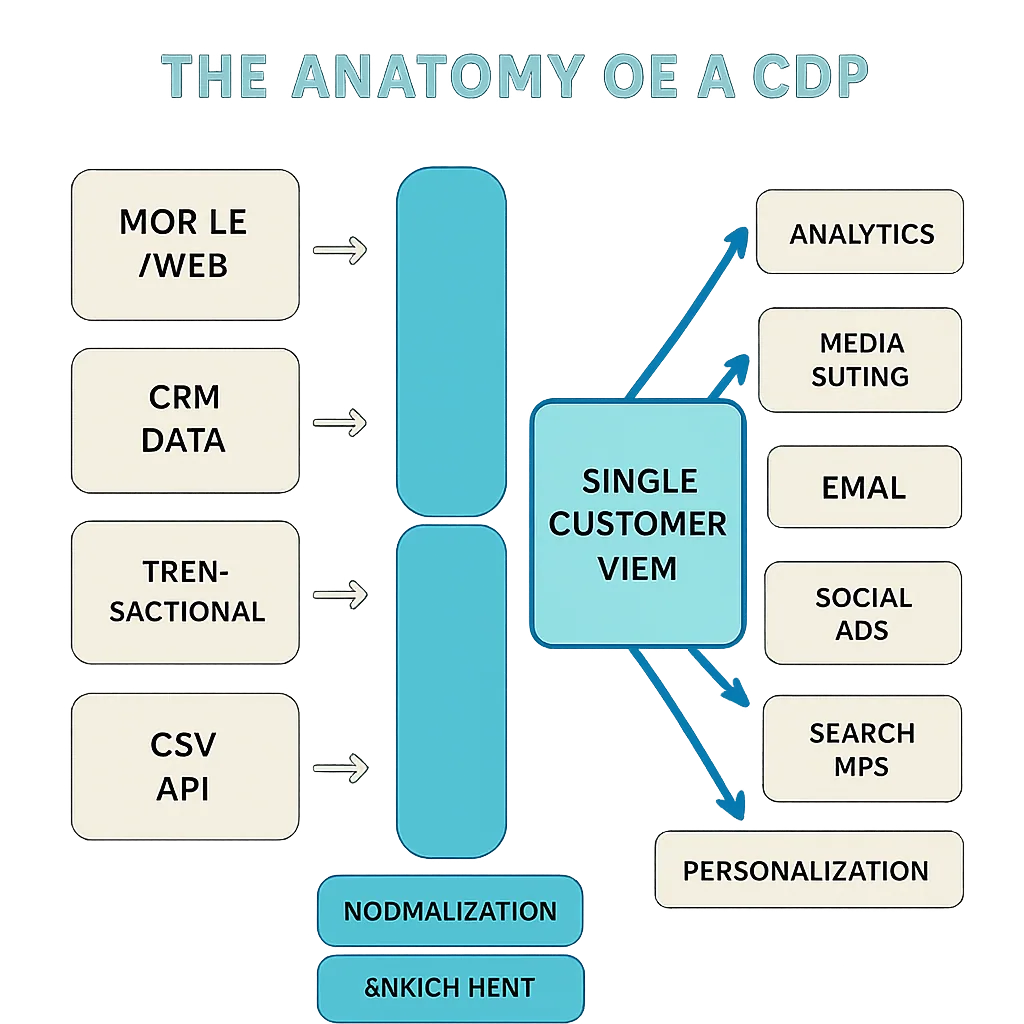
Common advertising and marketing use cases of a CDP.
Some publishers — including the French-language daily Le Monde — have built their own consent management platforms and merged that functionality with a custom CDP for subscribers, which then serves as a data management platform for advertisers. This approach gives the publisher full control over their data stack while still offering advertisers a compliant, well-structured audience product.
For large publishers, it makes strategic sense to align with advertisers who share common brand values and can reach similar audiences. Logical pairings include:
- Culinary publications and food brands
- Real estate media and home renovation companies
- Technology sites and consumer electronics brands
Demand-Path Optimization (DPO)
Demand-path optimization (DPO) is the process of analyzing the paths that media buyers (advertisers and agencies) take to purchase a publisher's inventory, with the goal of improving the efficiency, transparency, and profitability of those transactions.
DPO helps publishers identify which parts of the media supply chain are working in their favour and which are not. Practically, it can boost ad income and yield, reduce AdTech costs, and improve the on-site user experience.
Publishers conducting DPO examine several factors across each demand path:
- Transaction costs at each stage.
- The transparency of the purchasing path.
- How easily buyers can access the desired inventory.
- The attractiveness of the terms on offer.
- The resulting ad revenue.
Every link in the chain is analyzed: supply-side platforms (SSPs), ad exchanges, ad networks, agency trading desks, and demand-side platforms (DSPs). Publishers can use the IAB's Buyer.json mechanism to gain transparency into the media-supply chain and identify exactly who is buying their impressions.
Business Benefits of DPO for Publishers
- Buyer identification: Publishers know precisely who is purchasing their impressions, enabling better vetting and relationship-building.
- Path identification: Effective and ineffective purchasing paths are distinguished, making it clear where optimization is warranted.
- Elimination of bad actors: Ad fraudsters and low-quality media buyers can be identified and removed from the supply chain.
- Value recognition: Publishers can identify ad exchanges and SSPs that extract fees without delivering proportionate revenue in return.
- Increased transparency: Streamlined media-buying paths make it easier for legitimate advertisers to purchase more impressions.
- Improved advertiser relationships: DPO naturally promotes direct engagement with media buyers, strengthening those relationships over time.
- Risk mitigation: Publishers can identify and exclude advertisers with poor credit scores or a history of late payment.
- Better user experience: Low-quality ads that slow page load times can be attributed to specific demand sources and eliminated.
Summary
There is no single monetization strategy that works for every publisher. The right approach depends on a publisher's scale, audience size, content type, and commercial relationships. Most will find themselves navigating some combination of subscriptions, advertising, and hybrid models — each with its own trade-offs.
Across all three approaches, the consistent challenge involves data: collecting it properly, obtaining user consent, segmenting audiences, and activating that data for ad targeting and personalization. AdTech solutions — header bidding, self-serve platforms, CDPs, and DPO — address different parts of this challenge and, when implemented thoughtfully, can meaningfully improve both revenue and operational efficiency.