The Main Technology Platforms and Intermediaries in the Digital Advertising Ecosystem
Advertising before the Internet was a largely manual process — people created, configured, and delivered campaigns by hand. The Internet changed all of that, and today online advertising runs on a complex web of interconnected software platforms.
The online advertising ecosystem consists of over a dozen different types of advertising technology platforms and intermediaries, each playing a distinct role in the creation, execution, and measurement of a campaign.
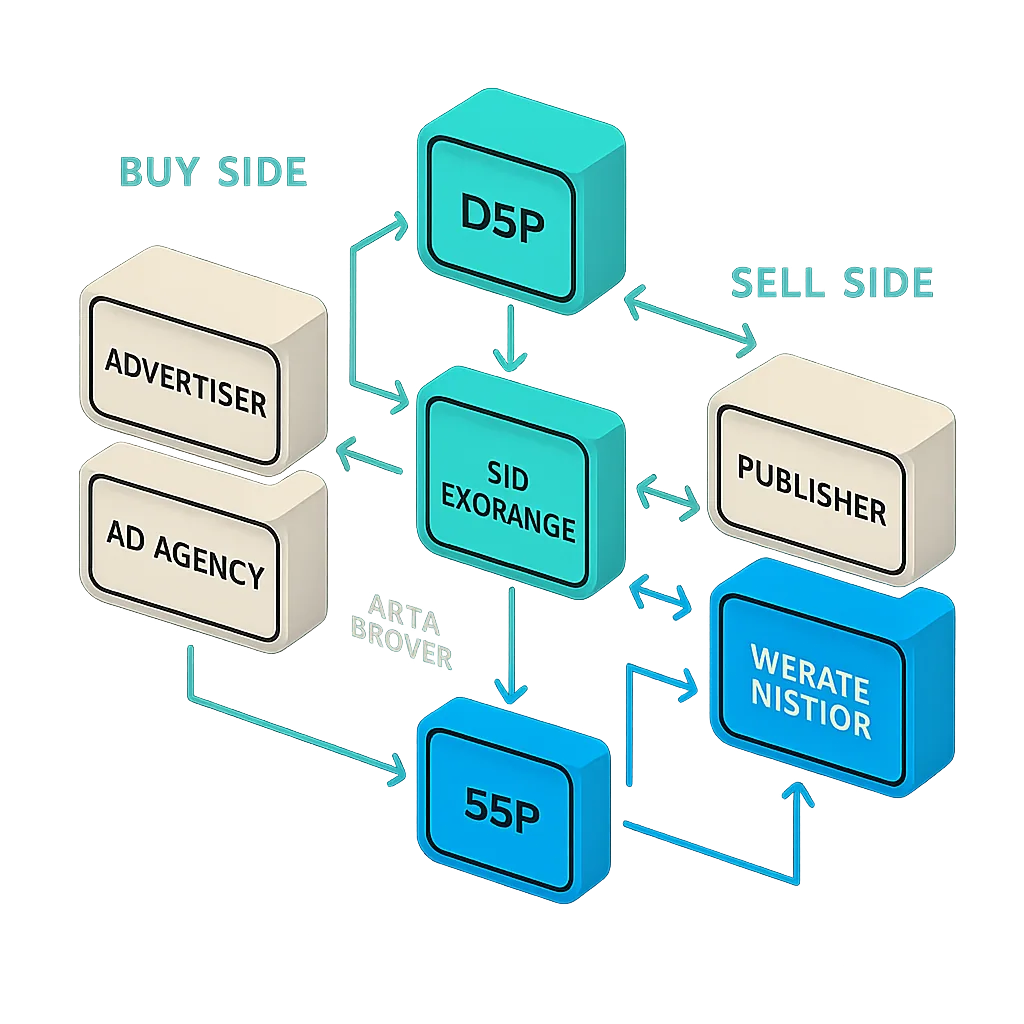
As the diagram above shows, a considerable number of platforms and intermediaries are involved whenever ads and data change hands. What follows is a structured overview of each one.
Advertisers — The Buy Side
Advertisers (brands) represent the buy side: they are the ones looking to purchase online media, also called ad space or inventory.
Advertising Operations (AdOps)
On the advertiser's side, the AdOps department is responsible for setting up, monitoring, and optimizing campaigns. In the early days this was handled manually, but AdOps teams eventually adopted AdTech platforms — most notably the ad server — to streamline the process.
The Advertiser's Ad Server (Third-Party Ad Server)
A third-party ad server, also known as the advertiser's ad server, is a web-based technology platform responsible for:
- Deciding which ads to show on a given website
- Serving those ads
- Connecting with other AdTech platforms (e.g., demand-side platforms) to purchase inventory
- Collecting and reporting data such as impressions, clicks, and conversions
Intermediaries
Intermediaries are the companies and platforms that sit between advertisers and publishers.
Advertising Agencies
An advertising agency is a company that provides services to brands associated with creating, planning, and managing advertising campaigns. Agencies are generally independent, external firms working for clients that range from small businesses to multinational corporations, non-profits, and government bodies.
Traditionally, brands hired agencies to produce television commercials and print campaigns in magazines, newspapers, and on billboards, as well as to handle other forms of promotion. With the growth of the Internet, agencies now use an array of advertising and marketing technologies to create, run, manage, and measure online campaigns — often operating under labels such as interactive, creative, media, or digital agencies.
A Brief History of Advertising Agencies
Before agencies existed, ads were placed through representatives who simply bought and resold advertising space at a markup. Over time, these intermediaries took on additional responsibilities: planning, writing, designing, and coordinating ads.
The first recognizable agencies date back to 1786, when William Taylor opened his office in London — widely acknowledged as the first advertising agency in history. The concept then crossed the Atlantic when Volney B. Palmer opened the first agency on American soil in Philadelphia in 1840. Adland: A Global History of Advertising quotes Palmer describing himself as:
"the duly authorized agent of most of the best newspapers of all the cities and provincial towns in the United States and Canada, for which he is daily receiving advertisements and subscriptions."
Palmer's office at the corner of Third and Chestnut Street in Philadelphia effectively became the prototype for the modern advertising agency. In 1842, he began buying large quantities of newspaper space at discounted rates and reselling it at higher rates to advertisers — though the actual creative work (copy, layout, artwork) was produced by the client, which made him essentially an ad-space broker.
This brokerage model dominated through the 19th century, until N.W. Ayer & Son was founded in New York. The agency provided a much broader range of services — planning, creating, and executing complete campaigns — and became well known for its work with brands such as De Beers, AT&T, and the U.S. Army.
'Diamonds are forever' was coined in 1947.
How Ad Agencies Have Evolved
In the early days, agencies were barely involved in the creative process at all. Even now, creative work represents only a portion of what agencies do. Beyond creative development, agencies conduct market research, prepare detailed media plans, and purchase advertising space.
Over the decades, agencies evolved to match changing client needs, taking on many functions that fall loosely under the umbrella of marketing.
Before the Internet, the first advertising agents acted primarily as intermediaries who sold space and charged commissions. From the 1800s through the 1950s — the so-called "Mad Men" era — agencies gradually became true partners to brands, taking responsibility for strategy development, campaign concepting, and managing the ad insertion process.
With the introduction of the Internet, AdTech companies began disrupting traditional agency operations by offering new capabilities and shifting the balance of power. Agencies responded by leveraging advertising technology, which gave them access to unprecedented amounts of consumer data. Today, specialized agencies explore opportunities in social media, display advertising, retargeting, and content personalization, while AdTech vendors build sophisticated tools — like demand-side platforms (DSPs) — that offer targeting and analytics well beyond what was possible in traditional advertising.
Large International Ad Agencies
Advertising agency globalization accelerated in the 20th century, as American agencies began opening overseas offices before both World Wars. McCann Erickson, established in New York City in 1902, opened its first European offices in 1927, followed by South American offices in 1935 and Australian offices in 1959. Companies such as J. Walter Thompson pursued international expansion to serve clients wherever they operated. English agencies followed suit in the 1960s and 1970s.
Saatchi & Saatchi, one of the most iconic English agencies, was founded in 1970 and rose to international prominence through relationships with clients such as British Airways and Toyota, eventually building a worldwide network of offices.
The five largest advertising agency groups today are:
A list of popular agencies
- Omnicom Group — New York City
- Publicis Groupe — Paris
- Interpublic Group — New York City
- Dentsu — Tokyo
Despite the challenges agencies have faced — particularly over the past two decades with the rise of AdTech vendors — they have remained a key component of the advertising process.
Agency Trading Desk (ATD)
An agency trading desk (ATD) is typically defined as a company that offers programmatic managed services to brands. ATDs are responsible for running programmatic media-buying activities on behalf of brands and operate on two layers:
- Services layer — media buyers, account managers, developers, etc.
- Technical layer — proprietary technology plus external tools such as DSPs
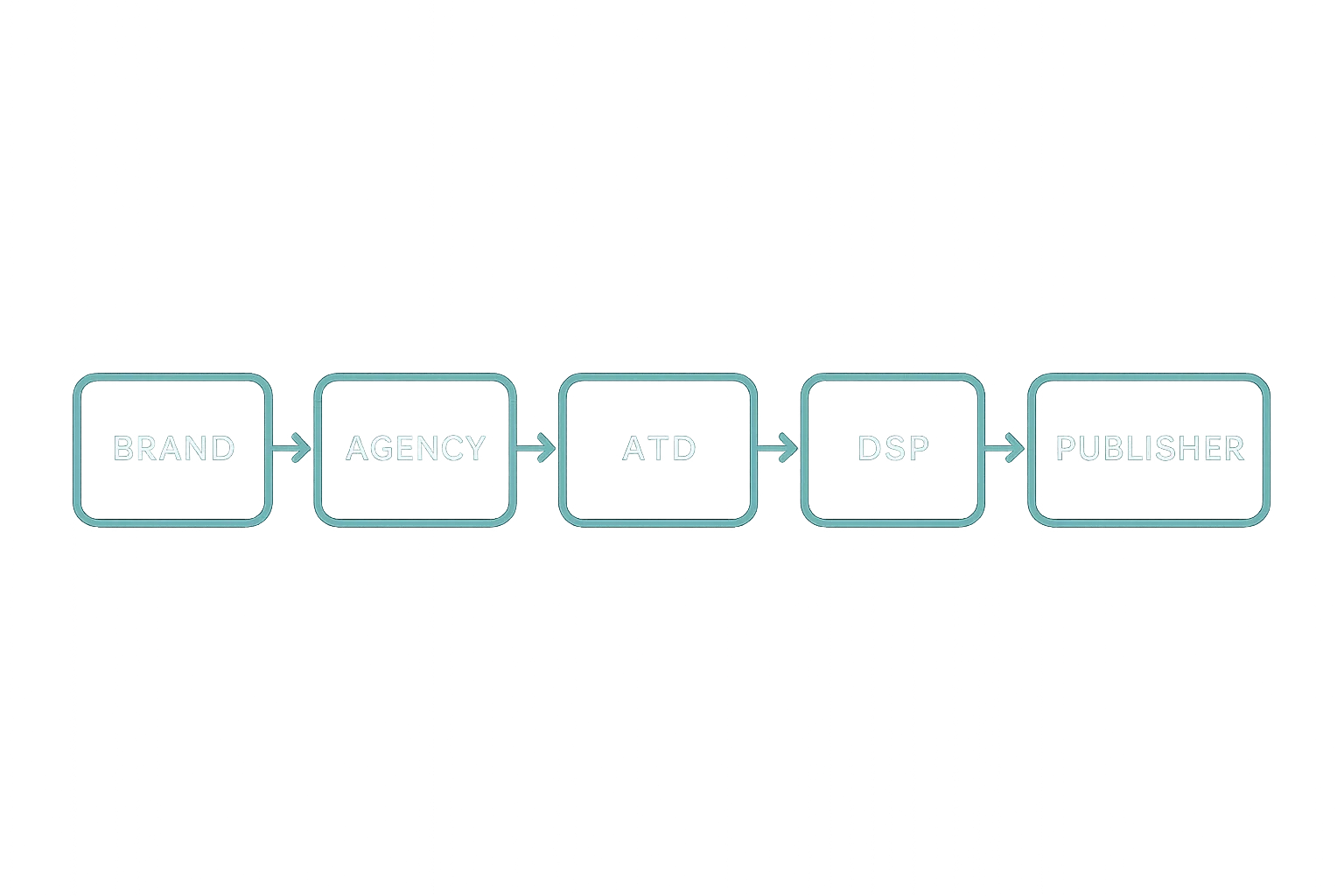
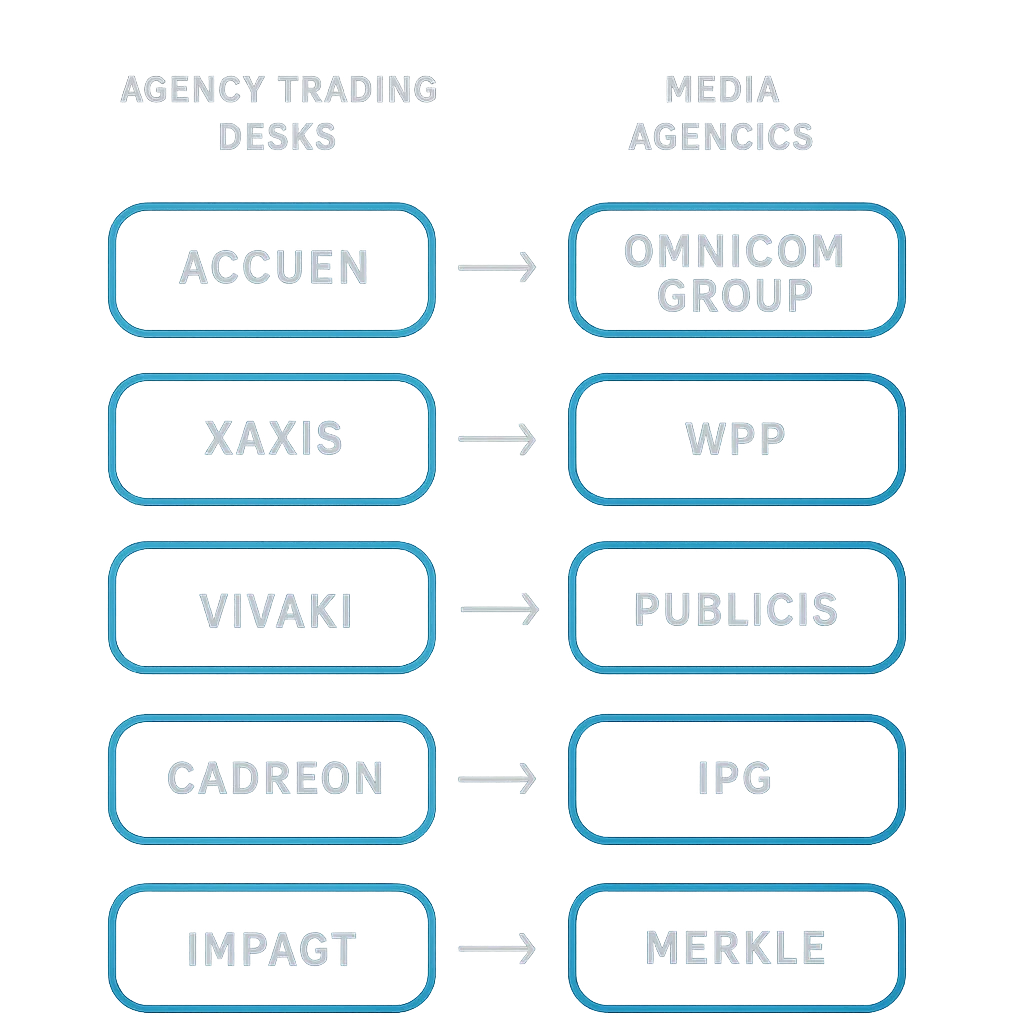
All major advertising agencies operate their own agency trading desk to handle programmatic buying for their clients.
Ad Network
An ad network is a technology platform that acts as a broker between a group of publishers and a group of advertisers.
Ad networks were first introduced in the mid-1990s as a way to help publishers sell available inventory and help advertisers scale their campaigns across many different sites without dealing with each publisher directly.
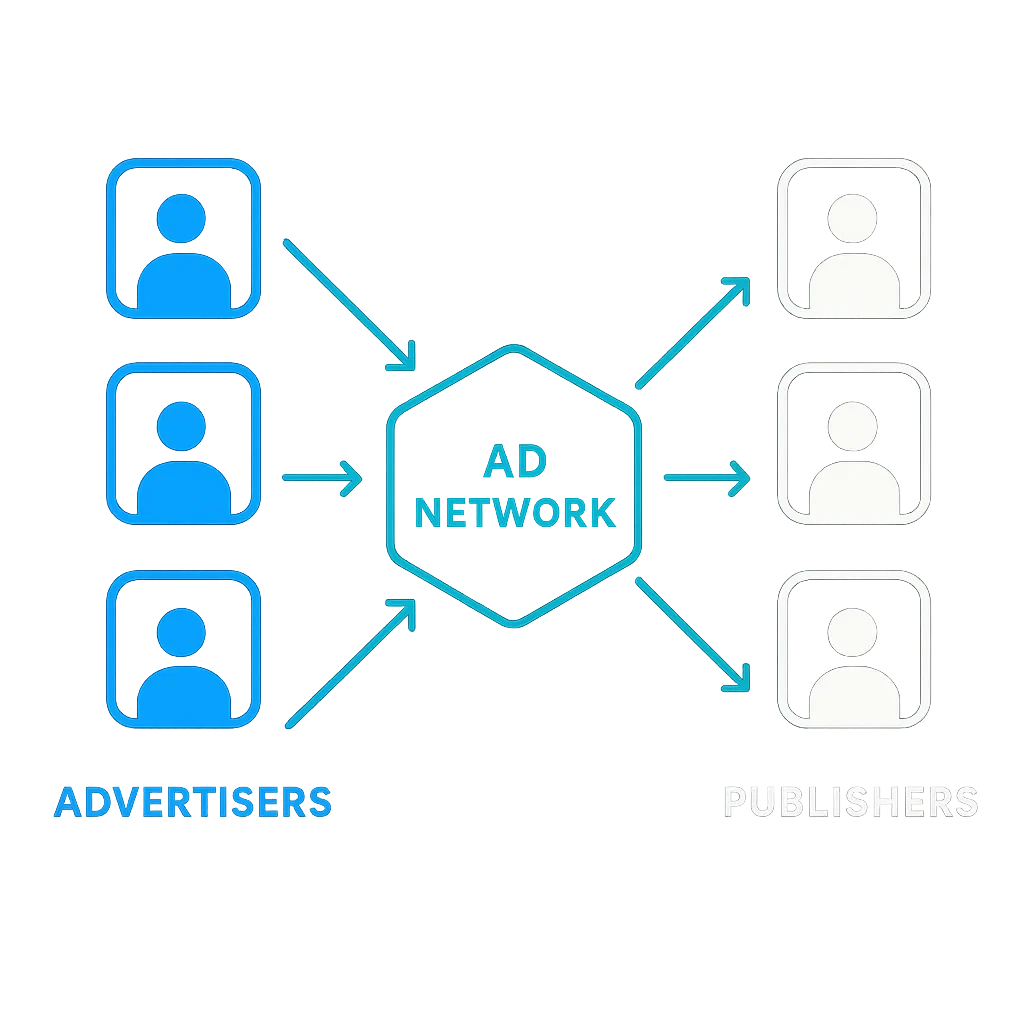
Ad networks aggregate unsold (remnant) inventory from publishers and offer advertisers a consolidated, generally less expensive pool of impressions on a cost-per-mille (CPM) basis.
Benefits for Publishers and Advertisers
While ad networks primarily help publishers sell remnant inventory, they also benefit advertisers:
- Scale: An advertiser can buy inventory from many publishers through a single ad network and centralize campaign reporting.
- Time savings: The campaign is set up once, with no need to sign insertion orders with individual publishers.
- Campaign reach and measurement: Reach is measured across the full campaign, and frequency capping is applied holistically.
- Monetization: Publishers can sell inventory they were unable to move through direct deals.
Types of Ad Networks
Many ad networks specialize in particular types of inventory:
- Premium ad networks: Offer inventory from top publisher brands (e.g., The New York Times).
- Vertical ad networks: Focus on specific topics such as business, technology, automotive, or fashion.
- Specialized ad networks: Focus on a specific channel type (e.g., mobile, video, native).
- Performance and affiliate ad networks: Use revenue share, cost-per-click (CPC), or cost-per-action (CPA) pricing models.
Targeting Criteria in Ad Networks
The targeting and decision-making processes in ad networks function similarly to those in ad servers, with some differences. Common targeting criteria include:
- Run on network (RON) — ads run across all sites in the network
- Run on site (ROS) — ads target specific domains/publishers within the network
- IAB content categories
- Geolocation
- Keywords (contextual targeting)
- Time of day
- Browser type / operating system
- …and many others
Demand-Side Platform (DSP)
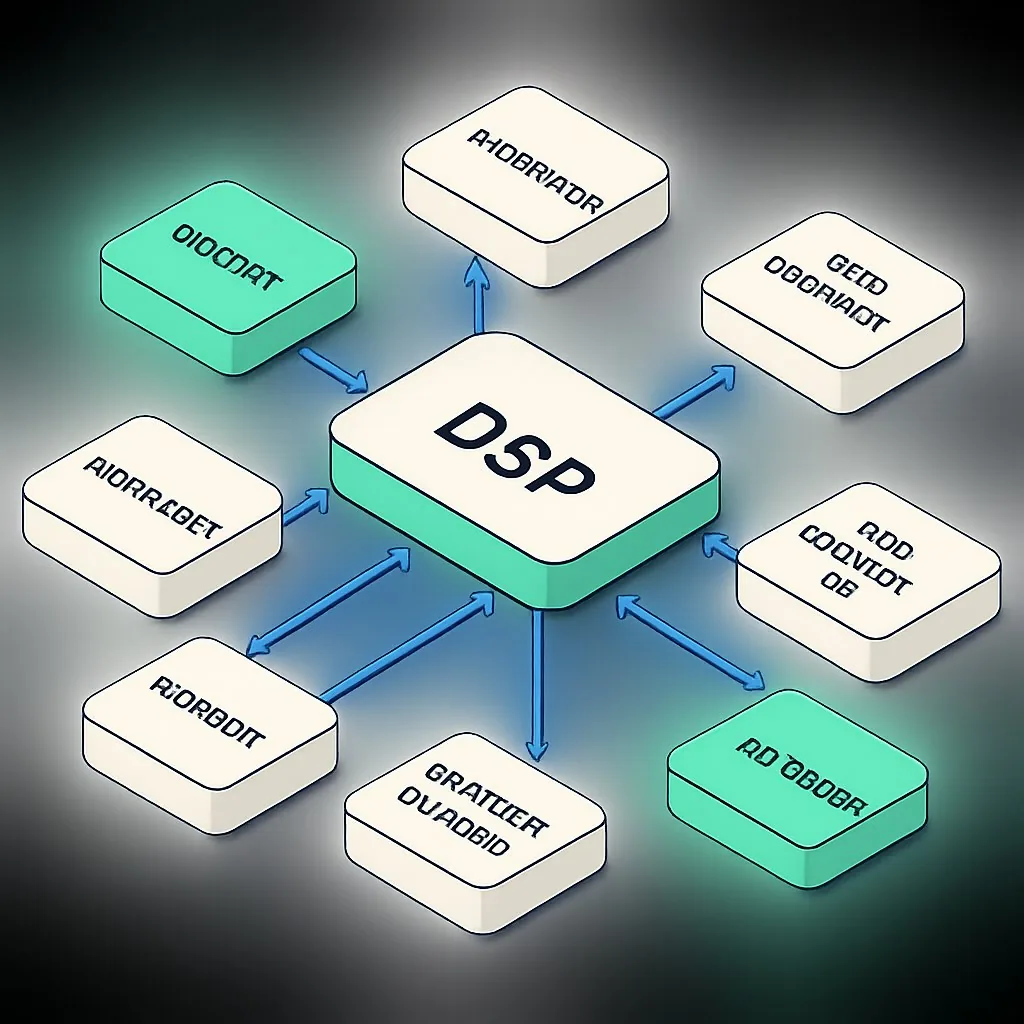
A demand-side platform (DSP) is a technology platform that allows media buyers — advertisers and agencies — to run advertising campaigns and purchase inventory from various ad exchanges and SSPs through a single user interface.
DSPs are a key component of the real-time bidding (RTB) process, which allows advertisers to buy media on an impression-by-impression basis. To improve targeting and enhance media buys, DSPs often pull in data from data-management platforms (DMPs) and data brokers.
DSPs are complex platforms comprising many different components:
Ad Network vs. DSP: What's the Difference?
Although ad networks and DSPs appear to operate similarly on the surface, the critical distinction is:
Ad networks aggregate inventory from multiple publishers and sell it as packages to advertisers, whereas DSPs purchase inventory on an impression-by-impression basis via real-time bidding (RTB).
Data-Management Platform (DMP) — For Advertisers
A data-management platform (DMP) is responsible for collecting, storing, and organizing large volumes of data for advertisers, drawn from first-party, second-party, and third-party sources.
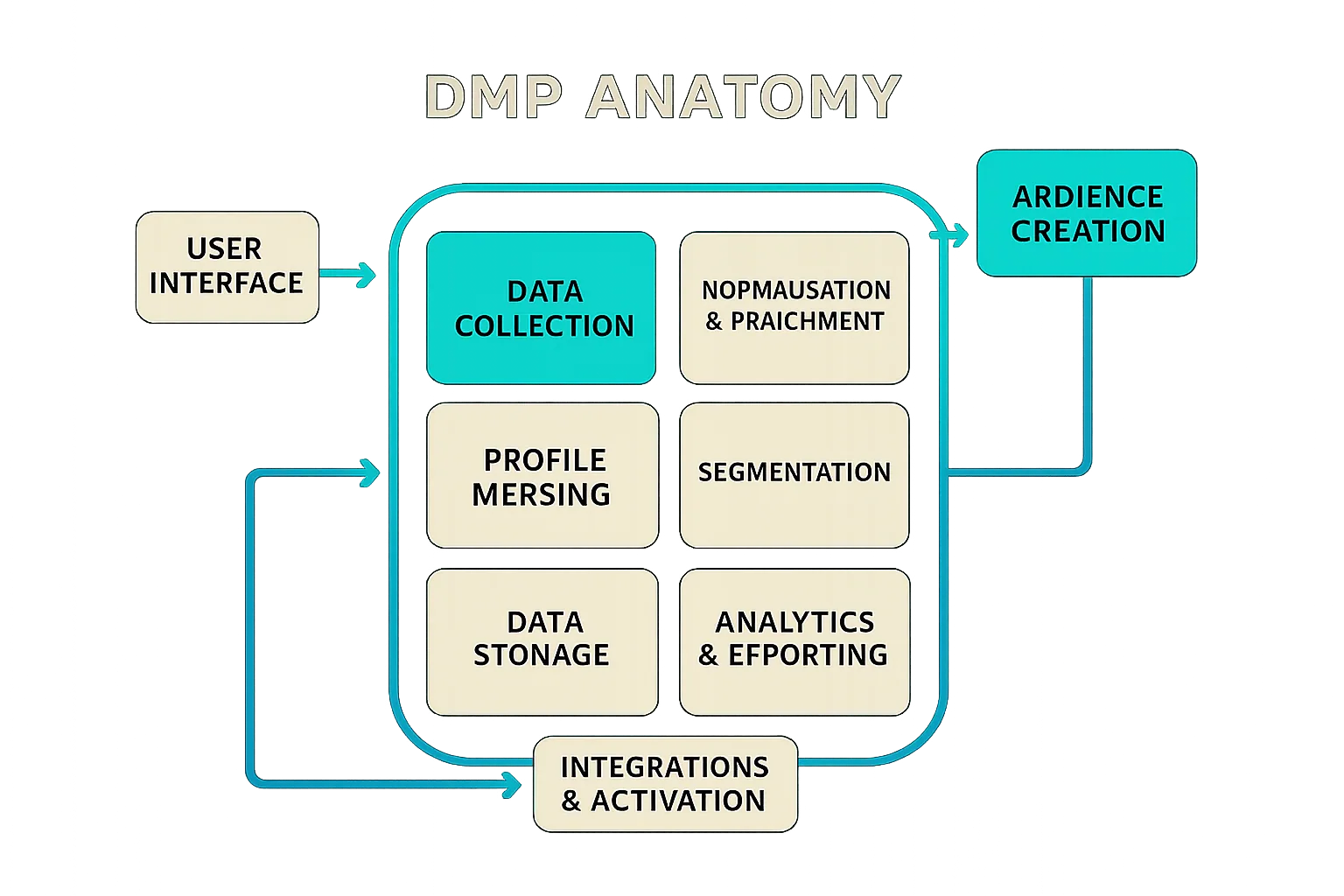
Advertisers use DMPs to improve the targeting of their campaigns by following a typical workflow:
- Collect data — e.g., first-party and third-party data.
- Create audiences based on criteria such as gender, location, or interests.
- Export these audiences to media-buying platforms like DSPs for use in ad targeting.
Ad Exchange
An ad exchange is a dynamic technology platform that facilitates the buying and selling of available impressions between advertisers — who place bids via DSPs — and publishers — who offer inventory via supply-side platforms (SSPs) or directly with the exchange.
Ad exchanges are frequently compared to stock exchanges: the buying and selling of media is analogous to trading stocks, with prices discovered in real time through auction mechanics.
Supply-Side Platform (SSP)
A supply-side platform (SSP) is a technology platform designed to help publishers sell their inventory across multiple ad exchanges and ad networks — and in some cases directly to DSPs — in an automated, secure, and efficient manner.
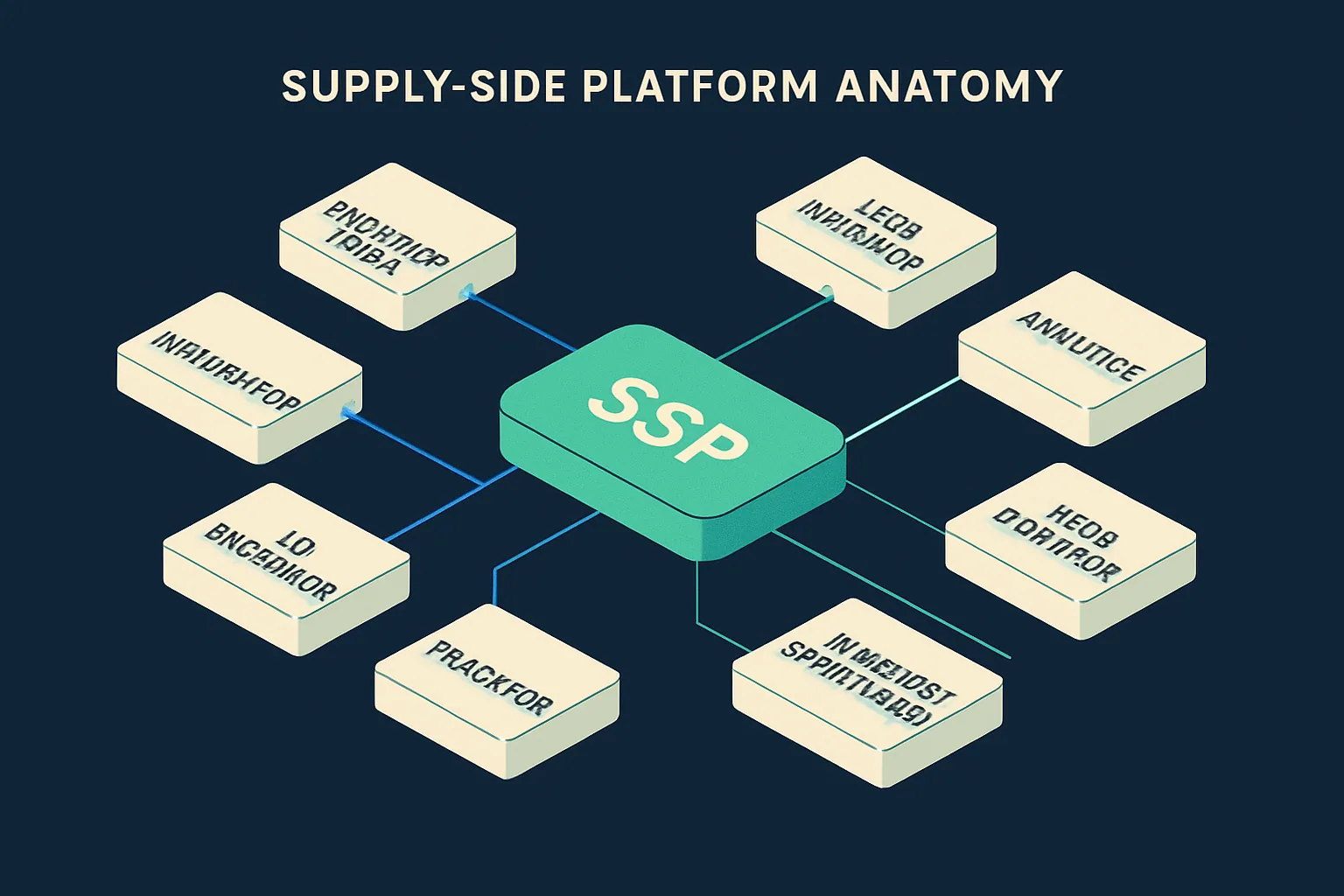
While publishers don't strictly need an SSP to participate in ad exchanges, SSP technology provides meaningful benefits: maximizing yield from inventory and offering deeper insight into audience composition.
SSP vs. Ad Exchange: What's the Difference?
- SSPs give publishers tools to manage inventory, connect to ad exchanges, and optimize yield.
- Ad exchanges bring DSPs and SSPs together to conduct media transactions — conceptually similar to an eBay for ad inventory.
In practice, most SSPs today also include exchange functionality, meaning DSPs can connect directly to SSPs and purchase inventory through RTB auctions. This DSP-SSP connection is achieved using the OpenRTB protocol.
Data-Management Platform (DMP) — For Publishers
While DMPs are most commonly associated with advertisers, they also create opportunities for publishers. The main things publishers can do with a DMP include:
- Creating additional revenue streams through audience extension
- Increasing the effective cost of their inventory
- Improving user engagement through content personalization
Data Broker
A data broker — also known as an information broker, data provider, or data supplier — collects and sells offline and online consumer data to other companies.
Data brokers purchase data from publishers and other data holders (credit-card companies, telecoms, ISPs, retailers, etc.) and combine it into aggregated audiences, known as segments. Segments are typically organized by category:
- Demographics — gender, age, income group, etc.
- Interests — sports, travel, etc.
- Purchase intent — e.g., in-market car buyers or prospective home buyers
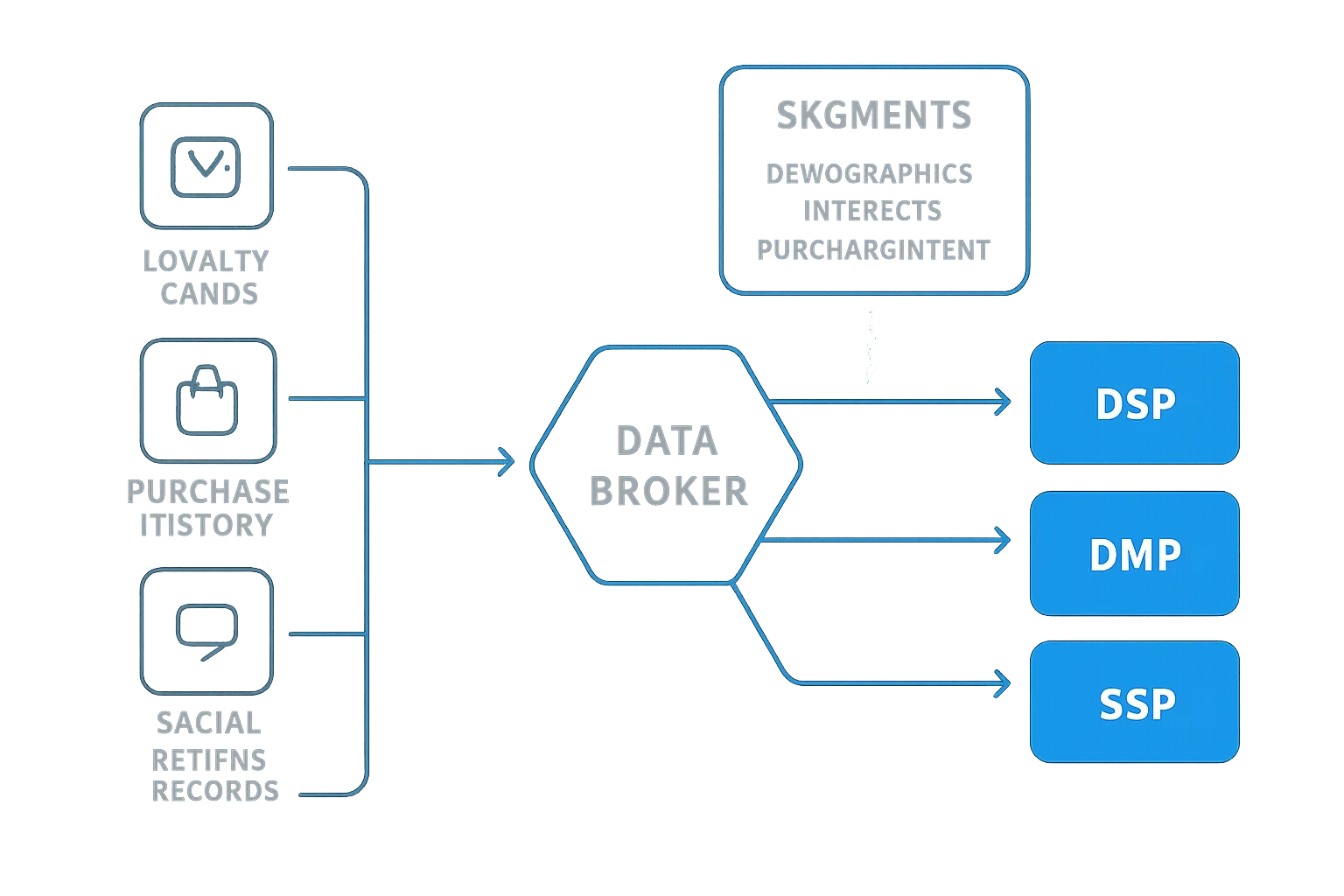
These segments are sold to advertisers and used for ad targeting, typically by connecting to DSPs and DMPs.
A list of the main data brokers
Verification and Measurement
Verification services use technology to provide advertisers with additional information about their campaigns. Specifically, they can inform advertisers about:
- Which websites displayed the ads
- Where ads were displayed (geolocation)
- What percentage of ads were actually viewable by users
- Whether fraudulent traffic was detected (e.g., impressions, clicks, or conversions generated by bots)
- Whether ads appeared next to questionable content (e.g., illegal or offensive material)
Measurement and analytics companies provide detailed analysis of ad performance and reach, as well as insights into customer behaviour, trends, and user-centric data to help advertisers improve performance and targeting.
It's worth noting that these analytics are distinct from web analytics used for tracking website traffic or in-app behaviour. Web and app analytics belong to the marketing-technology (MarTech) ecosystem, though an increasing number of those tools are now offering ad campaign insights — part of a broader trend toward unified platforms that bridge online marketing and advertising technology.
How ad-verification tools work:
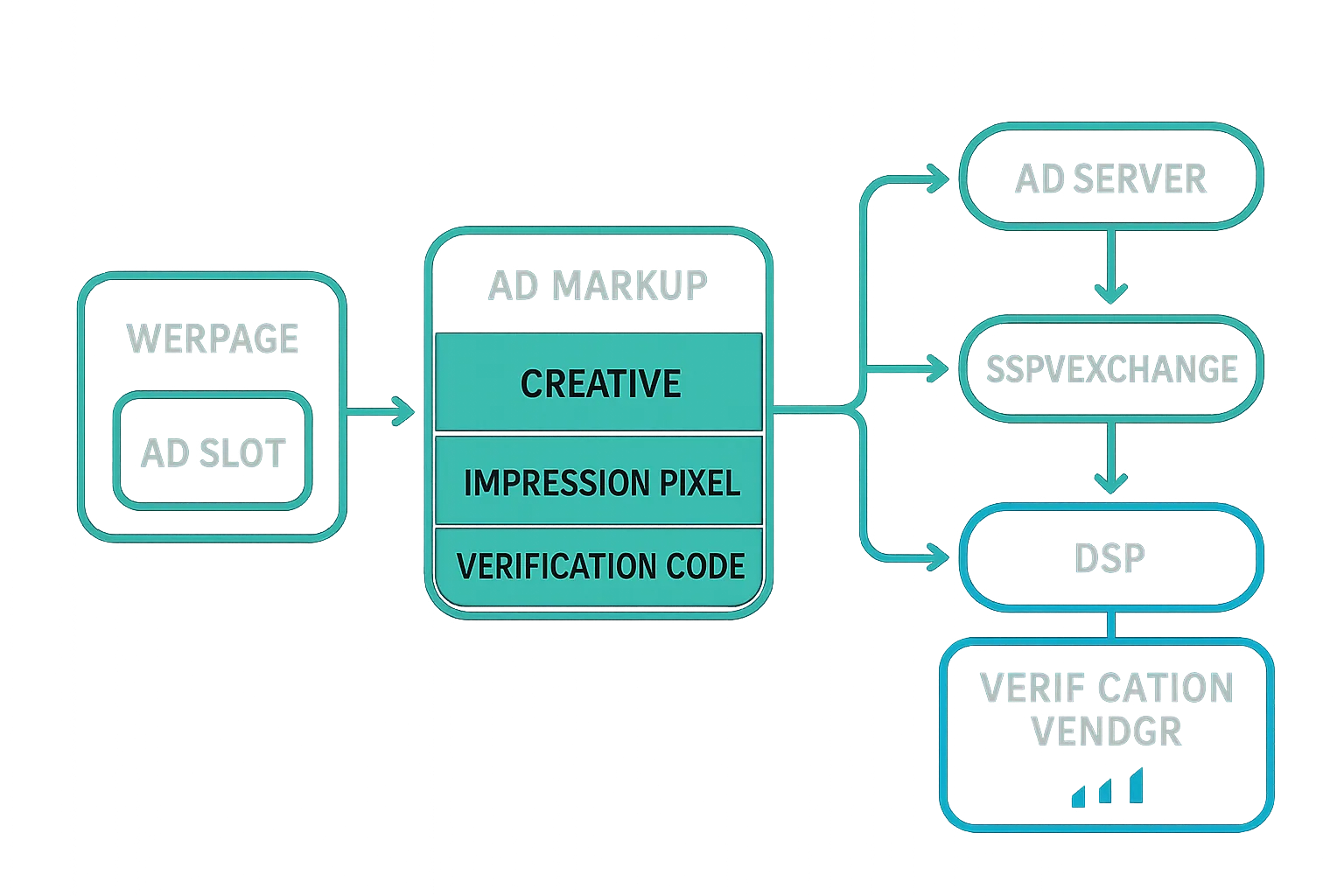
Here is the sequence illustrated above:
- A user opens a web page containing an ad slot.
- DSPs are called via SSPs, ad exchanges, and ad networks. In the case of a direct publisher-advertiser deal, the ad markup — including the creative, impression-tracking pixel, and ad-verification code — is configured directly in the publisher's ad server.
- The DSP with the highest bid wins the impression, and the ad is sent to the publisher's site via the ad markup.
- As the ad loads, the ad-verification code collects information about the website and user: ad placement, audience, engagement, and so on.
- The ad-verification vendor sends performance reports to the advertiser.
Creative Optimization
A creative optimization company works with media buyers (advertisers and agencies) to improve the performance of online ad campaigns. These companies typically add a layer of rich media — such as video — to standard banner ads, making them more interactive, dynamic, and engaging.
Dynamic creative optimization (DCO) platforms take this further by using user data to personalize the creative in real time and run A/B tests to determine the best-performing variant, all with minimal human involvement.
The Sell Side — Publishers
Publishers (websites and apps) represent the sell side: they want to sell their ad space to media buyers.
Advertising Operations (AdOps)
The publisher's AdOps department is responsible for setting up advertiser campaigns in their ad server (the first-party or publisher's ad server), trafficking tags, configuring header-bidding wrappers, and making campaign adjustments as needed.
First-Party Ad Server (Publisher's Ad Server)
This platform allows publishers to manage the ad slots on their website and display ads sold directly to advertisers (direct campaigns). When no direct campaigns are available, the first-party ad server acts as a management layer, deciding which ad codes — from a third-party ad server, SSP, or ad network — to serve in those slots.
Does everyone need an ad server?
Not necessarily. The answer depends on the type of player:
- Most publishers will use an ad server, but not every advertiser needs one — since most DSPs offer ad-serving capabilities, advertisers can store and manage creatives directly within a DSP.
- Publishers can also use an SSP instead of a dedicated ad server, as many SSPs include ad-serving functionality and support multiple campaign types. However, having a dedicated ad server gives publishers flexibility to switch SSP vendors without disruption.
- Smaller publishers can bypass both and simply add ad codes directly into their website, though this removes the management and optimization benefits.
How AdTech Companies Make Money
Building and maintaining AdTech platforms is an expensive undertaking. Infrastructure costs are significant, and staffing requirements — developers, technical personnel, managers, sales teams — add up quickly. AdTech vendors must deliver high-performance products while ensuring their business model covers costs and generates profit.
Since the early days of online advertising, technology providers have charged commissions and fees, typically as a percentage on top of the cost of media. Historically, most AdTech platforms added roughly 30% to the cost of media, though that figure has declined over the years due to competitive pressure and growing demands for transparency into fees and commissions — sometimes referred to as the AdTech tax.
Many AdTech companies now claim their take rates are in the single digits.
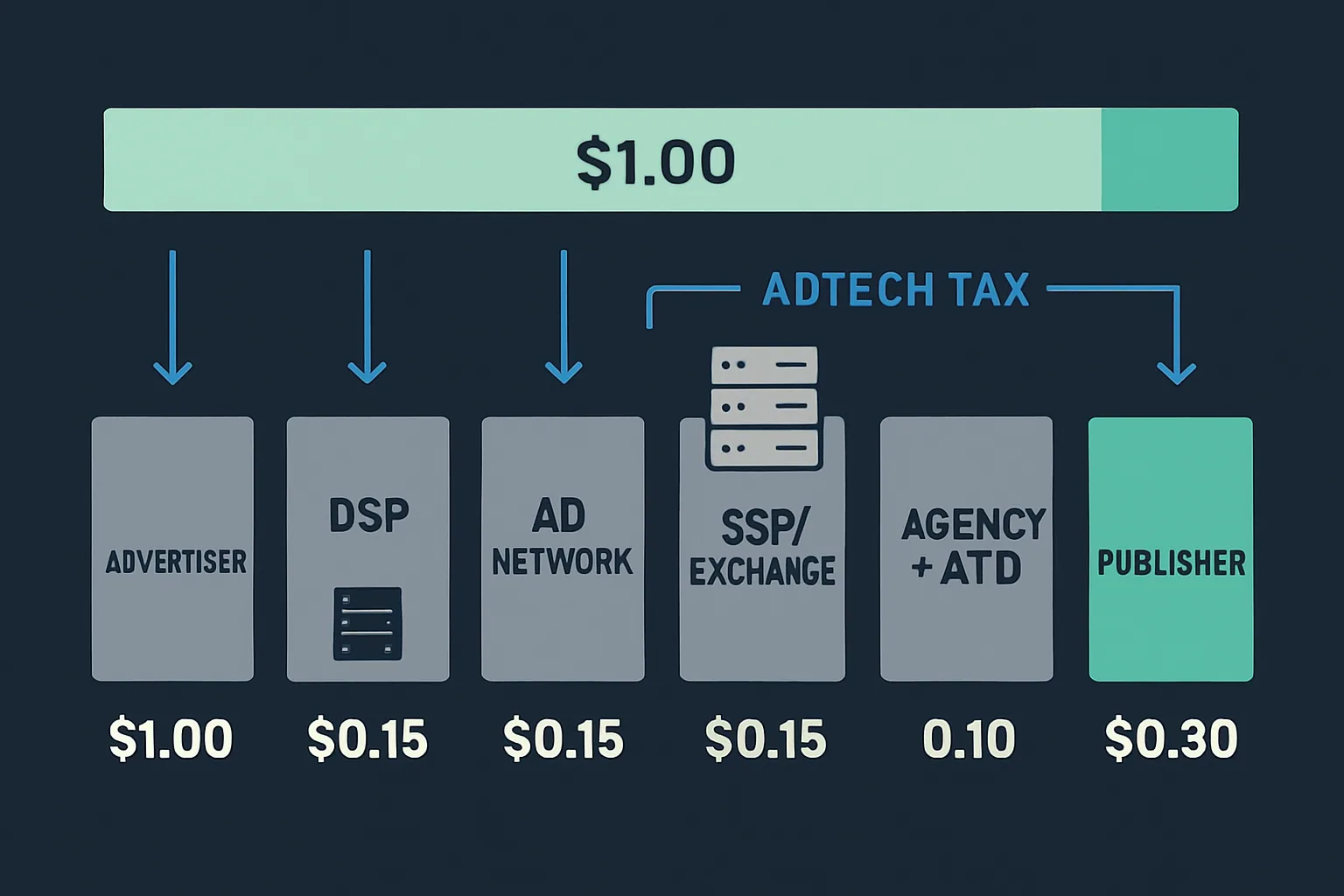
While every setup is different, the illustration above reflects how an advertiser's budget is typically distributed across the supply chain. The problem is compounded by the fragmented nature of the ecosystem: with numerous vendors involved at each step, advertisers don't receive full value for their spend, and publishers receive only a fraction of the original advertiser budget.
Over recent years, the AdTech industry has begun to consolidate. Larger vendors have acquired smaller ones, reducing the number of individual intermediaries in a given transaction — and, in turn, the cumulative AdTech tax applied to it.
The Walled Gardens
The AdTech ecosystem can be divided into two broad groups: independent AdTech companies and walled gardens.
The term walled gardens traditionally referred to the Google-Facebook duopoly, but increasingly encompasses Amazon and Apple as well — collectively known as GAFA (Google, Apple, Facebook, Amazon). These companies are called walled gardens because they maintain closed ecosystems: they keep their audience data to themselves and require brands to use their proprietary advertising platforms to access it.
Beyond its search engine, Google owns a wide array of consumer-facing products used by billions of people — including Gmail, Google Maps, and YouTube. On the advertising side, Google operates several platforms:
A list of Google's products
- Google Ad Manager (GAM): Combines what was formerly DoubleClick for Publishers (DFP) and DoubleClick Ad Exchange (AdX). This suite allows publishers to manage, sell, and serve inventory to advertisers.
- Google Ads: Previously known as Google AdWords. Used by brands to buy ads on the Google search engine.
- Google Marketing Platform (GMP): An array of tools including Search Ads 360 (formerly DoubleClick Search), Analytics 360, Data Studio, Optimize 360, Surveys 360, and Tag Manager 360. GMP also includes Display & Video 360 (DV360), which consolidated DoubleClick Bid Manager (DBM), DoubleClick Campaign Manager, DoubleClick Studio, and Google Audience Center 360. Used by advertisers and agencies to purchase ad space from publishers.
- Google AdSense: A display ad network primarily used by small and medium-sized publishers.
- Google AdMob: An ad network for in-app mobile inventory, used by over a million advertisers and publishers.
Because Google's consumer products are often accessed through a Google account, the company is able to collect detailed behavioural data on users and make it available to advertisers.
Meta (Facebook)
With over 2.3 billion active users, Meta (formerly Facebook) is a highly attractive platform for advertisers seeking to reach a specific audience. Its main advertising products include:
- Facebook Ad Manager: Programmatically sells Facebook inventory across formats that appear on Facebook's own properties.
- Facebook Audience Network: Allows advertisers to extend their campaigns to mobile apps and websites outside of Facebook, reaching the same audiences at broader scale.
Apple
Similar to Google, Apple operates a broad ecosystem of consumer-facing products — iPhone, Mac, iOS — and has been expanding into services such as Apple Music, Apple Pay, and Apple Video. By building products that lack interoperability with competing platforms, the company has cultivated a uniquely captive user base.
Apple does not operate advertising platforms comparable to Google or Facebook, though it does run ads in its App Store. The company has taken a notably firm stance on user privacy, including its Intelligent Tracking Prevention feature on Safari and its changes to how app developers and AdTech companies can access the IDFA identifier on iOS devices.
Amazon
Amazon has leveraged its large and growing e-commerce business to build a meaningful AdTech operation. Advertisers can run campaigns via Amazon's DSP across its own properties — including its e-commerce platform, Fire devices, Kindle, IMDb, and Prime Video.
Unlike Google and Meta, Amazon holds extensive first-party data on what consumers search for and purchase, making it a particularly compelling channel for retailers. In 2019, Amazon expanded its advertising product line by acquiring Sizmek's ad server and dynamic creative tool.
Understanding the role each of these platforms plays — from ad servers and DMPs on the buy side, through ad exchanges and SSPs on the sell side, to the walled-garden ecosystems of GAFA — is foundational to navigating programmatic advertising. Each layer adds functionality and, in many cases, cost; knowing what each one does makes it easier to evaluate where value is genuinely being created in the chain.