Digital Advertising Mediums and Channels: A Practical Guide
Before the Internet existed, brands and agencies relied on mediums like newspaper ads, direct-mail brochures, and TV commercials to reach mass audiences. Today, the range of available mediums and channels is far broader — and the distinctions between them matter for anyone working in digital advertising.
Medium vs. Channel: Clearing Up the Terminology
The terms medium and channel are often used interchangeably, but it helps to keep them distinct:
Medium: A means of verbal or non-verbal communication. Examples include text ads, video ads, and audio ads.
Channel: A means of transmission or distribution. Examples include display, social media, and TV advertising.
In practice: you might create a video ad (medium) and choose to run it on Facebook (channel). The two concepts operate at different levels of the stack.
Advertising Mediums
Text and Image Ads
When advertising moved online in the late 1990s, text and image formats were the only medium available. The first online ad was a simple text/image banner:

Text and image ads have since evolved into many different formats:


Despite the introduction of newer mediums over the years, text and image ads remain the most popular medium for display advertising. They can be served and displayed via HTML, JavaScript, iframe, and SafeFrame tags.
Native Ads
Native ads are designed to blend with surrounding content by following the natural form of the user experience and matching the design and behaviour of the web page, application, or platform in which they appear.
Although native ads are intended to look like editorial content, they are still required to carry a clear and prominent disclaimer identifying them as paid advertisements.
Native ads are generally found on content-rich sites — news sites, blogs, and social networks. The IAB's Native Advertising Playbook 2.0 defines several key formats:
Content recommendation ads (formerly content recommendation widgets): This is probably the most subtle form of native advertising. These ads typically appear at the end of articles, labelled with phrases like From the web or Recommended for you.
Source: IAB Native Advertising Playbook 2.0
In-feed and in-content ads: These appear in article and content feeds (in-feed) or inside articles themselves (in-content). Unlike content recommendation ads, which direct users away from the current site, these are embedded within the content flow. They can take the form of text, image, or video.

Source: IAB Native Advertising Playbook 2.0
Branded/native content (also called sponsored, brand, or custom content): Rather than directing the user elsewhere, branded content lives on the publisher's own site — formatted to look like the site's editorial content. This format involves collaboration between the brand and the publisher's editorial team and tends to produce more creative, engaging results than other native formats.
Classic examples come from Netflix's campaigns promoting Orange is the New Black and House of Cards:

Source: The New York Times
House of Cards native ad example from The Atlantic
Source: The Atlantic
Other Forms of Native Advertising
The first version of the IAB's Native Advertising Playbook included paid search and promoted listings as examples of native ads. These are no longer classified as native ad types — they now fall under the Search Advertising category.
Video Ads
Video advertising refers to ads delivered in video form rather than static formats like banners.
It's worth distinguishing video advertising from television advertising — while online streaming services are blurring the line, they remain separate categories. Depending on the channel, serving a video ad is similar to serving an image or native ad, except the creative is delivered to and displayed within a video player rather than rendered directly on the page.
Most video ads are served via protocols developed by the IAB Tech Lab: VAST, VPAID, and VMAP.
Video Ad Serving Template (VAST)
VAST was developed to resolve compatibility problems between advertisers and publishers when serving video ads. It supports multiple video formats — including MP4, 3GP, and MOV — can serve pre-roll, mid-roll, and end-roll ads, and provides interactive functionalities such as pausing and skipping.

Video Player Ad Interface Definition (VPAID)
VPAID allows advertisers to serve rich, interactive video ads and collect data on how users engage with them — for example, whether a user clicks through to additional information, fills in a form, completes a survey, or plays a game embedded in the ad unit.
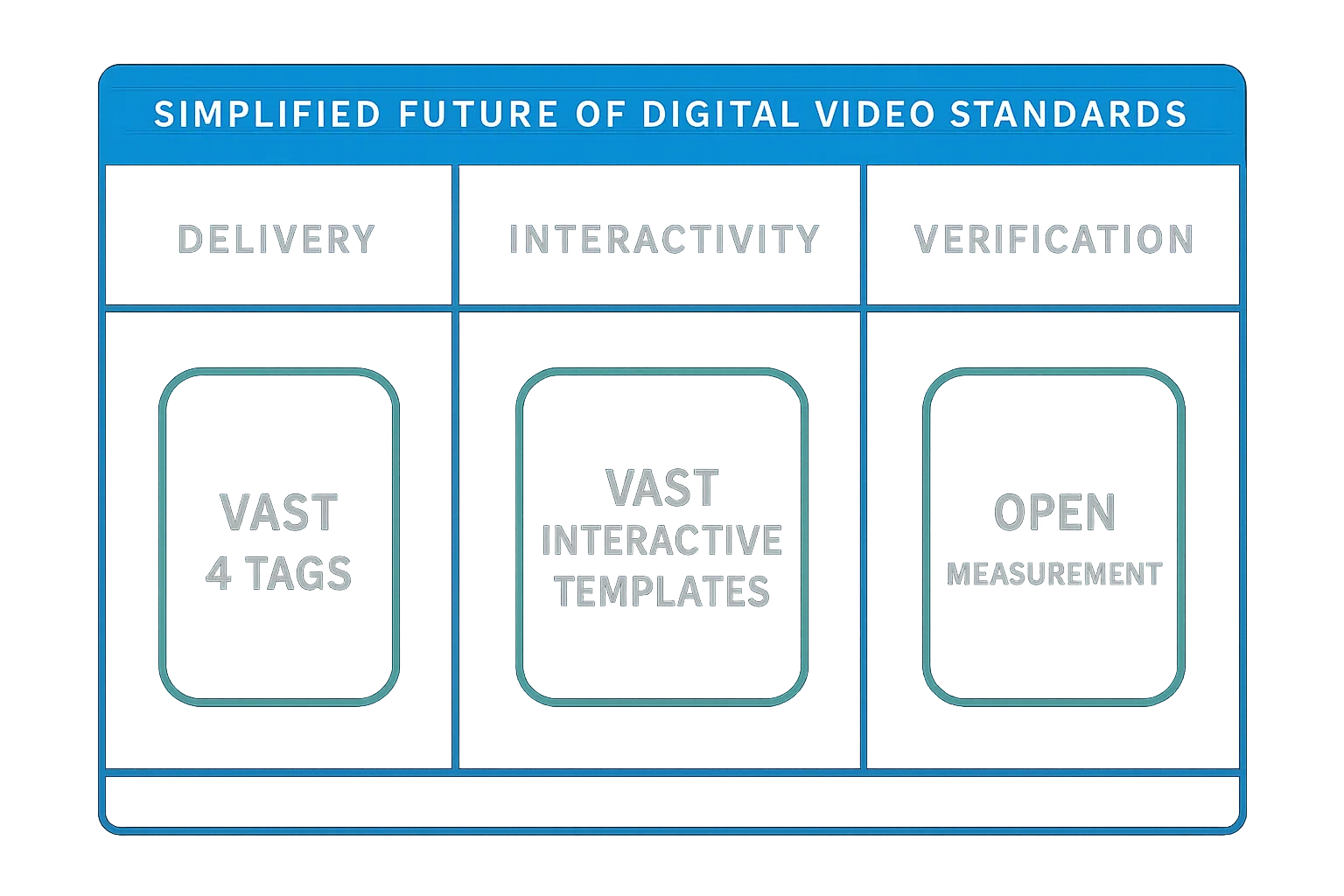
In 2017, the IAB Tech Lab announced it would retire the VPAID standard and replace it with two separate specifications:
- SIMID (Secure Interactive Media Interface Definition) — for interactive functionalities
- OMID (Open Measurement Interface Definition) — for attribution
Video Multiple Ad Playlist (VMAP)
VMAP gives video content creators control over ad break placement within their content — useful in particular for creators who don't control the actual video player. Using VMAP, content creators can define:
- The placement of ad breaks within their content
- The timing of each break
- The number of breaks available
- The number of ads permitted per break
Rich Media Ads
Rich media is an interactive form of advertising that can incorporate animated images (e.g., GIFs), audio, and video alongside elements that invite user interaction.
Unlike standard text and image ads, rich-media ads are built for engagement. Common formats include:
- Banners: Similar to standard text banners but with interactive elements.
- Expanding ads: Begin as normal banners but expand when the user clicks — in various directions (right to left, top to bottom, etc.).
- Interstitials: Ads that float on top of a page's content.
- Lightboxes: Similar to expanding ads; they expand and often occupy the full screen when a user interacts (e.g., hovers for at least two seconds) or clicks.
Rich-media ads are typically created and displayed using HTML5 or JavaScript and can utilize VAST or MRAID (Mobile Rich Media Ad Interface Definition) — another IAB Tech Lab standard.
MRAID is an API designed to display rich-media ads inside mobile apps. Because mobile apps are built with different programming languages and run on different operating systems, MRAID provides a standard framework that allows creative content to run consistently across all mobile devices and apps.
Audio Ads
Audio advertising has grown significantly alongside the rise of podcasts, music-streaming services, and digital radio. Although text, image, and video ads dominated online advertising for over a decade, audio has become a meaningful medium in its own right.
Audio ads are served using VAST 4.1 — the earlier standalone standard, DAAST (Digital Audio Ad Serving Template), has since been merged into VAST 4.1. Key audio ad formats include:
Companion/banner ads: Visual banner ads that appear on-screen while a user listens to audio content (e.g., a podcast or music stream).
Audio companion ad example from Spotify
Ad pods: Pre-roll (before content) and mid-roll (within content) audio ad placements that can contain one or more ads — analogous to the ad pods used in video advertising.

Dynamic ads: Unlike static audio spots delivering the same message to all listeners, dynamic ads are assembled in real time based on known information about the user — including their location, time of day, and even current weather conditions.

Advertising Channels
Web Advertising
Web advertising was the first channel available to brands and agencies when the Internet became commercially accessible in the late 1990s. It refers to advertisements displayed in web browsers across desktops, laptops, and mobile devices (smartphones and tablets).
Displaying ads — whether text, image, or video — in a browser involves injecting a piece of HTML or JavaScript into a page. The browser then loads and renders the ads alongside the rest of the page's content.

Mobile App Advertising
Mobile app advertising (also called in-app advertising) refers to ads displayed inside mobile apps on smartphones and tablets. Unlike web advertising on mobile, which uses a browser, mobile apps require a software development kit (SDK) to display ads.
The process works as follows: the app developer integrates a given AdTech vendor's SDK into their app, defines the ad space, and then selects the ad medium (text, image, native, or video) and format (banner, interstitial, etc.).

Social Media Advertising
Social media platforms like Facebook, LinkedIn, and Twitter technically fall within the web and mobile-app advertising categories, but they operate as distinct advertising channels with their own ecosystems, data assets, and ad formats.
Platforms including Facebook, Twitter, Pinterest, LinkedIn, and Instagram predominantly use native advertising — ads appear in and next to the news feed, making them look like organic content:

Social media advertising offers several advantages over other channels:
- Retargeting via email: Advertisers can retarget users using email addresses collected through their own CRM, often producing strong conversion rates.
- Granular targeting: Platforms like Facebook and LinkedIn collect detailed demographic and behavioural data — name, age, location, interests, education — enabling precise audience targeting.
- Cost-effectiveness: Social media advertising can be more cost-effective in terms of both reach and conversions compared to display or video channels.
- Ad-block resistance: Because social ads are predominantly native formats embedded in the feed, they tend to receive more engagement (viewable impressions, clicks, likes) than traditional banner ads and are less susceptible to ad-blocking software.
Advanced TV Advertising (OTT, Connected TV, and Addressable TV)
TV advertising has historically been a cornerstone of brand-building. The ability to reach large audiences with engaging, often entertaining content makes it effective for driving both awareness and sales. New forms of TV delivery are now opening up capabilities that traditional broadcast never offered.
The key terms in this space:
Advanced TV: A term coined by the IAB referring to any form of TV other than traditional broadcast, cable, and satellite delivery.
OTT (Over-the-Top): Devices or services used to stream digital content to a connected TV. Examples include:
- Netflix
- Hulu
- HBO GO
- Amazon Prime
- Disney+
- AppleTV+
- Roku
- ZEE5
Connected TV (CTV): Devices that connect to the Internet and enable viewers to watch video content from OTT services. Examples include smart TVs, gaming consoles, and dedicated streaming devices. Notably, the IAB Tech Lab does not classify desktop computers, laptops, smartphones, or tablets as CTV.
Addressable TV: Unlike traditional linear TV — which broadcasts the same ad to all viewers of a given program — addressable TV delivers different ads to different households watching the same program. It achieves this using data collected via Internet Protocol TV (IPTV), including connected TVs, OTT devices, and set-top boxes.
For example, a viewer in Seattle watching a particular show could see a different ad than a viewer in Portland watching the same show at the same time.
All of these formats offer targeting, attribution, and measurement capabilities unavailable in traditional TV. However, numerous technological and ecosystem barriers remain, and the industry is still working toward delivering these capabilities at scale and with high accuracy.
Other Forms of TV Advertising
Linear TV advertising: Linear TV broadcasts programs on specific channels in scheduled time slots. Viewers must tune in at the scheduled time, have no control over the ads they see, and cannot skip them. Ads are delivered without any user-level targeting.
Hybrid Broadcast Broadband TV (HbbTV): HbbTV combines broadcast TV with broadband Internet to deliver enhanced viewing experiences — additional services and content typically accessed via a connected TV (e.g., a smart TV) using the remote control. Viewers activate HbbTV applications in response to on-screen prompts, often a red dot in the corner of the screen. HbbTV can also be accessed via gaming consoles, OTT streaming devices, and set-top boxes.
HbbTV ads are delivered through special applications and multiple server connections between the HbbTV broadcaster and AdTech platforms. These applications are built using web technologies including HTML, CSS, Media Source Extensions (MSE), Encrypted Media Extensions (EME), and Timed Text Markup Language (TTML).
DOOH Advertising
Out-of-home (OOH) advertising predates the Internet. Traditionally, it encompassed billboards, street furniture (bus stops, telephone boxes), and transit placements (taxis, buses, subway walls).
DOOH on bus displays
Source: JCDecaux
DOOH on trams
Source: JCDecaux
Digital advances in OOH displays — digital screens, Internet connectivity, and sensors — have given rise to digital out-of-home (DOOH) advertising, which enables new creative formats and interaction models that static OOH never could.
While DOOH is one of the more exciting frontiers in digital advertising, it still faces real hurdles around media buying, attribution, measurement, and targeting. These challenges also represent clear opportunities for AdTech companies to build infrastructure and tooling in an underserved space.
Search Advertising
When users search for a product or service on Google, Bing, or DuckDuckGo, search engines display a mix of organic and sponsored results, with clear labelling to distinguish the two.

Sponsored ads appear when a user's search keywords match the terms an advertiser has bid on. This intent-based targeting — matching ads to an explicit query rather than inferring user interest from behaviour — makes search advertising particularly effective. The combination of explicit intent and native-style presentation produces higher click-through and conversion rates than banner advertising.
Who Offers Search Ads?
Search Engines
Most search engines operate self-serve ad platforms: Google via AdWords, Bing via Bing Ads, and so on. The global search market is heavily concentrated, with approximate market share distributed as follows:
- Google (~77%)
- Baidu (~9%)
- Microsoft Bing (~8%)
- Yahoo! (~3%)
- Yandex (~1%)
Publishers
Beyond traditional search engines, many publishers — particularly e-commerce platforms — offer their own on-site search with advertising placements, often in the form of promoted listings.
Promoted search results on Amazon
These on-site search capabilities serve a dual purpose: they improve product discoverability for users and create an additional revenue stream for the publisher. For the merchant (advertiser), placement within relevant on-site search results directly supports sales — a mutually beneficial arrangement.
With the main mediums and channels mapped out, the logical next step is understanding how these ads are actually served and displayed to users — which involves the ad delivery infrastructure, protocols, and platforms that sit behind every impression.