Attribution: Models, Methods, and Cross-Device Measurement
Identifying users across online channels, across online and offline channels, and across multiple devices is a foundational capability in digital advertising. It allows advertisers to understand how their audience interacts with their brand throughout a customer journey — and, more importantly, to attribute conversions and goals to specific touchpoints.
What Is Attribution?
Attribution is the process of identifying which touchpoints a consumer interacted with, or was exposed to, during a period of time before completing a goal set by an advertiser or marketer. By understanding which touchpoints are contributing to conversions and which are not, advertisers and marketers can make more informed decisions about campaign optimization.
Attribution has always been part of advertising and marketing, even before the Internet. What modern data and technology have added is the ability to measure it with far greater accuracy.
What Is a Customer Journey?
A customer (or user) journey is the path a person takes from the moment they first become aware of a brand to the point at which they complete a defined goal — for example, making a purchase or downloading an app.
Everyone's customer journey is different, but understanding the stages of that journey, and the interactions a person has along the way, helps advertisers and marketers grasp how those interactions influence the decision to convert.
Each interaction a person has with a brand during their customer journey is known as a touchpoint.
What Is a Touchpoint?
A touchpoint is an interaction a user has with a brand across different channels. Importantly, a user doesn't have to actively click or engage for something to count as a touchpoint. For example, a user who sees a display ad but doesn't click on it has still experienced a touchpoint.
Examples of touchpoints include:
- Website visits
- Product views
- Reviews
- Blog posts
- Ebooks and whitepapers
- Digital ads
- Social media content
- Videos
- Emails
- Store visits
In many cases, these touchpoints influence a person's perception of a brand. Advertisers and marketers typically tailor messaging across different touchpoints depending on where in the customer journey a person is — awareness, consideration, or purchase.
For example, display ads might introduce a product to new audiences, while retargeting campaigns on Facebook might bring back people who have already visited a website and nudge them toward a purchase.
Online-to-Online Attribution Models
Online-to-online attribution identifies which touchpoints a user experienced before completing a goal across different online channels. Because most online ad campaigns aim to drive users to a website, advertisers typically review attribution reports provided by web analytics tools, MarTech platforms (such as marketing automation and attribution software), and AdTech platforms like ad servers.
There are two main types of online-to-online attribution: inter-channel and intra-channel.
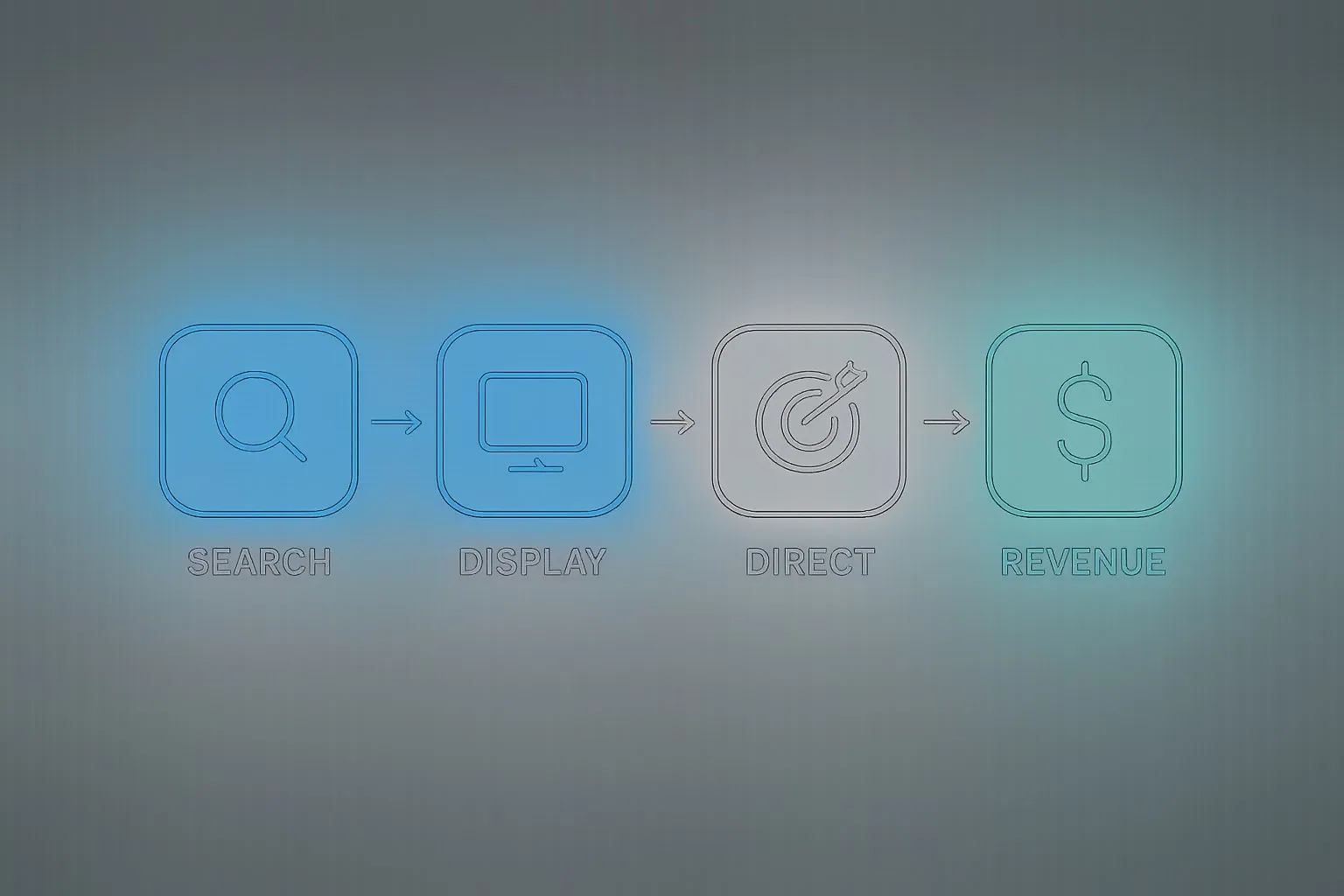
Inter-channel attribution looks at touchpoints across different channels.
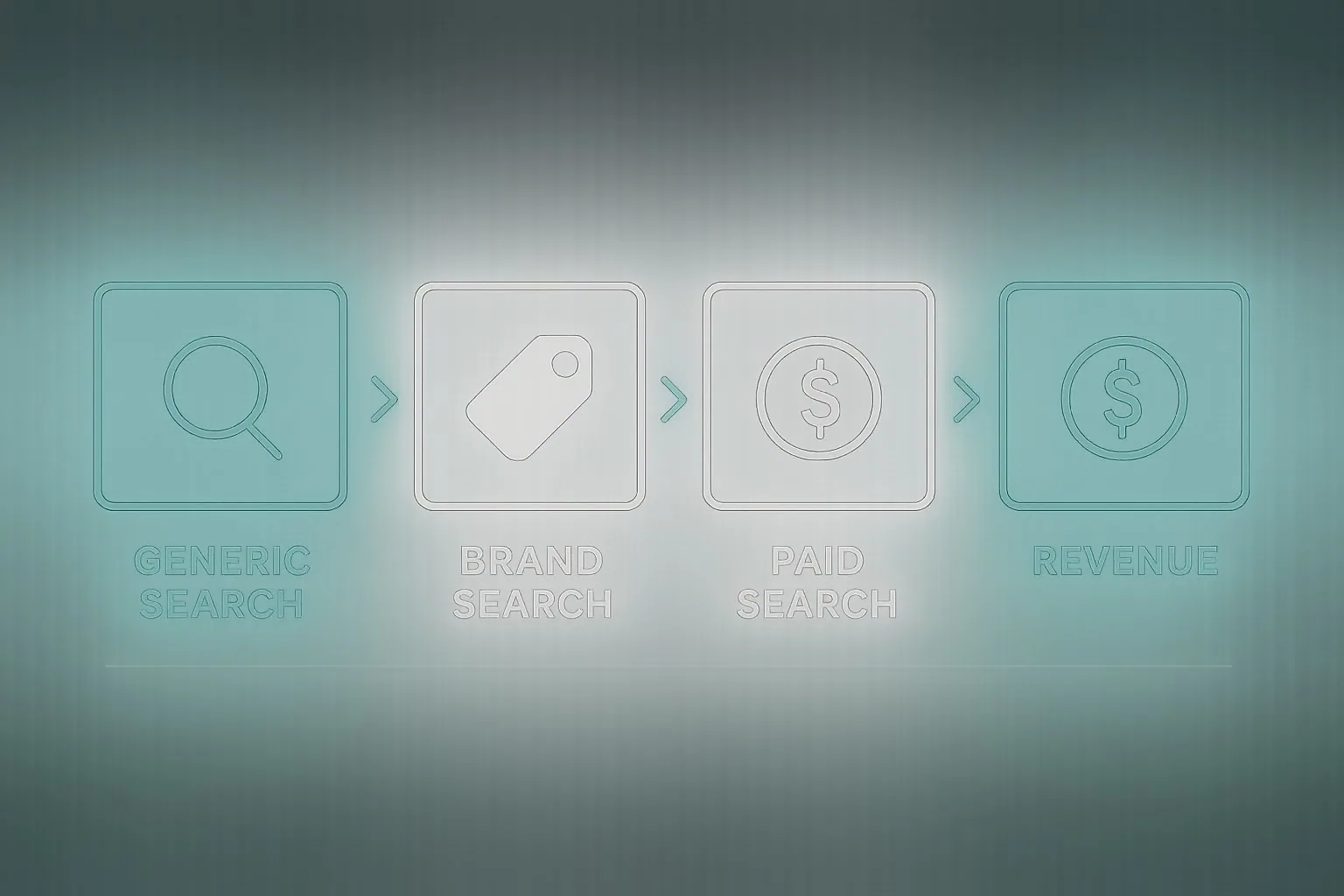
Intra-channel attribution looks at touchpoints within the same channel.
How Online Attribution Works
The simplest way to detect which online channels and interactions a user had in their customer journey is to use the Referrer field in the HTTP protocol, which is passed with every request from a browser to a web server.
Here's an example of a standard HTTP GET request:
GET / HTTP/1.1
Host: example-advertiser.com
DNT: 1
Accept-Language: en-us
Accept-Encoding: gzip, deflate
Referrer: http://publisher1.com/article-about-adtech.html
User-Agent: Mozilla/5.0 (Macintosh; Intel Mac OS X 10_12_6) AppleWebKit/603.3.8 (KHTML, like Gecko) Version/10.1.2 Safari/603.3.8
In this example, a user was reading an article on publisher1.com, then clicked on a link or ad and was directed to the advertiser's website. The Referrer field captures that origin.
Web analytics tools and AdTech/MarTech platforms typically classify referrers into the following categories:
Direct
When a visit is marked as "direct," it means the referrer information is unknown. This can happen for several reasons:
- The user typed the URL directly into their browser's address bar or accessed it from bookmarks.
- The user arrived from a subdomain (e.g. clicking from publisher1.com to blog.publisher1.com).
- The user clicked a link or ad in a native mobile app that didn't include UTM parameters in the URL.
- Technical issues caused referrer loss — most notably, clicking from a secure (https://) website to an unsecure (http://) website.
The table below shows when referrer information is passed or lost depending on the protocol combination:
| HTTP Protocol | Referrer passed or lost? |
|---|---|
| https:// to http:// | Referrer lost |
| http:// to https:// | Referrer passed |
| http:// to http:// | Referrer passed |
| https:// to https:// | Referrer passed |
Since most websites now use https://, the https-to-http referrer loss scenario is less of a practical concern than it once was.
Organic
Organic traffic comes from search engines such as Google Search, Bing, and DuckDuckGo. If an advertiser is also running paid search ads, those would be recorded separately under "campaign" (see below).
Social
Visits originating from social media platforms such as Facebook, LinkedIn, Twitter, and YouTube are classified as "social."
Website
When a user clicks a link from another website and arrives at the advertiser's site, the visit is classified as a "website" referrer — as in the HTTP example above.
Campaign
The "campaign" referrer is recorded when the destination URL contains UTM parameters. In this case, the Referrer field is ignored in favour of the UTM parameters, which define the traffic source.
Some platforms record this simply as "Campaign," while others will label it more specifically as "Paid social" or "Paid search," depending on the UTM values.
For example, a click on a LinkedIn ad directed to a URL with the following parameters:
?utm_source=linkedin&utm_medium=ad&utm_campaign=linkedin-ad
...could be recorded as "Campaign" or "Paid social."
Similarly, a click on a Google paid search ad directed to a URL with:
?utm_source=google&utm_medium=ad&utm_campaign=paid-search-ad
...could be recorded as "Campaign" or "Paid search."
Every time a user arrives from a different channel, a new session begins and the referrer is recorded, gradually building a picture of that user's journey.
Online Attribution Models
With an understanding of how channels are detected, the following are the main attribution models used to assign conversion credit across those channels.
1. The Last-Click Attribution Model
The last-click (also called last interaction or last touchpoint) attribution model is the oldest model in common use, and remains the default in many web analytics, MarTech, and AdTech platforms.
This model assigns 100% of a conversion to the last known referral, click, or traffic source. If the final action before a conversion was a direct entry, then 100% of the credit goes to that direct entry.
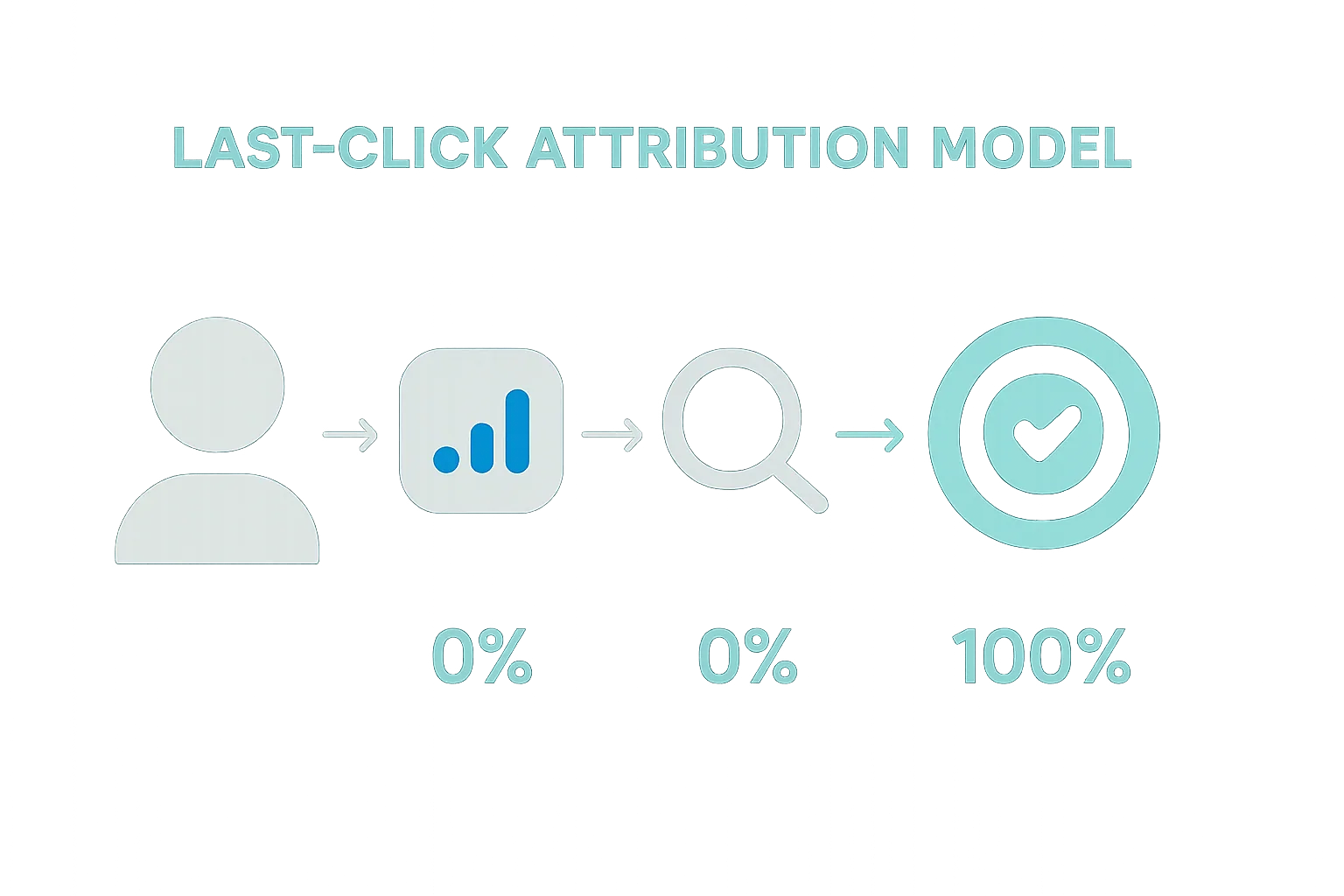
While simple to implement, the last-click model ignores every other touchpoint in the customer journey. This can lead to poor channel optimization decisions, since it gives no credit to earlier interactions that may have played a significant role in driving the conversion.
2. The Last Non-Direct Attribution Model
The last non-direct attribution model operates similarly to last-click, but removes direct visits from the equation.
With this model, 100% of a conversion is attributed to the last known referral that was not a direct visit.
For example:
- A user clicks a Facebook link and visits a website.
- They browse but leave without converting.
- They later type the website URL directly into their browser and download an ebook.
Because the third step is a direct visit, this model ignores it and assigns 100% of the conversion credit to Facebook.
Last click model
This is an improvement over pure last-click attribution, but it still overlooks other touchpoints in the journey and can lead to suboptimal decisions.
3. The First-Click Attribution Model
The first-click (also called first interaction or first touch) attribution model assigns 100% of a conversion to the very first click or referrer in the customer journey.
last click and last non-direct attribution model
This model suffers from the same fundamental drawbacks as the last-click and last non-direct models — it credits only one touchpoint and ignores the rest.
4. The Linear Attribution Model
The linear attribution model distributes conversion credit evenly across all touchpoints in a customer journey.
Model valuing each conversion equally
While it rarely reflects the true influence of individual touchpoints — since not all interactions are equally impactful — the linear model is useful for getting an overview of which channels appeared in the conversion path.
5. The Time-Decay Attribution Model
The time-decay attribution model is a refinement of the linear approach. Rather than distributing credit equally, it assigns more credit to touchpoints that occurred closer in time to the conversion. The further a touchpoint is from the conversion event, the more its credit "decays."
This model captures the full picture of the customer journey while weighting recent interactions more heavily than earlier ones.
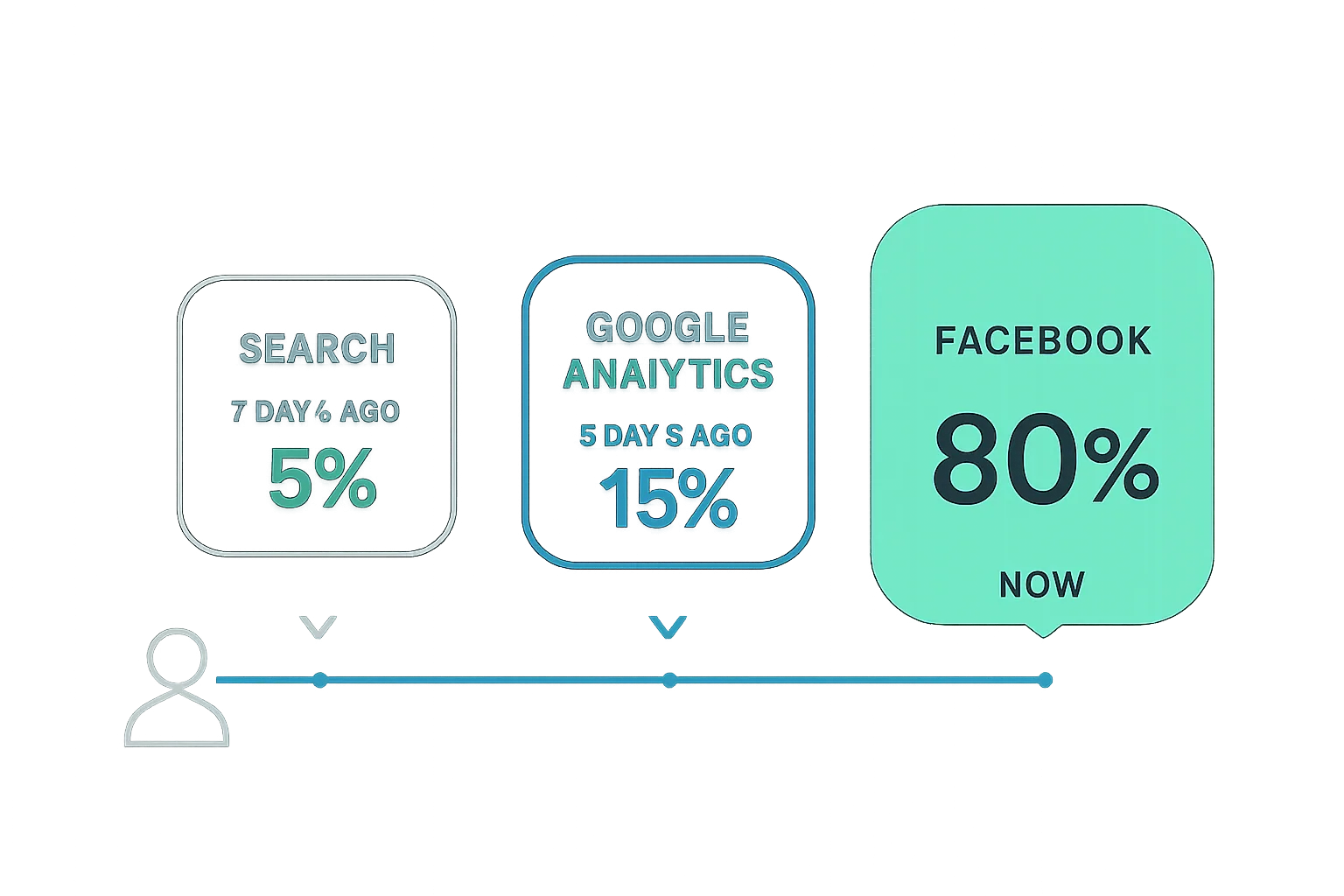
The assumption underlying this model is that the most recent touchpoints were the most influential in driving the conversion — which may or may not reflect reality for any given campaign.
6. The Position-Based Attribution Model
The position-based attribution model (sometimes called the U-shaped model) assigns credit to all touchpoints in the conversion path, but weights the first and last interactions more heavily. The remaining credit is distributed among the middle touchpoints.
Good choice_customer journey overview
This approach is often considered a practical balance: it acknowledges the full journey while giving extra weight to the touchpoint that created initial awareness and the one that drove the final conversion.
7. The Custom Attribution Model
Some AdTech and MarTech platforms allow advertisers to define their own rules for attributing credit to touchpoints. This flexibility lets advertisers account for the specifics of their campaigns, their customers, and the typical shape of their customer journeys.
Custom models are particularly valuable when a brand's conversion path consistently deviates from the patterns that standard models assume.
It's worth noting that all of the above online attribution models are scoped to a single device and web browser. To attribute conversions across different devices and browsers, cross-device attribution methods are required.
Cross-Device Attribution
Cross-device attribution aims to record a user's interactions with a brand across multiple touchpoints and devices, and to attribute conversions accordingly. Where standard online attribution models focus on channels, cross-device attribution extends the scope to cover different web browsers and devices as well.
Here's an example of how a cross-device attribution scenario might look:
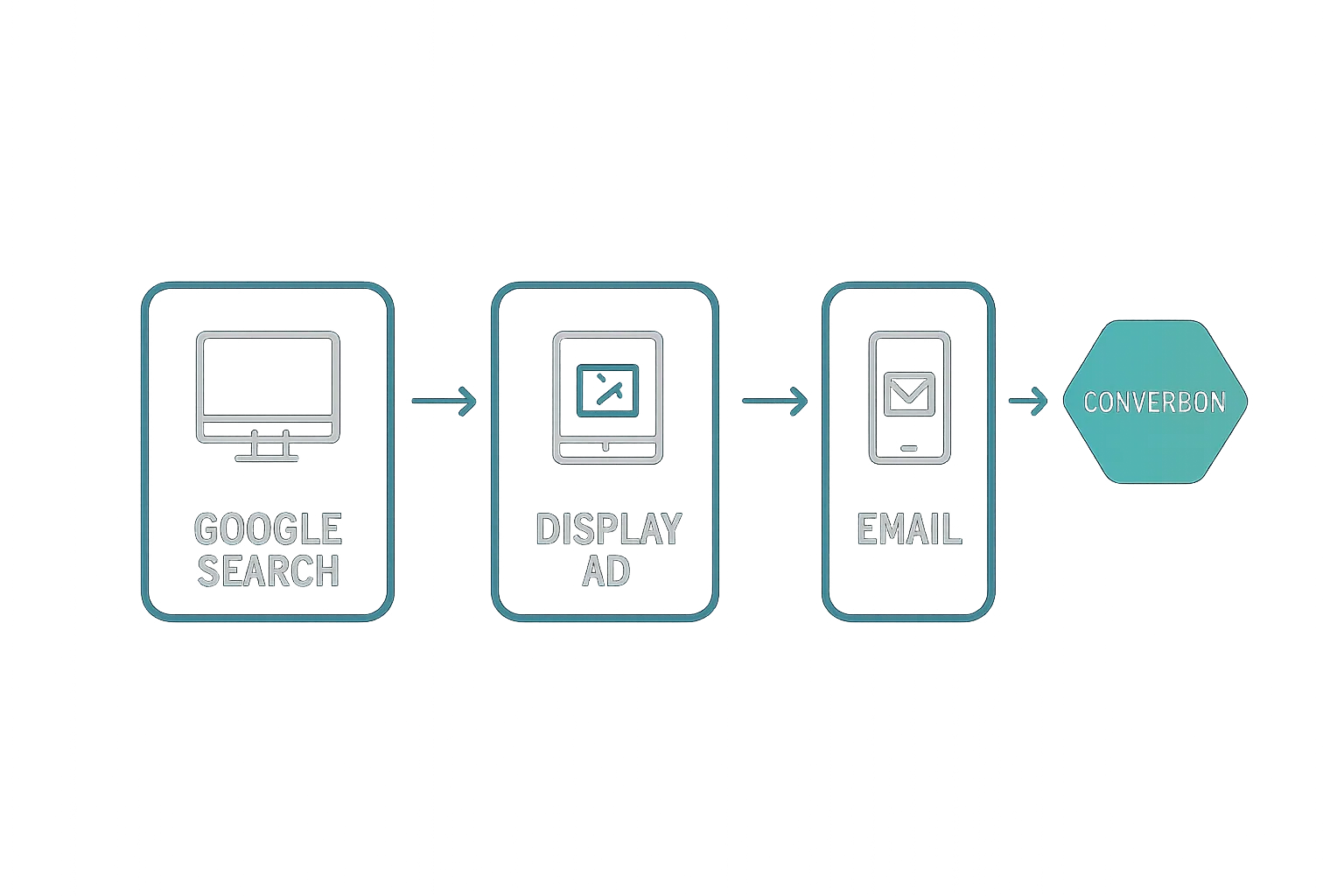
How Cross-Device Attribution Works
To attribute conversions across different online channels, AdTech and MarTech companies typically rely on cookies — most commonly third-party cookies. However, because cookies are tied to a specific device and browser, they cannot be shared across devices. This makes cookies insufficient on their own for cross-device attribution.
To bridge that gap, measurement companies use deterministic matching, probabilistic matching, or a combination of both.
Deterministic matching uses common identifiers — such as email addresses and phone numbers — to identify and match users across different devices. Because these identifiers are highly specific, the matches tend to be accurate.
Probabilistic matching uses less unique data points — such as IP addresses and location data — combined with algorithms and statistical modelling to infer that different devices belong to the same user. The matches are less precise than deterministic matching but allow for broader coverage.
To apply these methods, AdTech and MarTech companies build user profiles that aggregate these data points over time.
Deterministic matching for cross-device attribution:
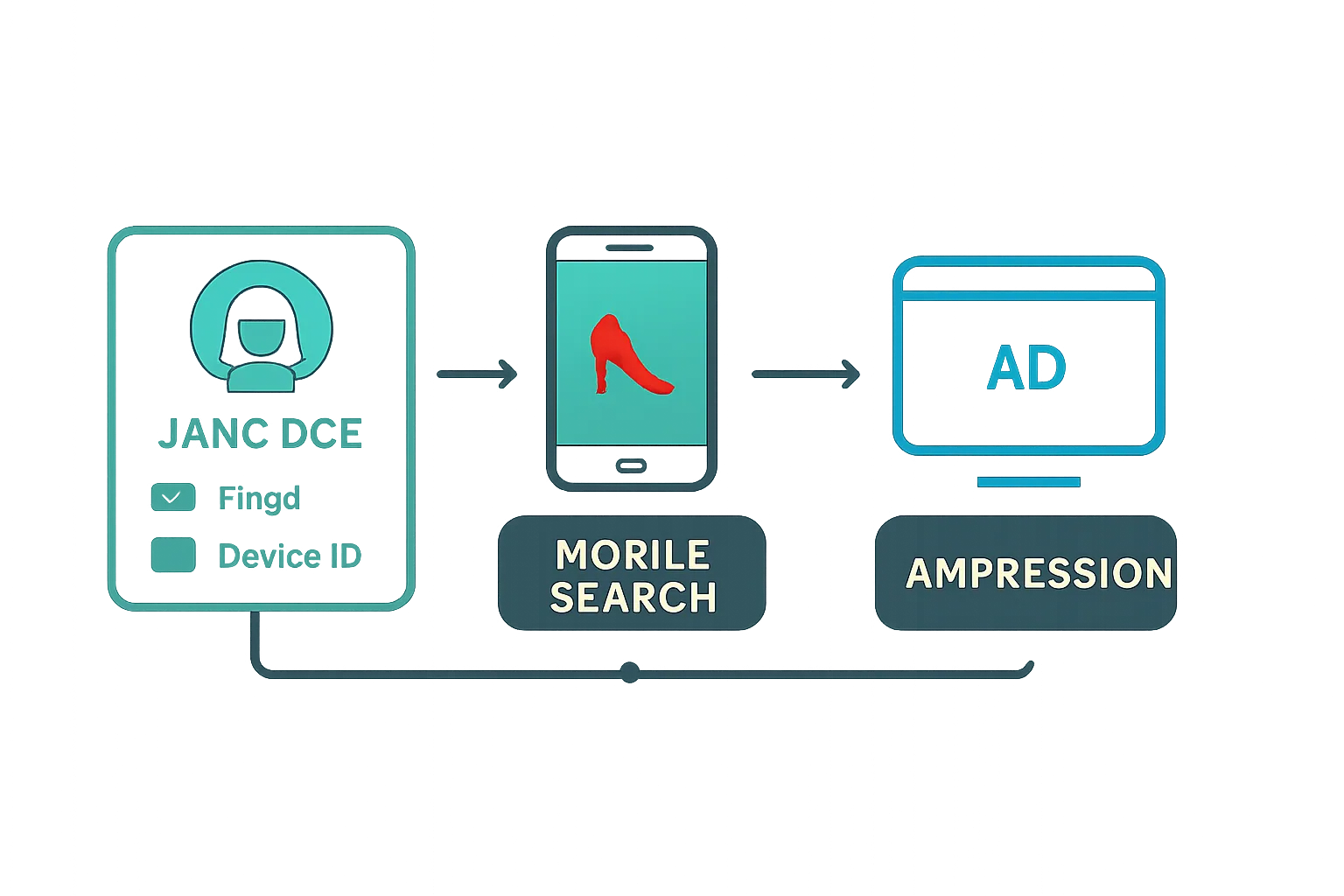
Probabilistic matching for cross-device attribution:

The actual attribution process is largely similar for both approaches. The key difference lies in the data used to identify the user in the first place.
For walled gardens like Google and Facebook, deterministic cross-device attribution is considerably easier than it is for independent AdTech companies. These platforms collect email addresses and names at registration, and users frequently sign into their accounts across multiple devices — generating a natural, high-confidence cross-device identity signal.
Independent AdTech companies — such as DSPs — typically need to rely on third-party services to achieve cross-device attribution. Platforms like LiveRamp or cross-device measurement services like Tapad collect user data from various online and offline sources, build user profiles, and generate what is commonly referred to as an identity graph, ID graph, or device graph. Brands, agencies, and tech companies then use these graphs for identification, ad targeting, and attribution.
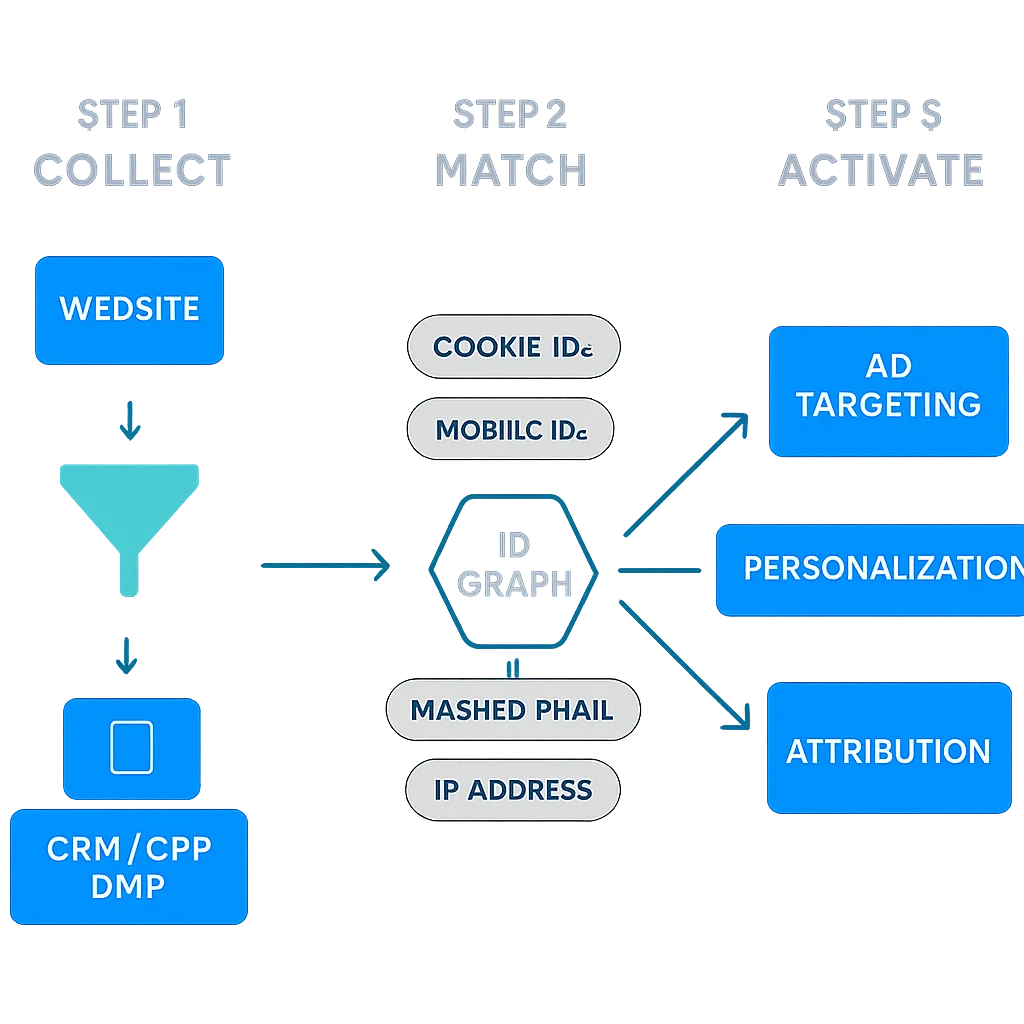
An illustration of how ID graphs work.
Offline-to-Online Attribution
Despite the continued shift of advertising budgets online, the need to connect offline ad exposure to online behaviour remains real. Advertisers running billboards, TV spots, or radio campaigns need ways to understand whether that offline exposure is driving online visits or conversions.
Common offline channels that require this kind of attribution include:
- Direct mail
- Out-of-home (OOH) and digital out-of-home (DOOH) advertising
- Telemarketing
- TV
- Radio
The following are the most widely used methods for connecting offline ad exposure to online outcomes.
Vanity URLs
Vanity URLs are custom domain names created specifically for an advertising campaign. They are designed to be memorable, on-brand, and shorter than the full destination URL. They appear frequently in OOH, TV, and radio advertising.
For example, rather than directing audiences to:
company1.com/new-product?utm_source=ooh&utm_medium=billboard-airport&utm_campaign=new-product
...an advertiser might use a vanity URL like newproduct.com.
The vanity URL can take the user to a dedicated landing page or redirect to another page, appending campaign tracking parameters in the process. There are three common formats:
- Standalone vanity URLs, e.g. newproduct.com
- Subpage vanity URLs, e.g. company1.com/newproduct
- Shortened vanity URLs, e.g. sv.ly/newproduct
Vanity URLs provide a reasonable proxy for measuring the reach and impact of offline campaigns. However, they are not perfectly accurate: a user who sees a billboard may later search for the product on Google rather than typing in the vanity URL. Any resulting conversion would be attributed to Google Search rather than the offline ad. Despite this limitation, vanity URLs remain a practical and valuable measurement tool for offline campaigns.
Time-Limited Attribution Windows
Another approach to measuring offline ad exposure is the time-limited attribution window. This method examines web traffic and conversions during a defined window of time — say, 30 minutes — following the broadcast of a TV or radio advertisement, and looks for statistically notable spikes.
When applying this model, advertisers need to work through several questions:
- How long should the attribution window be? Does it make more sense to look at 30 minutes of traffic after the ad aired, or longer?
- How can traffic and conversions that were influenced by the campaign be separated from baseline activity?
- How can the influence of other concurrent campaigns be isolated?
Most AdTech and MarTech platforms include some form of attribution window measurement in their reporting, but it is often limited to a single channel such as display. Measuring offline exposure against online traffic typically requires manual configuration in an analytics tool or a dedicated attribution platform.
Online Surveys
A more direct approach is simply to ask users how they found the website. While this may seem rudimentary, survey data can surface insights that algorithmic attribution models miss.
Surveys can be deployed at several points in the user experience:
- On the purchase or sign-up confirmation page.
- As a discreet sidebar prompt while a user is browsing (potentially with an incentive like a coupon code).
- As an exit-intent pop-up when a user is leaving the site.
Confirmation survey page
Not every user will complete a survey, and some may select answers at random. Even so, the aggregated results provide a useful reference point when compared against attribution and traffic source data.
Coupons
Coupons have been a staple of offline marketing for decades, and they remain one of the more reliable methods for attributing conversions to specific offline channels — often with better accuracy than model-based approaches.
They work particularly well with direct mail and printed advertising materials. Issuing unique coupon codes per campaign — and where feasible, per individual recipient — improves attribution precision considerably.
Zip/Postal Codes
Collecting postal codes from online customers can support attribution for offline campaigns such as direct mail and OOH advertising. If a significant concentration of conversions originates from a postal code that was heavily targeted by an offline campaign, that correlation can serve as a soft signal.
This method is inherently imprecise — it cannot confirm that a specific individual was influenced by the campaign — but it can add context when used alongside other attribution methods. It is most applicable to e-commerce businesses or retailers with both physical and online stores, since postal codes are naturally collected during checkout.
Online-to-Offline Attribution
Attribution also runs in the other direction: connecting online ad activity — such as ad views and clicks — to purchases that happen in a physical store.
Beacons
Beacons are Bluetooth-enabled devices that transmit signals to and from nearby mobile devices such as smartphones and tablets. When placed in brick-and-mortar stores, they can send push notifications to devices within a certain radius and collect device-level data. This data can then be used to link online ad activity — such as mobile app engagement or ad clicks — to in-store visits and purchases.
Zip/Postal Codes at Point of Sale
Just as postal codes can be used to connect offline ads to online conversions, the process works in reverse as well. Collecting postal codes at the point of sale allows advertisers to cross-reference in-store customer locations with the geo-targeting parameters of online campaigns.
As with the offline version of this approach, accuracy is limited. It is best treated as a supplementary signal rather than a standalone attribution method.
The Multi-Device Consumer Journey and the Measurement Challenges It Creates
In the early years of online advertising, the customer journey typically unfolded on a single device — predominantly a desktop or laptop computer.
Today's consumers use a broad range of Internet-enabled devices, moving fluidly between discovering products on social media via a laptop, searching for deals on a tablet, and reading emails on a smartphone.

Global device usage between mobile devices (e.g. smartphones), desktops/laptops, and tablets.
Source: StatCounter GlobalStats
This multi-device behaviour has given rise to the cross-device customer journey. When combined with the overlap between online and offline advertising activity, it becomes clear why complete attribution remains one of the harder problems in digital advertising.
Attribution tools, analytics platforms, and data platforms like DMPs and CDPs can help advertisers connect impressions and clicks to conversions across channels and devices. However, the growing number of privacy changes in web browsers and mobile operating systems is making it progressively harder to collect the data these attribution methods depend on.
Attribution is a critical component of improving campaign effectiveness. Getting it right — or at least getting it materially better — requires understanding both the models available and the underlying mechanisms by which user identity and behaviour are tracked across an increasingly fragmented digital landscape.