5 Things to Know When Building Your MVP
Once a plan and high-fidelity prototype are in place, MVP development is the next — and most demanding — phase. It requires the design team and developers to synchronize and begin the critical crossover from design to working software.
The development side of an MVP is the longest and most resource-intensive phase of the entire process. Even though the road to launching an MVP may seem shorter and more straightforward than a full software project, there are several areas where things can go wrong. The five considerations below cover the most common pitfalls and how to approach them.
1. Feature Selection
Selecting the right features for an MVP is harder than it sounds. The temptation is always to include more, but the only features worth including are those that directly serve the MVP's core objectives: validating ideas, testing assumptions, gathering user feedback, and demonstrating potential to investors.
Feature selection works best as a collaborative process between the product owner and the development team. By developing a shared understanding of the end users, the application's goals, and the broader product vision, designers and developers can identify which features are truly essential. Experienced developers can also combine smaller features into a single, more efficient feature that achieves the same outcome — reducing both development time and cost.
A practical exercise is to list each proposed feature alongside its expected benefit and estimated development time. This gives stakeholders a transparent view of the trade-offs and makes it easier to prioritize features that deliver the required outcomes in the shortest time possible.
2. The Right and Wrong Way to Build an MVP
There is a well-known illustration in the software-development community that captures the MVP mindset clearly:

The principle is straightforward: an MVP should deliver the most complete user experience possible from the minimum set of essential features. The goal is to ship a working product that allows users to accomplish their goals as quickly as possible — and then to improve on that with every subsequent release.
In the image above, the skateboard (representing the first release) allows the user to complete their goal, whereas a lone wheel does not. Starting with the skateboard gives users a viable, working product, generates real feedback, and creates a foundation to build upon. Each release then offers a meaningfully better solution than the last.
3. Adopt Agile
Agile is a software-development methodology that has steadily displaced traditional approaches because of the tangible results it delivers for both development teams and clients. It encompasses a range of specific methods and practices:
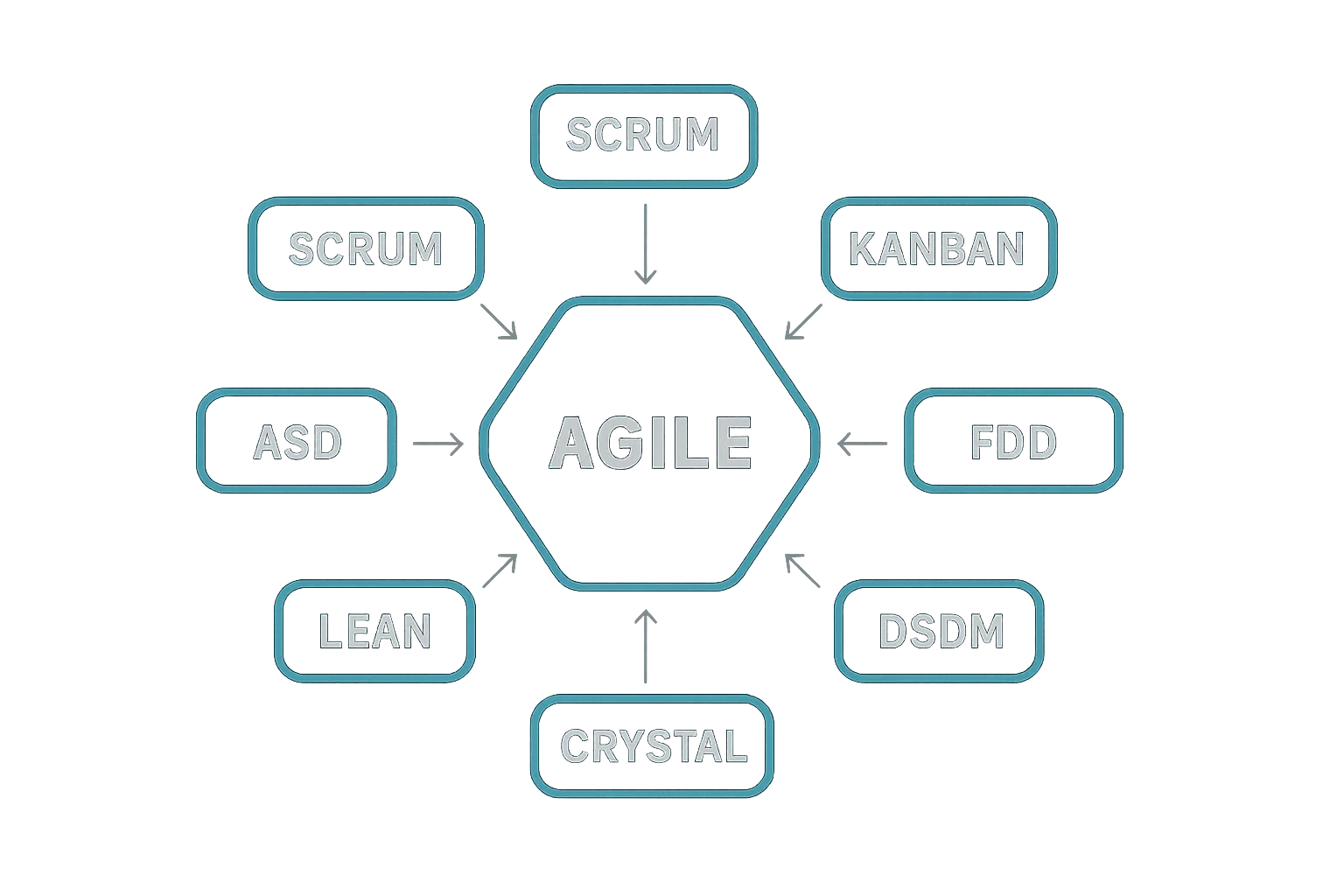
Since its introduction to software development in the early 1990s, Agile has become the project-management method of choice for results-focused development teams. While some teams still follow the traditional Waterfall approach, project success-rate data tells a clear story:
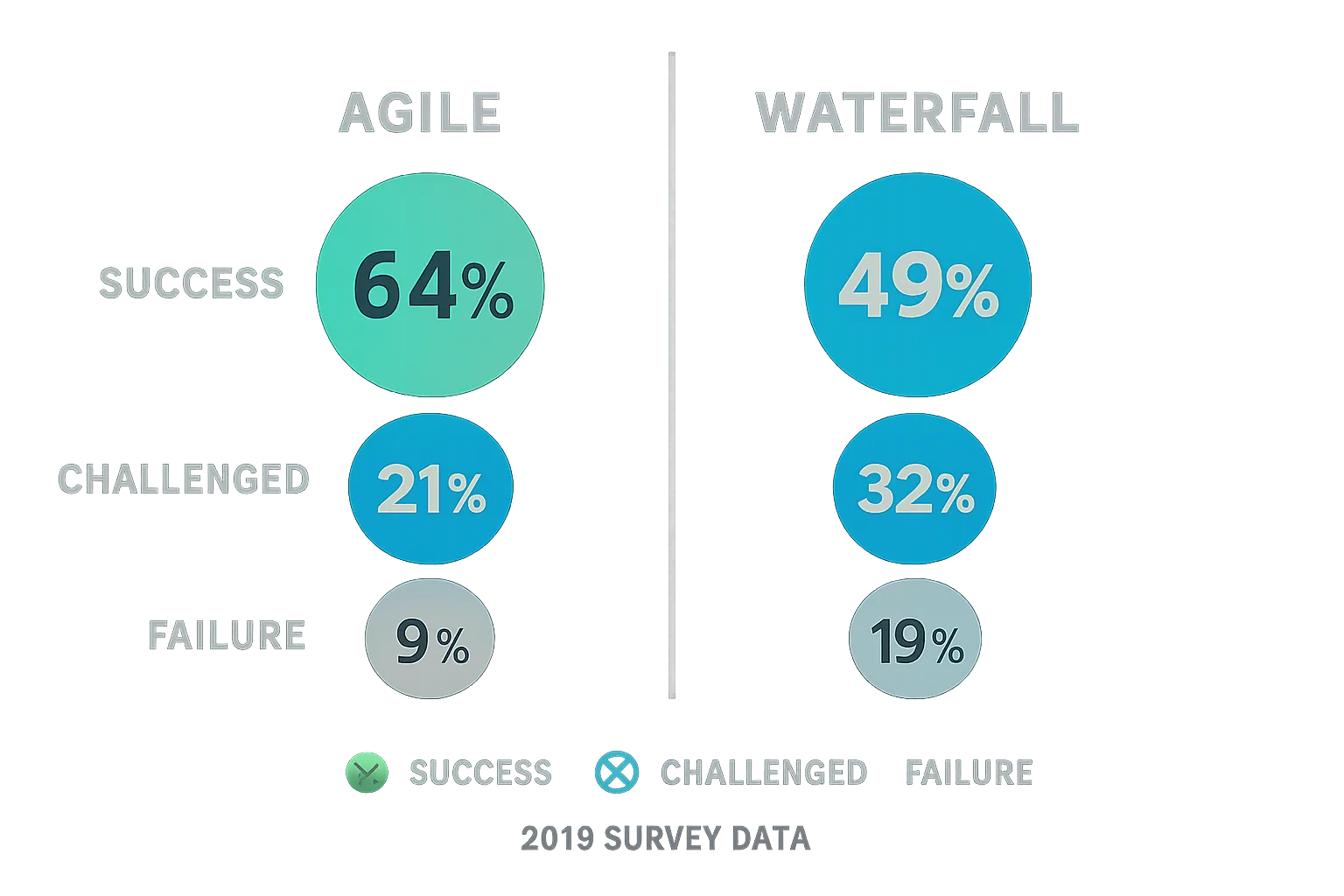
Beyond the higher success rate, Agile delivers several specific advantages for MVP projects:
Quicker MVP release: Change and redirection are common in any software project, and MVPs are no exception. Agile treats change as an expected part of the process rather than a disruption, making it far easier to manage mid-project redirects without derailing the timeline.
Higher-quality product: Because Agile is a progressive, iterative method, bugs and issues can be identified and resolved as they appear rather than accumulating until a late testing phase. Obstacles can be worked around more readily, and new opportunities to improve the application can be incorporated as they are discovered.
Clearer communication and greater transparency: Agile actively encourages client involvement and feedback from the very start of the project. Open communication channels mean the client remains engaged throughout, is able to contribute ideas, and can provide directional input at every stage — rather than simply reviewing a finished product at the end.
4. Application Testing
Testing is frequently treated as an optional extra in MVP development — especially given that MVP timelines are typically three to four months, which creates pressure to cut anything that feels non-essential. That framing is a mistake. Application testing needs to be considered part of the development process itself, not a separate task bolted on at the end. The quality of an application is only as good as its ability to pass tests.
In Agile, testing is a continuous process that runs throughout the entire application lifecycle — from the moment the first lines of code are written, through the main development phase, and right through to the introduction of new features and functionality. This approach to continuous testing results in faster MVP development overall and fewer bugs at launch.
5. Hourly Rate vs. Fixed Bid
Billing models may not seem like a core development concern, but they have a significant influence on how a project actually unfolds and, ultimately, on the outcome of the MVP.
Hourly-rate and fixed-bid models map closely to Agile and Waterfall respectively — which means they carry many of the same trade-offs. The hourly-rate model offers several advantages that are particularly relevant to MVP development:
A better developer-client relationship: Clients can see exactly where their budget is going and have transparent visibility into project progress. Rather than working at cross-purposes — as happens in fixed-bid arrangements, where developers are incentivized to build as quickly as possible while clients push for maximum scope — the hourly model aligns both parties toward a common goal.
Ability to change direction: Because work is billed on time actually spent, the team can adapt the project's direction when circumstances change or when a better path is discovered. This flexibility is difficult or impossible to achieve under a fixed-bid contract.
Faster development start: Developers working on an hourly basis do not need to spend extensive time upfront planning out every detail to mitigate financial risk. This means work can begin earlier, working features can be delivered sooner, and client feedback can start shaping the remainder of the project at an earlier stage.
Approaching MVP development with a clear feature-selection process, an Agile workflow, continuous testing, and an aligned billing model significantly improves the odds of shipping something users can genuinely engage with. The goal at each stage is to keep decisions grounded in the MVP's actual objectives — not the eventual full-product vision — and to treat every release as an opportunity to learn and improve.