What Is a Customer Data Platform (CDP) and How Does It Work?
In the early days of online marketing, marketers operated with remarkably limited information about their customers. Targeting options were minimal, and online advertising was closer to guesswork than science.
The situation today looks entirely different. Data is abundant — the challenge has shifted from finding information to organizing it effectively. Customer signals now flow in from dozens of channels and systems, and the real problem is knowing how to bring it all together in a way that actually improves marketing outcomes.
Centralizing all that data is the key. While the information exists, it tends to be scattered across multiple silos — databases, platforms, and systems that each store a piece of the customer picture but rarely communicate with one another.
Constructing a reliable image of any given customer requires access to first-, second-, and third-party data. In practice, that means pulling together large amounts of historical behavioural information from numerous sources and stitching it into the most complete profile possible.

What Is a Customer Data Platform (CDP)?
A customer data platform (CDP) is a platform used by marketers to collect all available data about customers and aggregate it into a single database — one that is integrated with, and easily accessible from, the various other marketing systems and platforms an organization uses.
Data a CDP Can Aggregate
- Transactional data about past purchases
- Browsing history
- Demographic data
- Behavioural data
- Event data (clicks, file downloads, etc.)
- Product usage data
- Partner and third-party data (optional)
Although CDPs frequently appear in conversations about advertising, their application extends well beyond marketing. Customer support teams, business intelligence functions, and operations groups all benefit from the same centralized view. The goal is to aggregate data sources — both online and offline — and compile them into a single customer view (SCV): one unified representation of each customer, held in a single place.
CDP technology sits at the core of campaign automation and customer journey management, segmentation and data analysis, online advertising and marketing solutions, and real-time personalization.
How Does a Customer Data Platform Work?
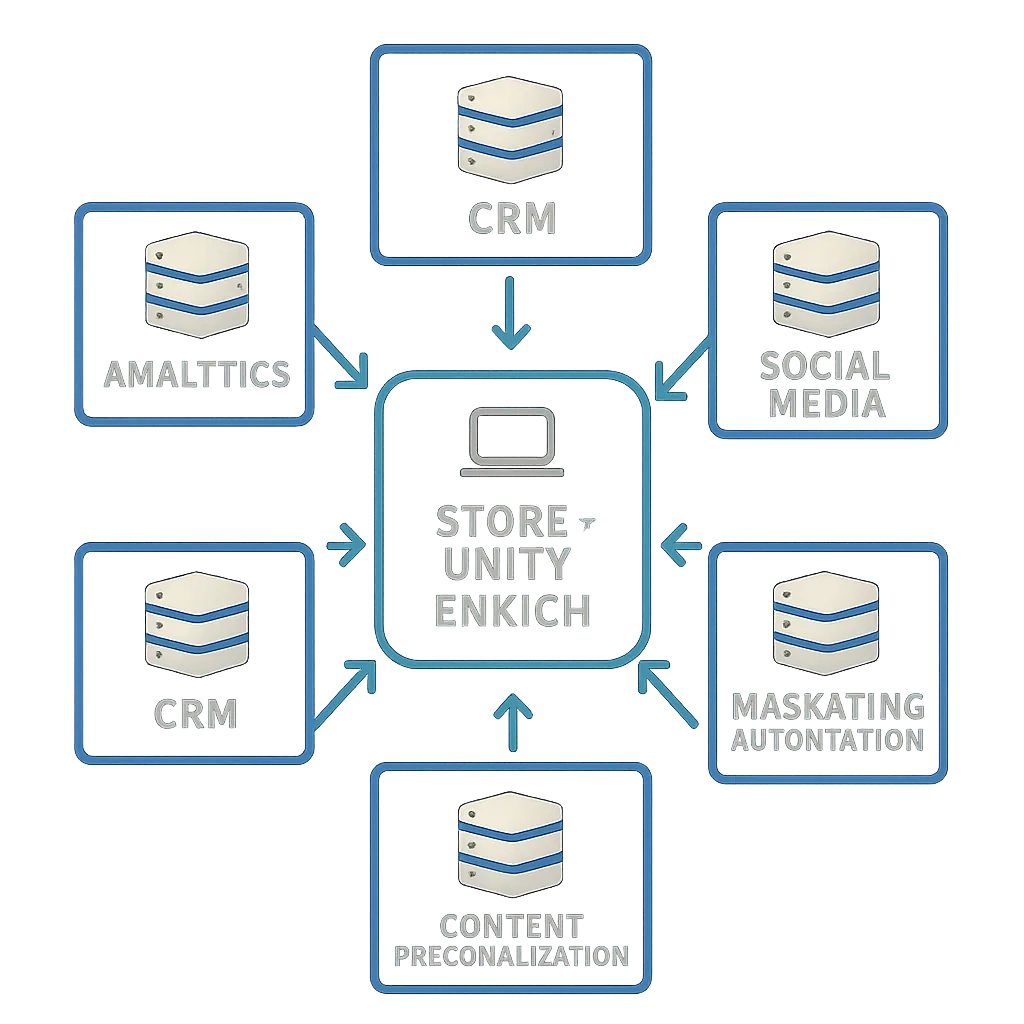
The primary role of a CDP is to collect large volumes of customer data, build a detailed profile for each individual, and enable effective, personalized communication across every channel that matters.
Why does gathering so much information matter? Because the more thoroughly a company understands its best customers, the easier it becomes to implement lookalike modeling — identifying similar prospects to target with marketing. That matching process, in turn, relies on both deterministic and probabilistic algorithms to resolve identities across different data sources.
The image below illustrates the role of a customer data platform:
What's the Difference Between a CDP, CRM, and DMP?
Customer data platforms can look similar to CRMs and DMPs at first glance — all three collect and store data about customers. The differences, however, are meaningful and worth understanding clearly.
CDPs
CDPs are the newest of the three platform types. They primarily use first-party data and are grounded in real consumer identities — that is, personally identifiable information (PII). Data flows in from various systems across the organization and can optionally be enriched with third-party data. CDPs are primarily used by marketers to nurture an existing customer base.
Key characteristics of CDPs:
- Focused on marketing to a known audience
- Oriented toward conversion, retention, and engagement with existing customers
- Primarily leverage PII and first-party data, with optional third-party enrichment
- Enable personalized marketing strategies across multiple channels (web, ads, email, mobile)
- Serve as the centralized store for user data across the organization
DMPs
Data management platforms (DMPs) are primarily built around aggregating third-party data, which typically relies on cookies. A DMP is fundamentally an AdTech tool — closer to the advertising stack — while a CDP sits more naturally in the MarTech layer. DMPs are mainly used to enhance advertising campaigns and acquire lookalike audiences.
Key characteristics of DMPs:
- Focused on advertising to an unknown audience
- Primarily leverage third-party data, with first-party data as a supplementary source
- Were developed before Google and Facebook opened their custom audience APIs, which later gave advertisers the ability to merge first-party data with ad-network targeting criteria
- Designed to improve display ad targeting
CRMs
CRMs share a surface-level resemblance to CDPs, but they do not handle multiple data types and typically require substantial manual maintenance. While used for some of the same purposes, they are not efficiently scalable as data volumes grow.
Key characteristics of CRMs:
- Similar to CDPs in intent, but limited to fewer data types
- Use PII and first-party data
- Generally require sales or operations staff to maintain accounts manually
What Can Marketers Achieve with a CDP?
In 1916, John Wanamaker — an American merchant and a prominent political figure widely considered to be the godfather of modern marketing — voiced his now-famous observation: "Half the money I spend on advertising is wasted; the trouble is, I don't know which half."
More than a century later, marketers face the same fundamental dilemma. Wasted spend remains one of the central frustrations of modern advertising, and the challenge of identifying which efforts are actually working has never fully gone away.
Efficiency
No marketing program can guarantee strong results at minimal spend every time. But marketers can significantly improve their success rate by reaching the right people — either by communicating with a carefully selected audience or by re-engaging those who have already shown interest in a product. Doing that well requires accurate segmentation and a centralized, complete view of the customer. That is precisely where CDPs deliver.
Before CDPs became established, working across multiple data sources was a time-intensive process involving manual management, verification, and de-duplication — and it was rarely free of human error.
Eliminating Data Silos
The need to break down data silos has become increasingly apparent. Organizations need a data layer that can aggregate inputs from multiple sources and remain consistently available across all internal systems. Marketing, business intelligence, and customer service teams each depend on data availability to do their jobs effectively. CDPs make this possible by centralizing customer data and enabling decisions based on a full set of variables.
By gathering business rules in one place, CDPs reduce the integration work required when rolling out new tools or platforms — an approach sometimes called data democratization, where consistent, reliable data becomes accessible to teams across the organization rather than locked inside individual systems.
Better Insights
Integrating multiple customer data sources into a single centralized platform produces more accurate and actionable insights. With that foundation in place, faster, data-driven business decisions become practical rather than aspirational.
Single Customer View
A comprehensive, holistic view of each customer — available to multiple departments and systems, including offline operations — enables organizations to deliver more coherent and relevant customer experiences across every touchpoint.
Summary
A single customer view — a 360-degree representation of everything a company knows about each of its customers — is what every marketer is ultimately trying to achieve. The role of a customer data platform is to make that achievable: collecting customer data from the range of platforms and channels a business already uses, and surfacing a unified view of the customer that enables the execution and optimization of personalized customer journeys.
Building an effective CDP requires thoughtful data architecture, reliable identity resolution, and ongoing governance to keep profiles accurate as customer behaviour evolves. Done well, it turns fragmented data into one of the most valuable assets a marketing organization can possess.