What Is a Data Clean Room and How Does It Work?
Third-party cookies were the primary mechanism for identifying individuals across different websites — enabling personalized ads, frequency capping, campaign measurement, and attribution. But third-party cookies are not particularly privacy-friendly, and browsers have been shutting them off one by one.
Apple's Safari and Mozilla's Firefox already block third-party cookies by default. Google Chrome announced it would follow suit, dropping support for them in 2023.
So how can advertisers continue to run personalized ads, measurement, and attribution without third-party cookies, while still offering meaningful user privacy protection?
Several solutions have emerged in response. Data clean rooms are among the most prominent.
This guide explains what data clean rooms are, how they work, their pros and cons, the risks involved, how they compare to CDPs, and why some brands are choosing to build their own.
What Is a Data Clean Room?
A data clean room is a software environment that allows brands and advertisers to run targeted advertising campaigns, apply frequency capping, measure and report on campaign performance, and carry out attribution — all in a privacy-friendly way. This is accomplished by uploading first-party data and comparing it to aggregate data inside the clean room, which other participating companies have also contributed.
Unlike traditional data partnerships — where companies directly exchange user-level data such as cookie IDs, device IDs, and hashed email IDs — data clean rooms match first-party data from multiple parties without allowing any user-level data to leave the environment. All first-party and user-level data stays inside the clean room and is not shared with any outside party.
How Does a Data Clean Room Work?
The process generally unfolds in three phases:
- Data upload: Companies add their first-party data to the clean room. This can include user-level data as well as transactional and historical records.
- Security and privacy processing: Various privacy-protection measures are applied to the data — encryption, hashing, pseudonymization, restricted access, differential privacy, and noise injection.
- Cohort creation: The cleaned and matched data is organized into cohorts, which can then be activated for advertising and marketing purposes such as targeting, measurement, and audience analysis.
Advertisers and publishers can then analyze reports produced by the clean room to improve current or future campaigns.
A useful analogy is a metal box on a one-way conveyor belt:
- Loading: An advertiser places a package of first-party data on the belt. On the other side, a publisher or second advertiser does the same.
- Cleaning: The belt carries both packages into the metal box — the clean room itself. Inside, the data from both parties is matched and cleaned: audiences are aligned and privacy techniques (encryption, hashing, pseudonymization, restricted access, noise injection) are applied.
- Ready to use: Ads can be shown to members of the matched audience, and the parties receive reports for analysis and further campaign activity.
Because privacy is central to the clean room model, all reports are based on aggregated data. An advertiser can learn how many people clicked on an ad, but receives no user-level identifiers or personal data.
The Main Use Cases for Data Clean Rooms
Privacy changes in web browsers and mobile operating systems, along with new privacy regulations, are creating better conditions for consumers — but making it harder for advertisers to run the data-driven activities they have relied on. Data clean rooms offer a workable balance: protecting user privacy while still enabling audience reach, campaign measurement, and attribution.
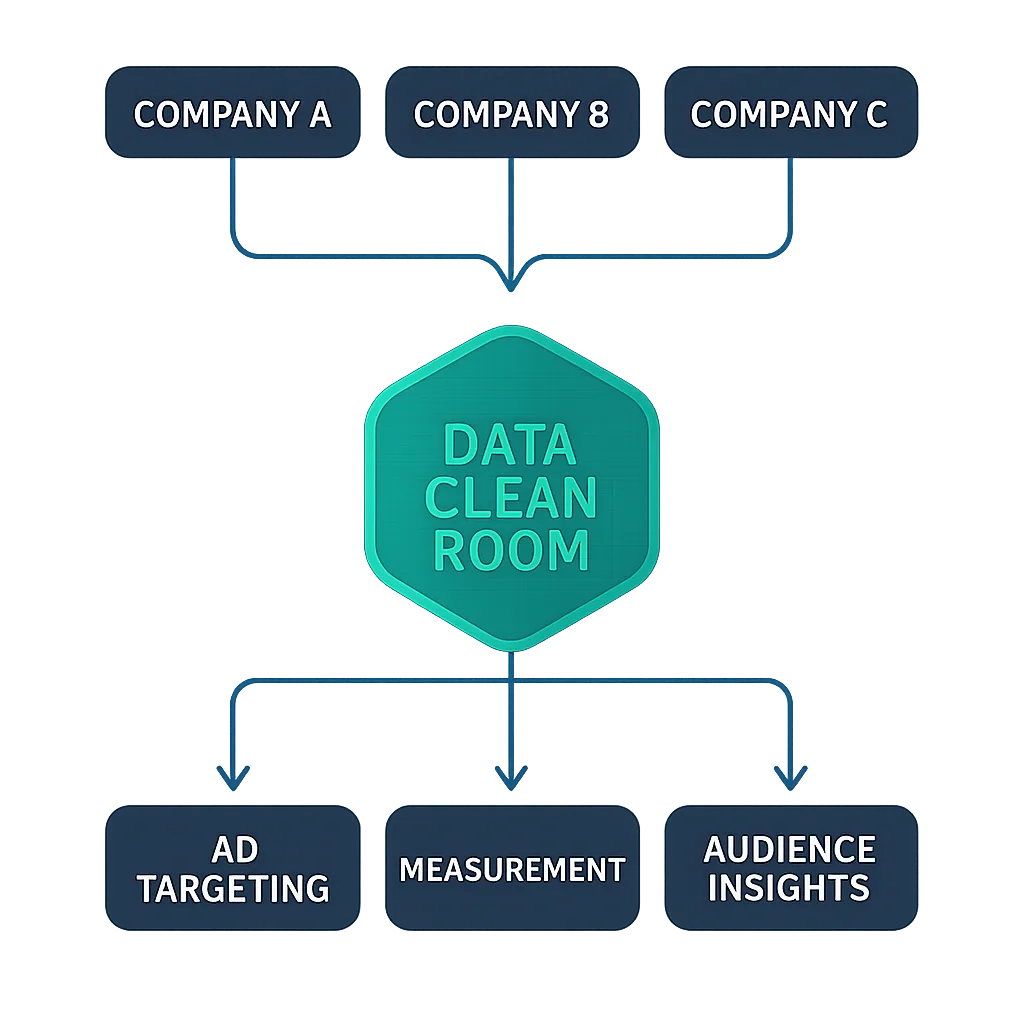
Data clean rooms can also help companies establish co-marketing partnerships by identifying the customers they share with each other, and to build more detailed audience profiles from anonymized, aggregated reports.
The Pros, Cons, and Risks of Data Clean Rooms
Like any technology, data clean rooms come with trade-offs.
Pros:
- A privacy-friendly approach to audience analysis, ad targeting, and performance measurement. User-level data is never exposed to other companies, even though it is contributed to the clean room.
- Some clean rooms deliver a holistic view of campaign performance across multiple distribution channels.
- Data contributed to the clean room remains under the control of the data owner — it is not shared with others.
Cons:
- Aggregated data for reporting and ad targeting is less accurate than ID-based data.
- Data must be unified into a single format before it can be uploaded to a clean room.
- Reluctance to share first-party and transactional data can reduce the overall effectiveness of the clean room and limit what it can accomplish.
- Many data clean rooms are platform-specific (e.g., Google or Facebook), which means advertisers must manually combine results from multiple clean rooms.
- Because data clean rooms are relatively new, there are no universal implementation standards yet.
Risks:
- To generate insights, advertisers must hand over valuable first-party data. In a worst-case scenario, a data breach could result in significant fines, as well as reputational damage and client loss.
- Manually managed clean rooms are vulnerable to human error — for example, granting access to unauthorized users, incorrectly formulating queries, or exchanging data through unsecured channels.
Different organizations require different levels of security to uphold privacy effectively. The sensitivity of the data contributed to a clean room varies based on two key factors:
- Industry and vertical: The healthcare sector deals with far more sensitive data than, say, the automotive sector.
- Appetite for data sharing: One company may be willing to ingest its entire customer dataset into a clean room, while another may contribute only a portion.
Despite these limitations, data clean rooms represent a genuinely promising approach to the challenge facing programmatic advertising: continuing to run ad targeting and measurement in a world where privacy protections are tightening.
What's the Difference Between a CDP and a Data Clean Room?
Both advertisers and publishers collect valuable first-party data from multiple sources, and many use a Customer Data Platform (CDP) to collect and manage it. A data clean room extends the capabilities of a CDP, taking data management further in a few key ways:
- A CDP allows collection, sharing, and processing of first-party data, but the focus is on user-level data and identifiers. Data clean rooms focus on using anonymized first-party data rather than individual IDs.
- A CDP with basic security measures (such as access controls) is more prone to data leakage than a data clean room, where data is anonymized through multiple techniques.
- A CDP does not allow analysis of data from other companies. A data clean room does — through anonymized reports based on aggregated data — making it possible to extract cross-party insights without exposing individual records.
Privacy Alternatives to Data Clean Rooms
Third-party cookie availability has been declining for several years. When Google Chrome — the world's most widely used browser — announced it would end support for third-party cookies, a range of alternatives began to take shape. There are three main ones:
Universal IDs: While third-party cookies are fading, programmatic advertising's dependence on identifiers is not. Universal IDs have emerged as a replacement, using hashed email addresses to create persistent identifiers that work across platforms without relying on browser cookies.
Google Chrome's Privacy Sandbox: A set of standards designed to protect user privacy while still allowing advertisers and publishers to run, measure, and report on programmatic campaigns. The Topics API, one of the newer standards, enables interest-based advertising by associating users with topic categories rather than tracking them individually.
Contextual ad targeting: The original ad-targeting method — available when online advertising launched in 1994 — contextual targeting is experiencing a revival. It serves ads based on the content of the page or app being viewed, rather than the identity of the user. While it may seem like a rudimentary approach, it can be quite effective, particularly when enriched with publisher-side data.
Beyond these three, other emerging approaches — such as cryptoidentities, which represent users through pseudonymous avatars — may also play a role in future identity resolution, enabling data matching and testing without sharing personally identifiable information.
Which Companies Offer Data Clean Rooms?
There are three types of data clean rooms:
- Walled-garden clean rooms, offered by platforms like Google, Amazon, and Facebook, where each company delivers hashed and aggregated data to businesses using their advertising platforms.
- Independent vendor clean rooms, where two data owners (e.g., a publisher and an advertiser) contribute their data to a neutral environment and share it safely between one another.
- Brand- or content-owner-built clean rooms, created by companies with massive amounts of user data and content — such as Disney, Spotify, and TikTok — that build proprietary solutions.
Here are some notable examples across these categories:
Google Ads Data Hub
Google Ads Data Hub is a privacy-safe data warehousing solution built on Google Cloud. It provides tools to create custom reports that contain no personally identifiable information (PII). Data sources include Google Campaign Manager, Display & Video 360 (DV360), Google Ads, and YouTube.
Amazon Marketing Cloud (AMC)
Amazon Marketing Cloud is a clean room solution built on Amazon Web Services (AWS). It helps companies assess the true impact of cross-media investments by matching and analyzing two data sources: advertiser datasets and event data from Amazon Advertising.
InfoSum
InfoSum operates a fully decentralized, cloud-agnostic clean room. By processing data outside of any centralized data lake or warehouse, InfoSum's architecture eliminates the data-leakage risks that typically accompany centralized storage models.
Snowflake
Snowflake enables advertising companies to build environments capable of processing shared datasets in real time while keeping customers' personal information hidden from other parties.
Disney Advertising Sales
Disney Advertising Sales launched its clean room in 2021. The cloud-agnostic solution is powered by Disney Select data and Disney Advertising's Audience Graph, with Habu, InfoSum, and Snowflake serving as key technology partners.
Why Brands Are Using (and Building) Data Clean Rooms
Adoption of data clean rooms is accelerating across industries, with the retail sector being among the earliest and most active adopters. Three real-world examples illustrate different motivations for using them:
Hershey's: Gathering Loyalty Card Data from Retail Partners
Hershey's is an example of a manufacturer seeking to evolve its advertising strategy and gain new insights into campaign performance. The company sells its products through a network of retailers but has limited visibility into areas like loyalty program effectiveness.
By operating its own data clean room, Hershey's can encourage retailers to share their first-party data — including loyalty card records — while still maintaining data security. Retailers store loyalty-card data alongside Hershey's ad data and share datasets within the clean room environment. This allows Hershey's to analyze ad frequency, evaluate loyalty program performance, and refine its advertising strategy.
Unilever: Tackling Cross-Platform Measurement
Unilever uses a data clean room to identify platforms where the same user was shown ad content without a measurable positive effect on retail outcomes. The company sends ad-related records and datasets to measurement partners Nielsen and Kantar, then analyzes results across platforms including Google, Facebook, and Twitter.
Disney: Enabling Privacy-Friendly Advertiser Access
Disney introduced its clean room solution to offer custom, future-oriented advertising solutions to marketers. By partnering with Habu, InfoSum, and Snowflake, Disney gives advertising clients a privacy-compliant way to reach Disney's audience and derive meaningful consumer insights without accessing individual user data.
Summary
The decline of third-party cookies in Google Chrome has pushed businesses to find new ways to run ad targeting and measurement while respecting user privacy. Data clean rooms are one of the most developed solutions available.
In a typical clean room workflow, two parties — such as an advertiser and a publisher — prepare first-party data packages and upload them to the clean room. The data is encrypted and anonymized inside the room, and both parties receive outputs in the form of cohorts and aggregated reports. No user-level data crosses the boundary of the clean room.
Common use cases include ad targeting and personalization, frequency capping, cross-platform measurement, and attribution. Other alternatives — universal IDs, Google's Privacy Sandbox, and contextual targeting — remain viable complements or substitutes depending on the use case.
The data clean room market is growing quickly as the third-party cookie deprecation timeline draws closer. The three main types — walled-garden offerings from Google, Meta, and Amazon; independent vendor solutions; and brand-built environments — each suit different organizational contexts, and many advertisers are beginning to evaluate which model best fits their data strategy.