What Is a Demand-Side Platform (DSP) and How Does It Work?
One of the most influential additions to the advertising ecosystem over the past decade has been the rise of demand-side platforms (DSPs) and the real-time bidding (RTB) infrastructure that powers them. This guide explains what DSPs are, how the bidding process works, what components they contain, and why media buyers rely on them.
What Is a Demand-Side Platform (DSP)?
A demand-side platform (DSP) is an advertising technology (AdTech) platform that allows advertisers working at brands and ad agencies to buy inventory (i.e., ad space) on an impression-by-impression basis from publishers via supply-side platforms (SSPs) and ad exchanges. DSPs enable media buyers — advertisers and agencies — to purchase a range of inventory from many different publishers, all from a single user interface.
A useful analogy: think of a DSP as a stockbroker. In the same way investors use stockbrokers to purchase stock from companies via a stock exchange, media buyers use DSPs to purchase ad inventory from publishers through an ad exchange.
Demand-side platforms began to emerge in 2007 when real-time bidding first took hold. Early DSP activity was concentrated on web browsers running on desktops and laptops, but the technology has since expanded to cover smartphones, tablets, and a full range of mediums — including mobile, video, and native advertising.
A DSP is essentially an intermediary, but one that handles far more than simple inventory purchasing. The main functions DSPs provide media buyers include:
- Creating, running, and managing multiple campaigns simultaneously across multiple SSPs and ad exchanges, all controlled from a single, centralized interface.
- Auto-optimizing campaigns via algorithms to increase ROI.
- Using third-party data from data management platforms (DMPs) to improve targeting.
- Providing real-time reporting through advanced analytics.
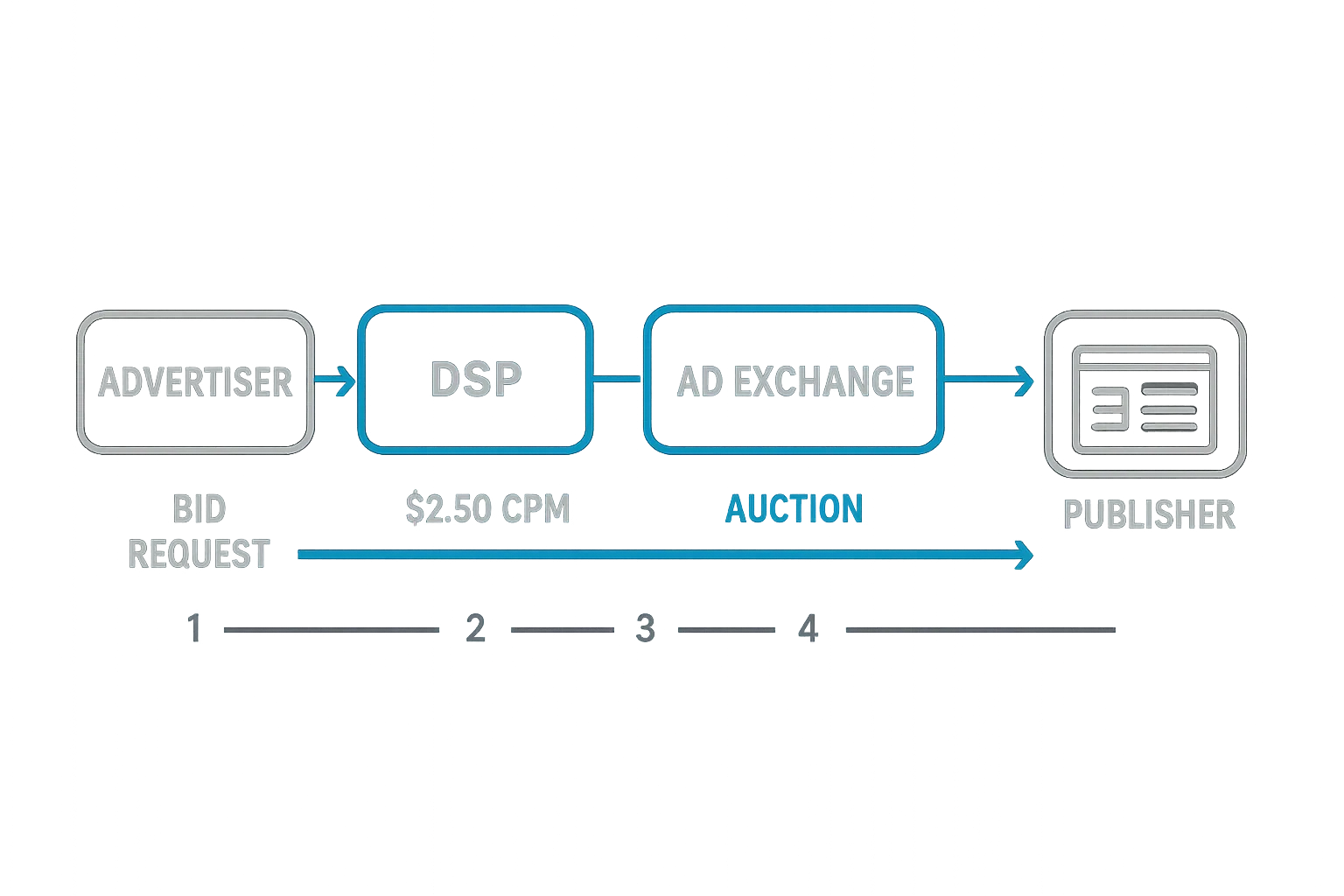
How Do Demand-Side Platforms Work?
Once an advertiser has set up their campaigns in a DSP — including targeting parameters and creatives — the DSP bids on impressions offered by ad exchanges and SSPs. Each time the DSP receives a request indicating that an impression is available, it analyzes the associated user data and determines how much that particular impression is worth based on its relevance to the media buyer's campaign.
Here's a practical example to illustrate:
A user who is approximately 30 years old, a sports enthusiast, and located in New York accesses a website. The website sends an ad request to an SSP, which forwards it to the ad exchange. The ad exchange notifies connected DSPs that an impression is available and initiates the bidding process.
Now assume the DSPs in this auction have the following targeting parameters configured:
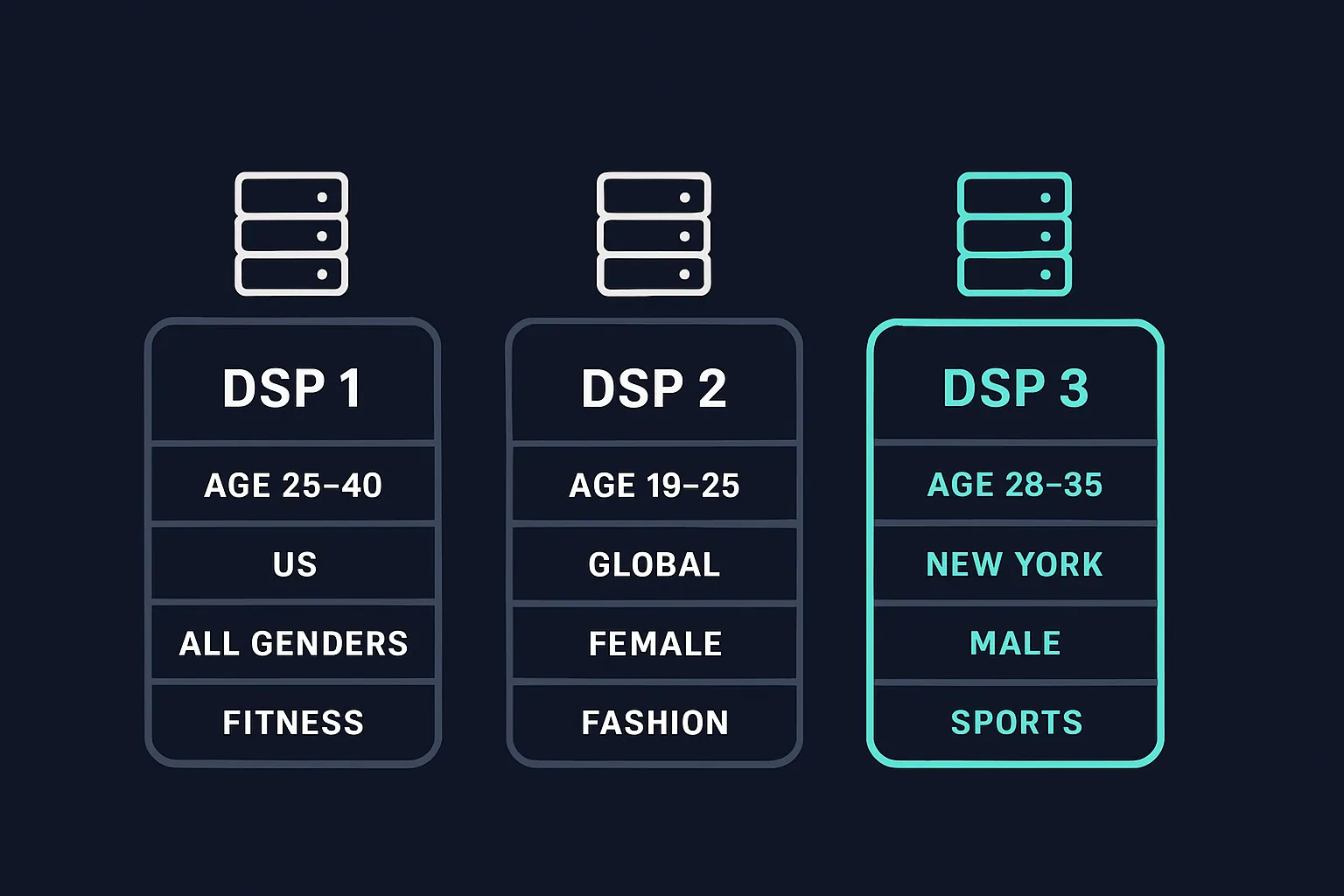
While several DSPs might derive some value from showing their ad to this user, it is DSP 3 that would benefit most — the user fits that campaign's target audience precisely.
Each DSP evaluates the impression against its data and targeting parameters, then submits a bid accordingly. In this example, the bids might look something like this:
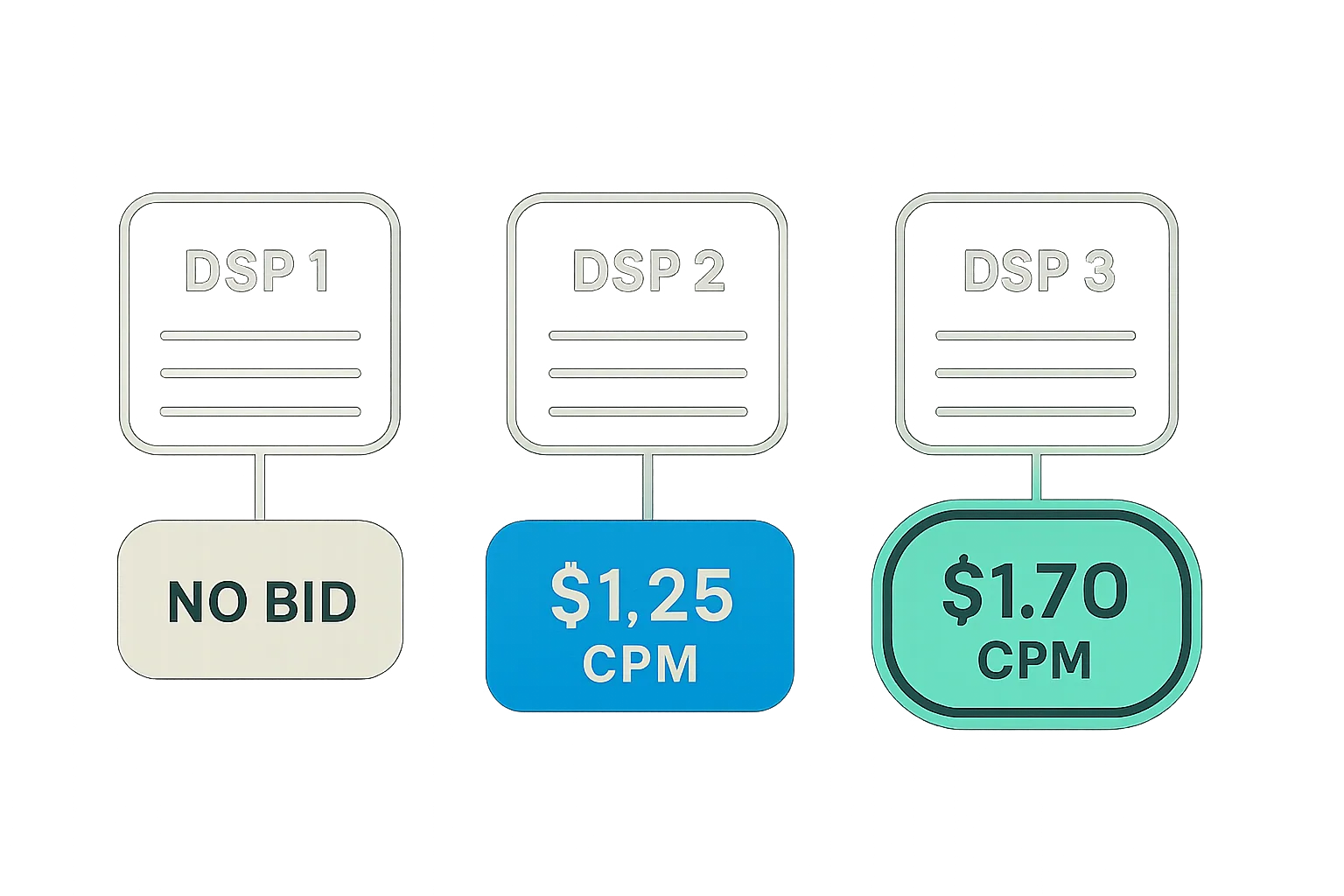
(CPM = cost per mille, the standard advertising unit representing cost per thousand impressions. The actual cost of any individual bid is 1/1000th of the stated CPM, since the advertiser is bidding on a single impression, not a block of one thousand.)
Traditionally, ad exchanges and SSPs have used the second-price auction model: the winning bidder pays the second-highest bid price plus $0.01. Over the past several years, however, auction dynamics in RTB have shifted somewhat, with a number of ad exchanges and SSPs moving toward or incorporating first-price auction models.
Once an impression is sold, it is returned to the publisher's website and displayed to the user. This entire process repeats each time a user loads a page or refreshes it, and it completes in roughly 100 milliseconds — hence the name real-time bidding.
What Are the Main Components of a Demand-Side Platform?
While no two DSPs are identical, most share a common set of core components. The diagram below illustrates the main building blocks:
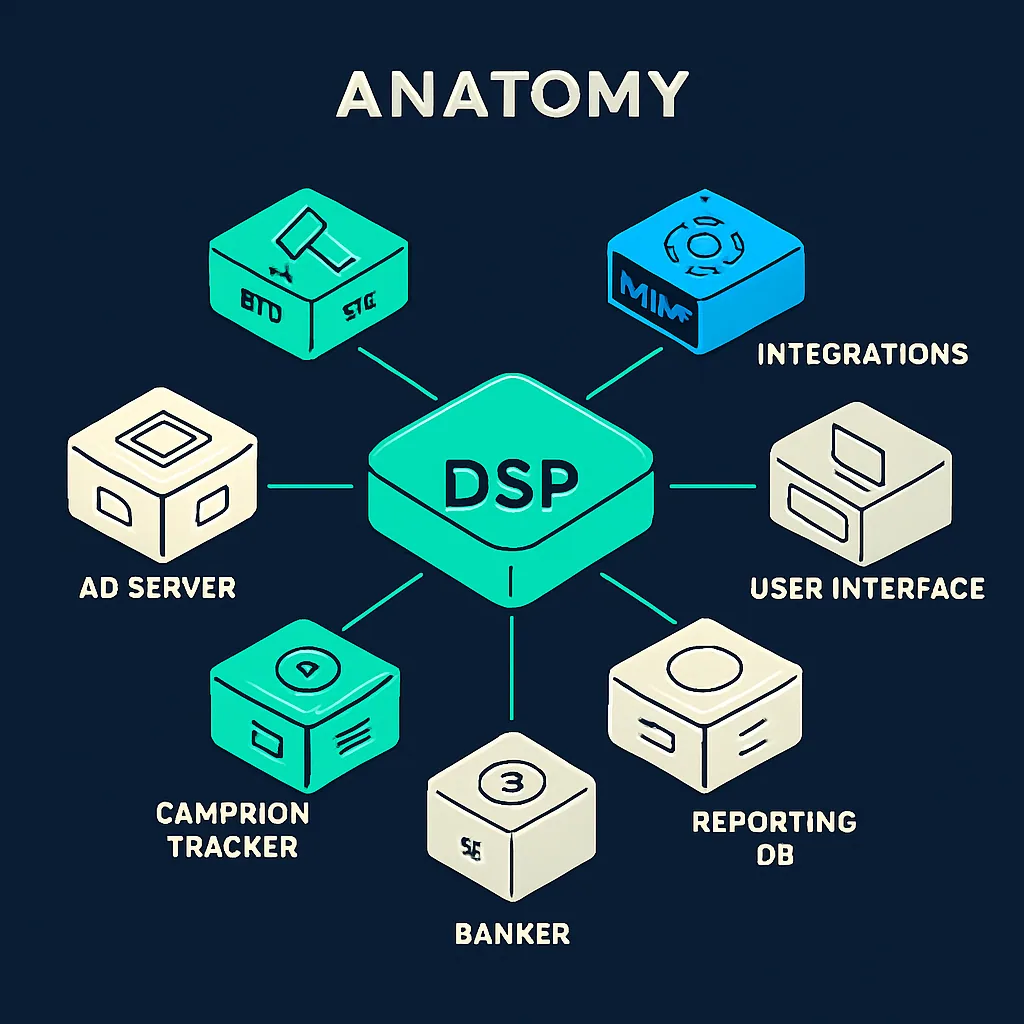
The specific role each component plays varies by implementation, but collectively they handle bidding logic, data ingestion, campaign management, reporting, and integrations with external data sources and ad exchanges.
What Advantages Do DSPs Offer Media Buyers?
DSPs were originally used primarily as a channel for buying remnant (unsold) inventory from publishers. They have since evolved into platforms capable of accessing available and even premium inventory. That shift reflects the breadth of advantages DSPs give media buyers:
- Audience reach on a lateral and bilateral basis — media buyers can target their core audience more precisely while simultaneously reaching a broader one.
- Access to larger inventory pools — by connecting to multiple ad exchanges and SSPs through a single DSP, buyers can display ads across a far greater number of websites than would be practical through direct deals.
- Campaign control and optimization — settings like blacklisting specific websites or audience segments, frequency capping (limiting how many times the same user sees the same ad within a defined period), retargeting across multiple ad exchanges, and behavioural profiling all give buyers fine-grained control.
- Real-time responsiveness — DSPs can react to external conditions such as weather, breaking news, or stock market activity, allowing the media buyer to serve contextually relevant ads in the moment.
- Third-party data integration — DSPs can integrate with third-party data brokers and DMPs, enabling media buyers to significantly enhance their audience targeting capabilities.
The rapid adoption of RTB has driven a corresponding surge in the number of DSPs available in the market, many of which now incorporate advanced features, novel data integrations, and channel-specific specializations.
How Does Targeting Work in a DSP?
All DSP targeting ultimately rests on data. Advertisers can target users based on several distinct data types:
Behavioural data: Information about a user's behaviour and interests — websites they have visited, products they have purchased, ads they have interacted with, and so on.
Contextual data: Information about the website or mobile app itself — URL, content categories, and the substance of the page content.
Demographic data: Information about the user's location, age, job title, gender, and related attributes.
How Does a DSP Access This Data?
Behavioural and demographic data typically need to be imported from a third-party data broker or DMP, where they have been collected from a range of online and offline sources. The DSP syncs cookies with the DMP to exchange user data, which can then be applied to targeting decisions.
Other data types — contextual data and user agent data (e.g., browser type, device advertising ID, and operating system) — are generally passed directly in the bid request from the ad exchange or SSP, without requiring a separate data sync.
Who Are the Main DSP Companies?
Over the past decade, dozens of DSP companies have entered the AdTech landscape, many specializing in specific formats or channels such as video or native advertising. Below are some of the more widely recognized platforms:
Sizmek
Sizmek is one of the longest-standing AdTech companies in the industry, originally founded under the name Eyeblaster. Beyond developing its own technology, Sizmek has acquired several other AdTech companies over the years, including Rocket Fuel for $145 million in 2017.
MediaMath
MediaMath, founded in 2007, is one of the first DSPs to come to market. The company provides advertisers and marketers with tools to buy ads online through a single interface. Its integrated DSP and DMP is exclusively buy-side aligned, with a focus on transparency, multi-channel reach, and full-funnel performance.
AdForm
AdForm, headquartered in Copenhagen, Denmark, with offices across multiple regions, provides advertisers and agencies with an open, transparent AdTech platform. Its DSP allows media buyers to purchase inventory across different ad formats and improve campaign performance using real-time algorithmic optimization.
Brightroll
BrightRoll, formerly owned by Yahoo and subsequently acquired by Oath in 2017, is an advertising platform that includes a real-time bidding marketplace with a particular emphasis on programmatic video. It serves brands, agencies, agency trading desks, DSPs, and advertising networks.
Criteo logo
Criteo is a DSP best known for personalized retargeting. The platform serves customized online display ads to consumers who have previously visited an advertiser's website. Criteo operates across 30 markets worldwide and is headquartered in Paris, France.
DoubleClick logo
DoubleClick Bid Manager (DBM) is Google's demand-side platform. It offers agencies, trading desks, and advertisers access to a broad collection of display, video, native, and mobile inventory available in real time.
The Case for Building a Custom DSP
For organizations with scale and specific requirements, building a proprietary DSP rather than licensing an existing platform carries several meaningful advantages:
Ownership of data and technology: A custom DSP puts full control of both the technology stack and the underlying data in the hands of the builder. This is particularly valuable for advertisers running large campaigns and agencies that purchase significant volumes of inventory on behalf of clients.
Elimination of white-label fees and commissions: Building a custom DSP won't remove every fee involved in programmatic transactions, but it does eliminate the platform fees and commissions associated with using white-labelled solutions — costs that can become substantial at scale.
Control over the product roadmap: Off-the-shelf DSPs come with many features, but they are rarely a perfect fit for every use case. Organizations with specific requirements can develop a DSP that gives them complete control over the feature set and development direction, building precisely what they need rather than adapting to what a vendor offers.