Waterfall Auctions vs. Header Bidding: How Each Model Works
Two mechanisms dominate how publishers programmatically sell digital ad inventory: waterfall auctions and header bidding. Understanding how each works — and where each falls short — is essential for anyone involved in publisher monetization or ad tech architecture.
What Is a Waterfall Auction?
Programmatic media sales have their roots in publishers' efforts to eliminate unsold impressions. Real-time bidding (RTB) and the technical platforms that support it originally served a straightforward purpose: help publishers quickly sell ad space that hadn't already moved through direct advertiser relationships.
The waterfall auction — also called daisy-chaining or waterfall tags — grew out of that need. In this model, a publisher passes its inventory from ad network to ad network in descending order of importance until all impressions are, ideally, sold.
Ad networks are ranked according to the average historic yield each has produced for that publisher. A network that has consistently sold premium inventory at higher prices earns the first position in the sequence. If that network fails to return a satisfactory bid, the next network in the chain is called upon — and so on down the line.
The model's appeal comes down to its relatively easy technical setup and its ability to ensure publishers aren't left holding unsold inventory. For a number of years, waterfalling was the default approach across the industry.
It is not without significant problems, however.
Problems with Waterfall Auctions
The central issue with waterfall auctions is the passback process — accepting bids from ad networks one at a time, in sequence. This structure eliminates meaningful competition for impressions, which tends to suppress overall yield for publishers.
Consider a scenario where a particular piece of inventory is highly valuable to an advertiser who happens to be buying through a network sitting lower in the daisy-chain. That advertiser might be willing to bid substantially more for the impression — but because access to the auction is rationed sequentially, they never get the opportunity. Prices end up lower than the market would otherwise support.
Passbacks also introduce latency. As the ad call moves from one network to the next, page load times can suffer, creating a degraded experience for users.
What Is Header Bidding?
Header bidding is an alternative selling mechanism publishers use to monetize unsold inventory, but the architecture is fundamentally different from the waterfall model.
Rather than contacting demand sources one by one, header bidding brings all demand sources together simultaneously and allows them to bid on available inventory at the same time — even before premium inventory and inventory from the publisher's own ad server has been sold. Any demand source that returns a bid within the allotted time window is considered.
The core advantage of this concurrent auction is a meaningful increase in publisher yield, for two reasons:
- Publishers can surface all interested buyers at once and evaluate the full spread of bids. This regularly uncovers demand sources willing to pay above what most premium buys would achieve. In a waterfall setup, those buyers may never even receive the chance to place a bid.
- Publishers see the real price of their inventory — not a historical average or an estimate.
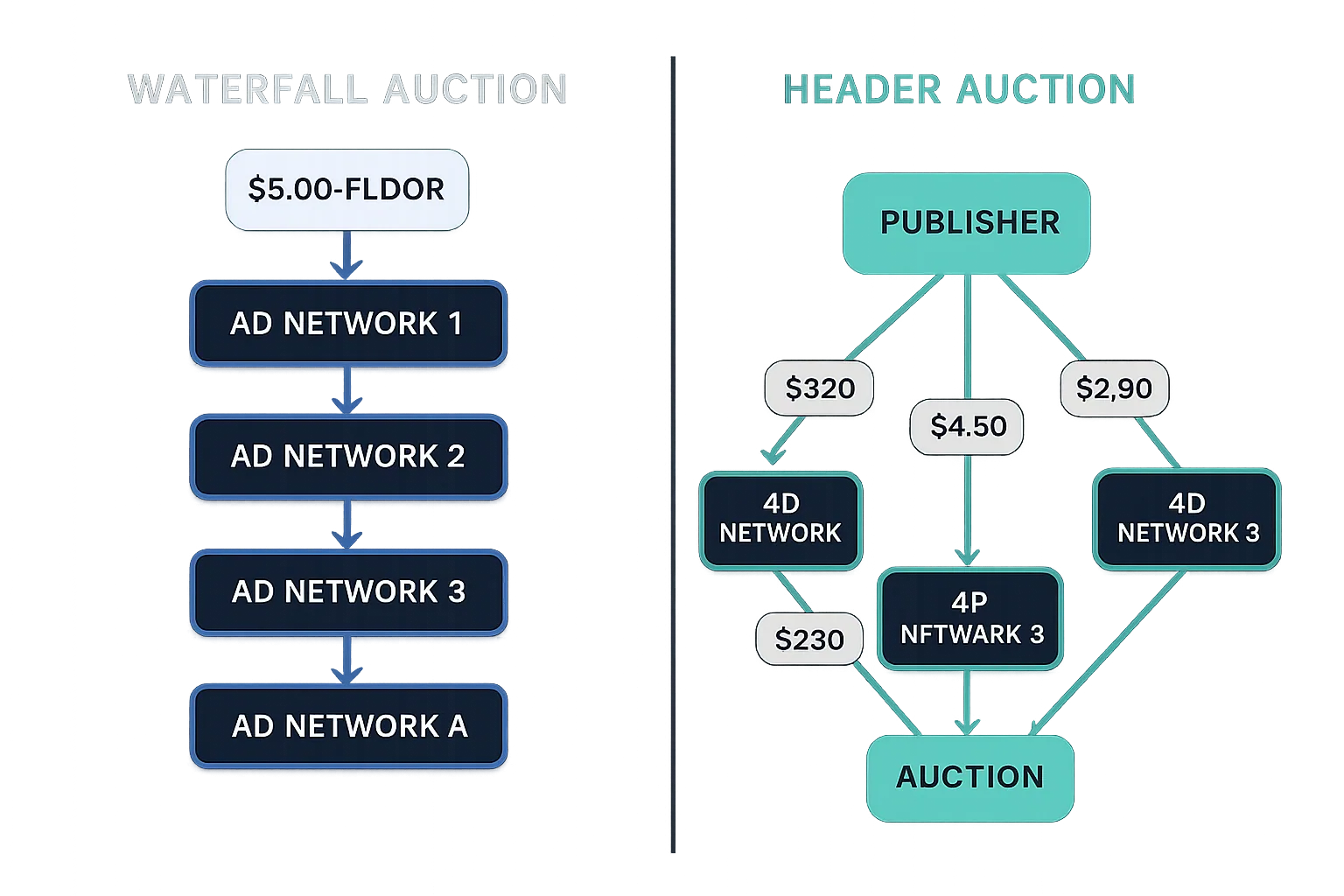
The diagram above illustrates how header bidding auctions can allow publishers to generate more revenue from the same inventory.
Downsides of Header Bidding
Header bidding addresses many of the structural weaknesses of waterfall auctions, but it introduces its own complications.
Implementation complexity is the most immediate challenge. Code connecting the publisher's page to each SSP, ad exchange, and ad network must be added directly to the page. The more demand partners involved, the more code needs to be managed and maintained.
Latency remains a concern even with header bidding. Each tag placed in the page header has the potential to slow down page load times — a different cause than waterfall latency, but the user-experience impact is similar.
Finally, there is the problem of duplicate bidding. An advertiser connected to multiple ad networks can inadvertently end up bidding against itself across those networks, often without realizing it. This inflates the apparent competition in the auction and can negatively affect ecosystem performance, including the volume of data being exchanged.
Both models represent meaningful trade-offs. Waterfall auctions are simpler to operate but structurally limit competition and yield. Header bidding opens the auction to genuine simultaneous competition but requires more technical investment and introduces its own performance considerations. The right choice for any publisher depends on their technical capacity, the scale of their inventory, and the demand partners they work with.