How to Build a Dynamic Creative Optimization (DCO) Tool
The internet is flooded with advertisements, which is why advertisers employ a range of strategies, tactics, and tools to tailor communication to individual customers. Dynamic creative optimization (DCO) technology can increase conversions by using customer data to create hyper-relevant creatives in real-time.
For a dynamic creative to succeed, it must be delivered to the right people in the proper context and at the right moment, directly addressing the recipient's specific needs and interests.
Marketers can achieve this by collecting substantial amounts of data about their customers' behaviour, location, and current interests to build effective ad campaigns.
This article covers what dynamic creative optimization (DCO) is, who benefits from it, and how a custom DCO tool is built to get the most out of a marketing programme.
Key Points
- DCO is a technology that creates hyper-relevant ads based on available information about a potential customer.
- Using a base (underlying creative), DCO prepares and tests dozens of creative versions in real-time, selects the most effective one, and serves it.
- DCO is used by companies with large product portfolios, such as e-commerce retailers, as well as those trying to reach specific audience segments — for example, people actively researching a new car purchase.
- DCO supports both upper-funnel campaigns (prospecting, brand awareness) and lower-funnel campaigns (retargeting, retention).
What Is a Dynamic Creative Optimization (DCO) Tool?
Dynamic creative optimization (DCO) is a process whereby advertisers show personalized ads to individual users based on known information about them. The software that powers this process — the DCO tool or platform — is a piece of advertising technology (AdTech) responsible for creating, serving, and measuring these hyper-relevant advertisements.
With DCO, different ad components — backgrounds, text, main images, value propositions, CTAs, and more — are changed on the fly to achieve the most personalized communication possible for each potential customer. These elements are assembled based on the information and data associated with a particular user.
Within a DCO tool, advertisers draw on demographic data, geographic locations, interests, contextual data, behavioural data, historical insights, and context-specific data. The tool forms a new creative from this information, tests it in real-time (A/B testing), and then displays the best-performing creative at scale.
What distinguishes DCO from other types of advertising technology is the combination of data usage and real-time dynamic ad creation. Together, these elements improve the probability that a potential customer will click on the ad and convert — for example, by making a purchase.
Who Can Benefit From a DCO Tool?
Marketers can use DCO tools across the full marketing funnel — optimizing lower-funnel campaigns such as retargeting and retention programs, as well as upper-funnel campaigns such as brand awareness and prospecting.
Initially, DCO tools were the domain of the largest brands and media agencies — especially those looking to reduce the time required to produce individual creatives at scale.
As more businesses accumulated richer data about internet users, it became clear that DCO can deliver value across most verticals.
In general, companies with large product portfolios, sophisticated marketing strategies, and substantial user data sets stand to benefit most from DCO tools.
Industries where DCO technology tends to deliver strong results include:
- E-commerce
- FMCG (fast-moving consumer goods)
- Automotive
- Consumer packaged goods (CPG)
- Financial services
- Healthcare
- Travel services
Benefits of Dynamic Creative Optimization
Studies show that static advertising is less effective than dynamic creatives, but improved campaign performance is only one part of the DCO value proposition.
Delivering a more compelling ad experience
Advertisers who combine programmatic ad buying and DCO technology, powered by rich data, can deliver a significantly more engaging ad experience to users.
Boosting performance vs. static ads
Relevant, personalized ads consistently drive more engagement, higher click-through rates (CTRs), and more conversions compared to static ads serving generic or minimally personalized content.
Optimizing ad elements
DCO algorithms optimize individual ad components — headlines, prices, CTAs, backgrounds, and more — to generate the strongest results for advertisers.
Time and cost savings
For companies with large product and service catalogues, DCO reduces the time and cost of producing and serving ads. A DCO tool can generate a near-unlimited number of ad variations across multiple formats automatically, lowering both production and delivery costs.
Continuous data input
Once data feeds from demand-side platforms (DSPs), data management platforms (DMPs), customer relationship management systems (CRMs), and other sources are configured, the delivery of dynamically modified ads becomes largely automated with minimal ongoing effort.
DCO tools can be used across display, social, video, and audio ad formats.
DCO vs. Other Forms of Ad Targeting
DCO is sometimes confused with related technologies. The most common comparisons are with dynamic creatives and creative management platforms (CMPs).
DCO vs. Static Creative
Both DCO and static creatives can use A/B testing to identify the most effective ads — but that is where the similarity largely ends. DCO uses dynamic content, changing ad components based on specific user information, and applies AI and machine learning to optimize digital campaign results. Static creatives, by contrast, cannot be altered based on context-related data, regardless of what information is available.
DCO vs. Dynamic Creatives
Although DCO is sometimes called "dynamic creatives," the two are not the same. The critical distinction is not the dynamic change of content itself, but the presence of machine learning (ML) mechanisms.
Dynamic creatives are most often used in simple retargeting campaigns: a user visits a website, views several products, and is then shown ads for those products while browsing other sites. The content changes, but it is not optimized.
DCO tools, by contrast, use ML and algorithms to tailor ads, test them against a smaller audience, and then serve the ads with the highest success rates at scale. The optimization layer is what separates dynamic creatives from dynamic creative optimization.
DCO vs. Creative Management Platforms (CMPs)
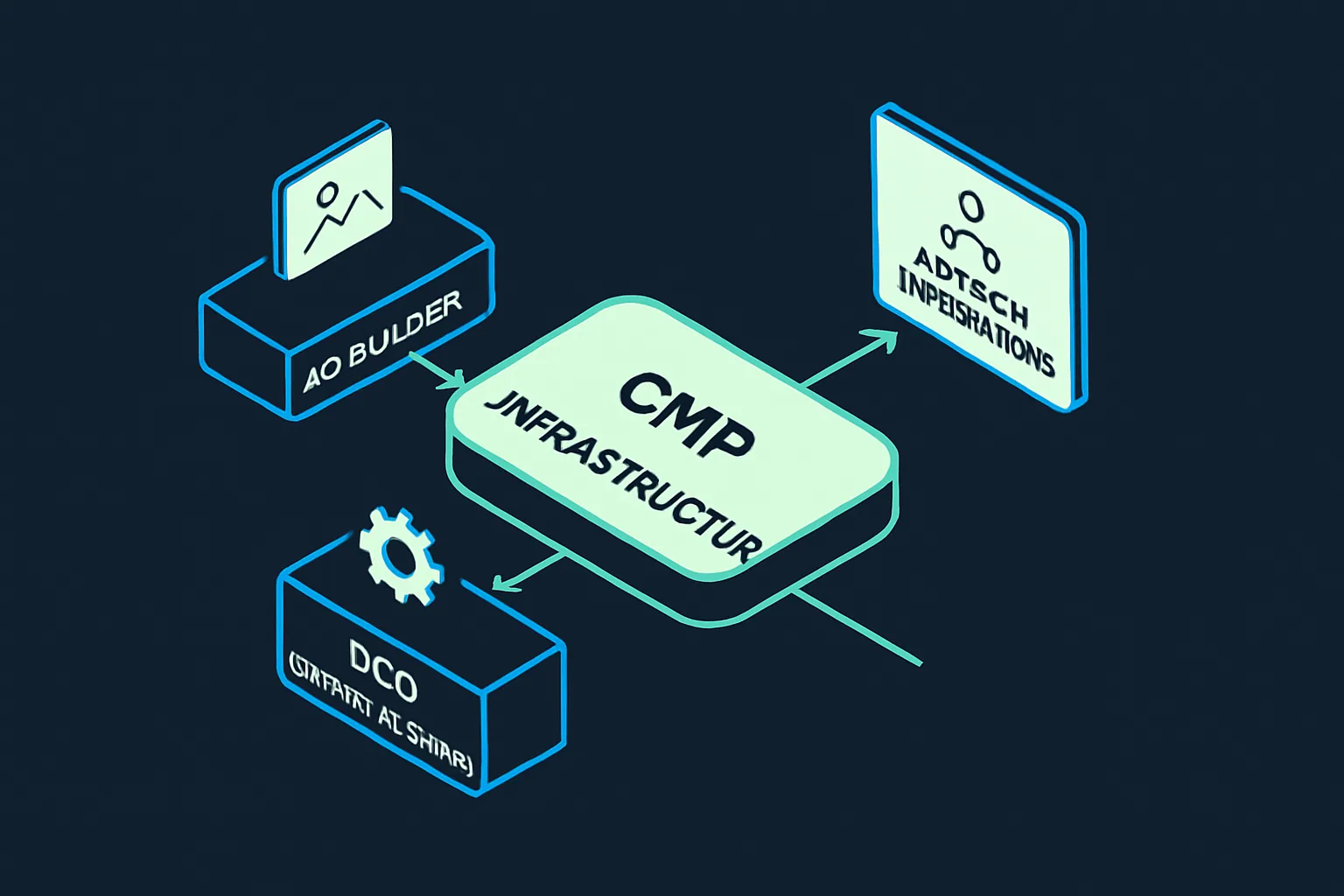
Creative management platforms (CMPs) and DCO are distinct but complementary technologies. CMPs are cloud-based AdTech solutions that help digital marketers create, test, and refine their creatives. Their engines produce and manage the design versions of ads needed for a DCO campaign.
Typical components of a CMP include:
- An ad builder for designing ads and their components.
- A publishing solution with ad server or ad network connectivity to serve ads.
- Additional tools such as analytics and a creative optimization engine.
DCO handles the process of serving and optimizing those ads. In straightforward terms: a CMP is responsible for the creative production side, and DCO handles the testing and serving side.
The Role of a Data Management Platform (DMP) in DCO
A data management platform (DMP) is software that gathers, organizes, and analyzes data from all the interactions customers and prospects have with a brand.
Digital touchpoints include interactions with a website, marketing campaigns, and social media platforms. Offline touchpoints — typically captured in a CRM — include contact centre queries, order history, personal information, contract renewals, and warranty data, as well as third-party data sources.
Real-time data from these systems and linked data sources is passed to the DCO tool by the DMP, giving it the audience intelligence needed to generate relevant creatives.
How Does a DCO Tool Work?
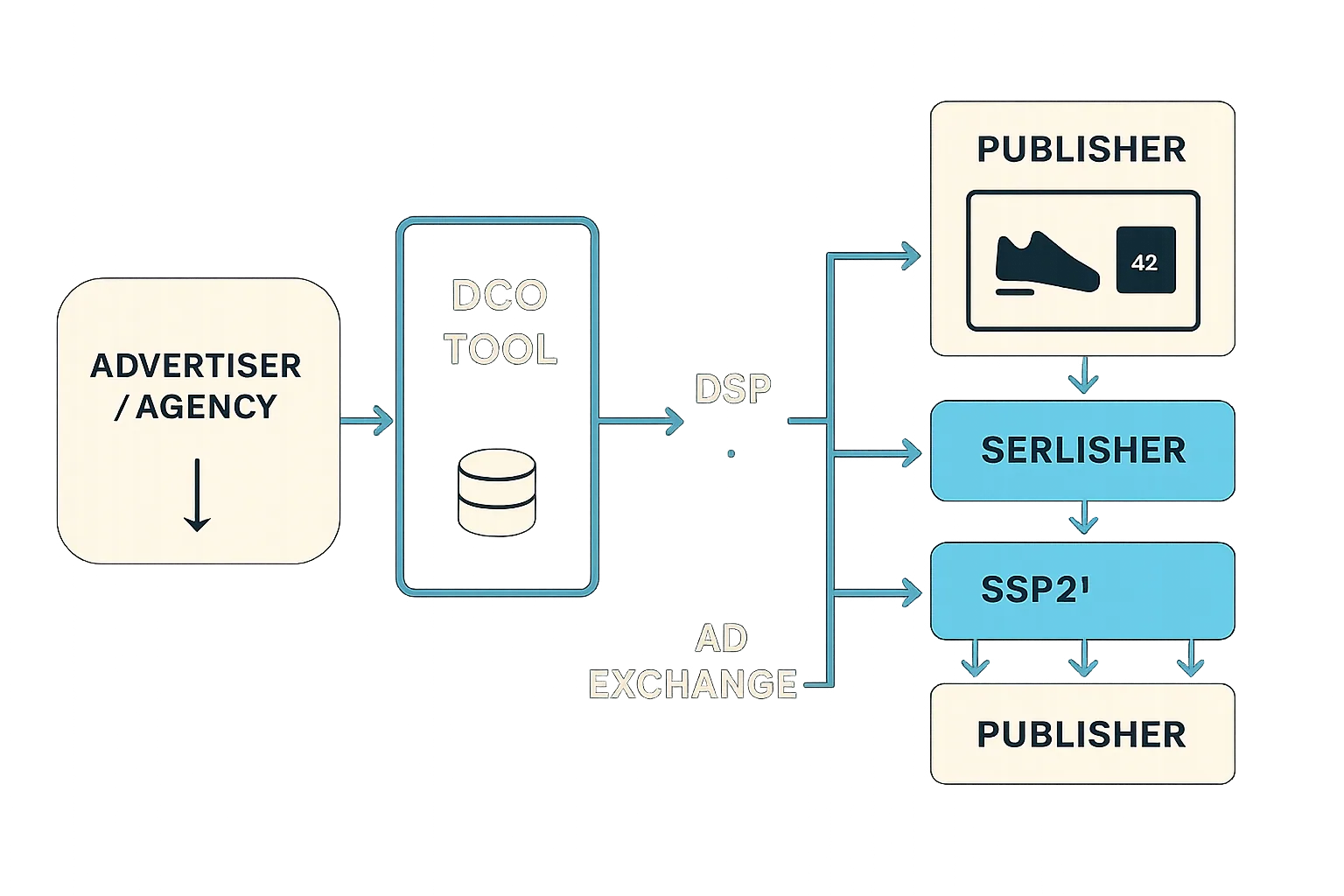
To serve dynamically created and optimized ads, a DCO tool integrates with existing AdTech platforms — primarily demand-side platforms (DSPs) and ad exchanges. From there, it uses data feeds and machine-learning algorithms to produce creatives.
Understanding how a DCO tool fits into the real-time bidding (RTB) process clarifies the mechanics:
When a user visits a website, a supply-side platform (SSP) sends a bid request to an ad exchange, which passes it to all connected DSPs. Each DSP evaluates the available user information and checks whether it matches the targeting criteria for any active campaigns before returning a bid.
Once bids are returned, the ad exchange selects the winning bidder (typically the highest bid), and the ad is scheduled to appear on the publisher's website. Before the ad is displayed, the DSP sends an ad call to the DCO tool, which creates and delivers a hyper-relevant ad to the user. The entire process — from bid to ad delivery — takes less than 100 milliseconds.
Does DCO Use Third-Party Cookies?
DCO relies on third-party cookies and data feeds. The most common DCO use case — retargeting — makes this dependency clear.
Three "layers" are involved in serving hyper-relevant ads: the browser, the user profile, and the data feed.
To run a hyper-relevant retargeting campaign, the advertiser places a pixel on their website, which builds audience segments. The DCO tool's cookie, placed in the user's browser, collects information about the site visitor. With the help of the pixel, it also gathers data on dynamic content triggers — for example, a product ID — and builds out a user profile.
The DCO tool then draws on a data feed to serve ads. That feed may include fields such as product ID, description, category, price, image URL, and promotional copy.
The product ID captured in the user's profile triggers the corresponding content within the data feed, and a relevant ad is assembled and delivered.
With the declining availability of third-party cookies, many DCO tools have begun using universal IDs as an alternative identity solution.
DCO Use Cases
DCO can enhance almost any digital campaign. The following use cases illustrate where the technology is most valuable:
Location-based customization: Creatives can be modified to reflect regional preferences or a brand's local offerings. The same logic applies to demographic and behavioural variables.
Retargeting campaigns and promotions: DCO can encourage consumers to convert through dynamically optimized ads featuring down-sells, cross-sells, and special promotions. Ads can also be targeted at users who have expressed purchase intent — for example, those who abandoned a shopping cart or visited a specific product page.
Contextual targeting: Creatives can be tailored to visitors of specific page types, making ads feel more relevant and seamlessly integrated into the browsing experience.
How to Build a Dynamic Creative Optimization (DCO) Tool
Building a DCO tool requires working through a structured design and development process applicable to any custom AdTech platform. The diagram below illustrates a standard approach to designing and building a DCO tool, covering the key stages from initial scoping through to deployment and iteration.
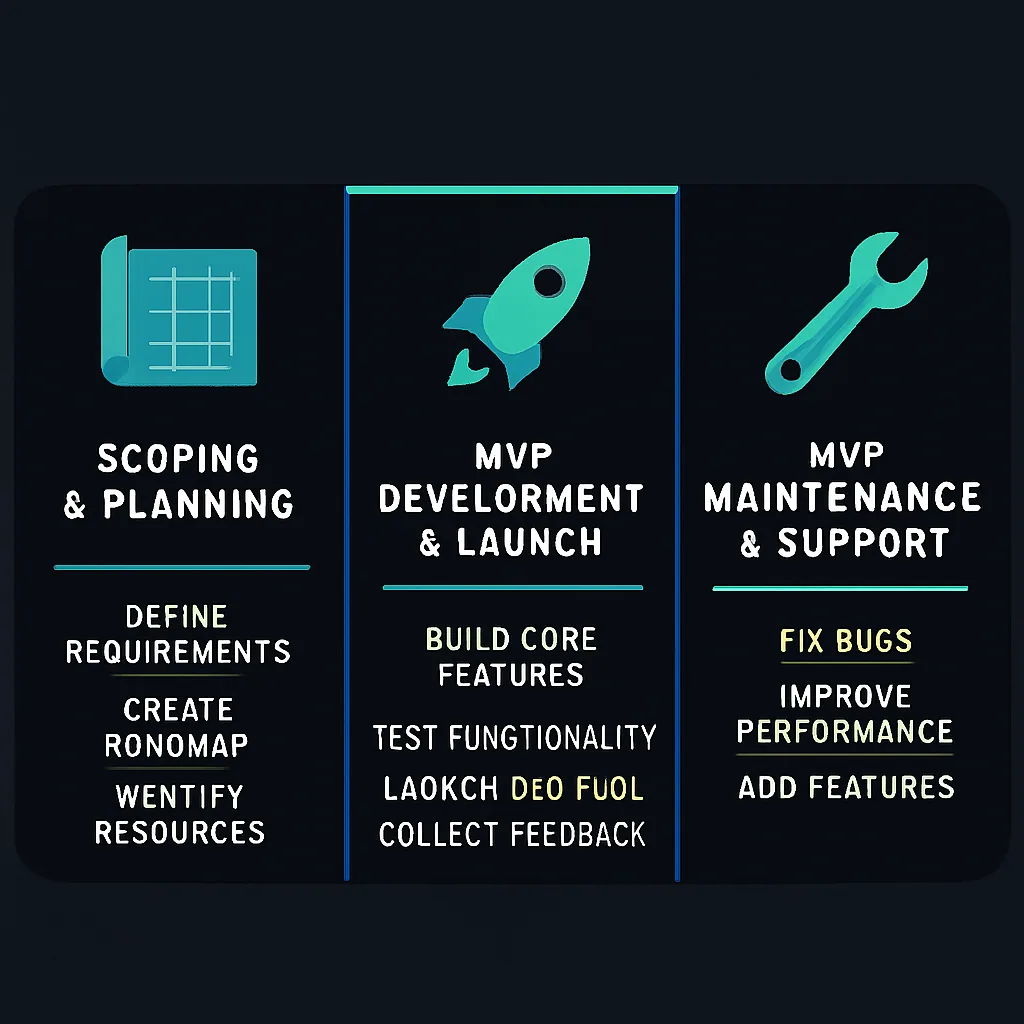
A well-built DCO platform typically requires integrations with DSPs and ad exchanges, a robust data feed ingestion layer, a creative assembly engine, an ML-driven optimization module for real-time A/B testing, and an analytics layer for reporting on creative performance. Each component depends on the others, which is why architecture planning and data flow design are critical early-stage decisions.
The result of that work is a system capable of assembling, testing, and serving thousands of creative variations in under 100 milliseconds — all tailored to individual users based on the richest available data signals.