5 Steps to Building a Successful Enterprise SaaS Solution
Software-as-a-Service has become one of the most dominant delivery models in enterprise technology, and the pipeline of companies looking to build SaaS products shows no sign of slowing. The opportunity is real — but so is the failure rate. Adoption of the model doesn't guarantee success; building successfully in this space requires a disciplined process.
What follows is a five-step framework covering the practices that consistently separate successful enterprise SaaS products from the ones that don't make it.
1. Do Thorough Research
Research is the foundation everything else rests on. Skipping or shortcutting this phase is one of the most common reasons enterprise SaaS projects fail to gain traction.
Customer and User Research
Any SaaS product ultimately stands or falls on whether it solves a real problem for the people using it. Before a line of code is written, it's worth articulating clearly: what process does this application improve, or what entirely new capability does it provide? Why would an enterprise choose it over what they're doing today?
Part of the answer is built into the SaaS delivery model itself. One of the core appeals of cloud-based software — for enterprises of all sizes — is eliminating the overhead of on-premise installation, licensing, and ongoing maintenance. Organizations can access capable, up-to-date software without carrying the cost of a full internal IT function to support it.
This structural advantage is reflected in adoption data. Research from International Data Corporation (IDC) has tracked a multi-year decline in the share of on-premise applications while SaaS deployments have increased across organizations of all sizes.

Market Research
Whether you're a startup or an established software vendor pivoting to a subscription model, comprehensive market research is non-negotiable. A technically sound product that doesn't address a genuine market need will not survive.
CB Insights has documented this repeatedly: the number one reason cited by failed startups for their collapse is that there was no market need for their product.

For vendors with an existing on-premise customer base considering a shift to SaaS, it's worth mining that installed base directly. Which features do customers use heavily? Which are rarely touched? What does the split between desktop and mobile usage look like? This kind of structured feedback surfaces what actually matters to customers — as opposed to what internal assumptions suggest — and shapes both the feature roadmap and the transition strategy.
Solid market research also clarifies two critical dimensions: target audience and competition. A tightly scoped product with a clearly defined value proposition is far easier to sell and far easier to validate in early testing.
Feature Selection
Enterprise SaaS carries specific feature expectations that differ from consumer software. The 2014 KPMG Cloud survey found that security, data privacy, and cost/price are the most important capabilities organizations seek when evaluating cloud solutions.

These findings point to a set of features worth prioritizing in any enterprise SaaS build:
Security Data security is a top concern at the enterprise level. Login procedures, role-based permissions, and access controls aren't optional extras — they're table-stakes features that directly affect whether a product gets through procurement and security review.
Privacy Closely related to security, data privacy requires deliberate architectural decisions: where data will be stored, how it will be protected, and whether on-premises, cloud, or hybrid deployment options will be offered. These choices shape the design from the ground up.
Customization Enterprise buyers expect software to adapt to their workflows, not the other way around. White-labelling and industry-specific feature enablement are two established approaches for building that flexibility into a platform without fragmenting the codebase.
Integration with existing systems Enterprises run on interconnected systems. A SaaS product that doesn't integrate cleanly with the tools already in use faces an uphill adoption battle. Compatibility with existing software infrastructure is often a prerequisite, not a nice-to-have.
Competitor Analysis
A full picture of the competitive landscape is essential before committing resources. Building a product that merely replicates something already available rarely makes strategic sense — unless the differentiator is the delivery model itself. Converting an established "as-a-product" solution into an "as-a-service" offering is a legitimate and often effective competitive strategy, even in crowded markets.
Competitive analysis also helps define the product. Knowing what features competitors offer (and what gaps they leave) informs both design decisions and the sales narrative.
2. Rapid Prototyping and Building a Minimum Viable Product (MVP)
Enterprise markets and technology landscapes shift quickly. A product that takes too long to reach users risks arriving obsolete — or missing the window of opportunity entirely. The response to this risk is speed: get something tangible in front of users as early as possible.
The first concrete step is building an interactive prototype. This isn't a finished product, but it serves several important functions: it organizes ideas visually, enables early testing of individual feature concepts, and provides the first real measure of user experience — something that wireframes and static mockups can't reveal. A working prototype also functions as a fundraising tool, giving prospective investors something concrete to evaluate.
The Role of the MVP
A minimum viable product (MVP) takes the prototype further by delivering a deployable, functional version of the application containing only the essential features needed to be useful. The target audience at this stage is early adopters — users willing to engage with an early-stage product and provide substantive feedback.
The MVP approach has its roots in startup methodology but has become standard practice across software companies of all sizes. It supports several objectives simultaneously:
- Faster time to market — a working version reaches initial users well before a full build would be complete
- Feedback-driven development — real usage data informs what to build next, rather than internal assumptions
- Risk reduction — early validation confirms (or challenges) core assumptions before significant resources are committed
- Assumption testing — the MVP proves or disproves whether the product actually solves the problem it was designed for
- Investor engagement — a functioning product is far more compelling in a funding conversation than a slide deck
3. Choosing the Right Software Development Methodology
Methodology matters. The best-researched product concept and the most carefully scoped MVP won't translate into a successful product if the development process is poorly matched to the goals of a SaaS build.
The two dominant approaches in software development are:
Traditional (Waterfall) A linear, sequential process with origins in construction and manufacturing. Each phase completes before the next begins. Testing is typically conducted separately, often at the end of the project.
Agile A flexible, iterative approach organized around short work cycles (sprints) that each produce working, testable increments of the product. Testing and quality assurance are integrated throughout, not saved for the end.
The performance difference between these approaches is well documented. A 2013 Ambysoft survey found that agile methodologies achieved a 64% project-success rate, compared to 49% for traditional waterfall methods.
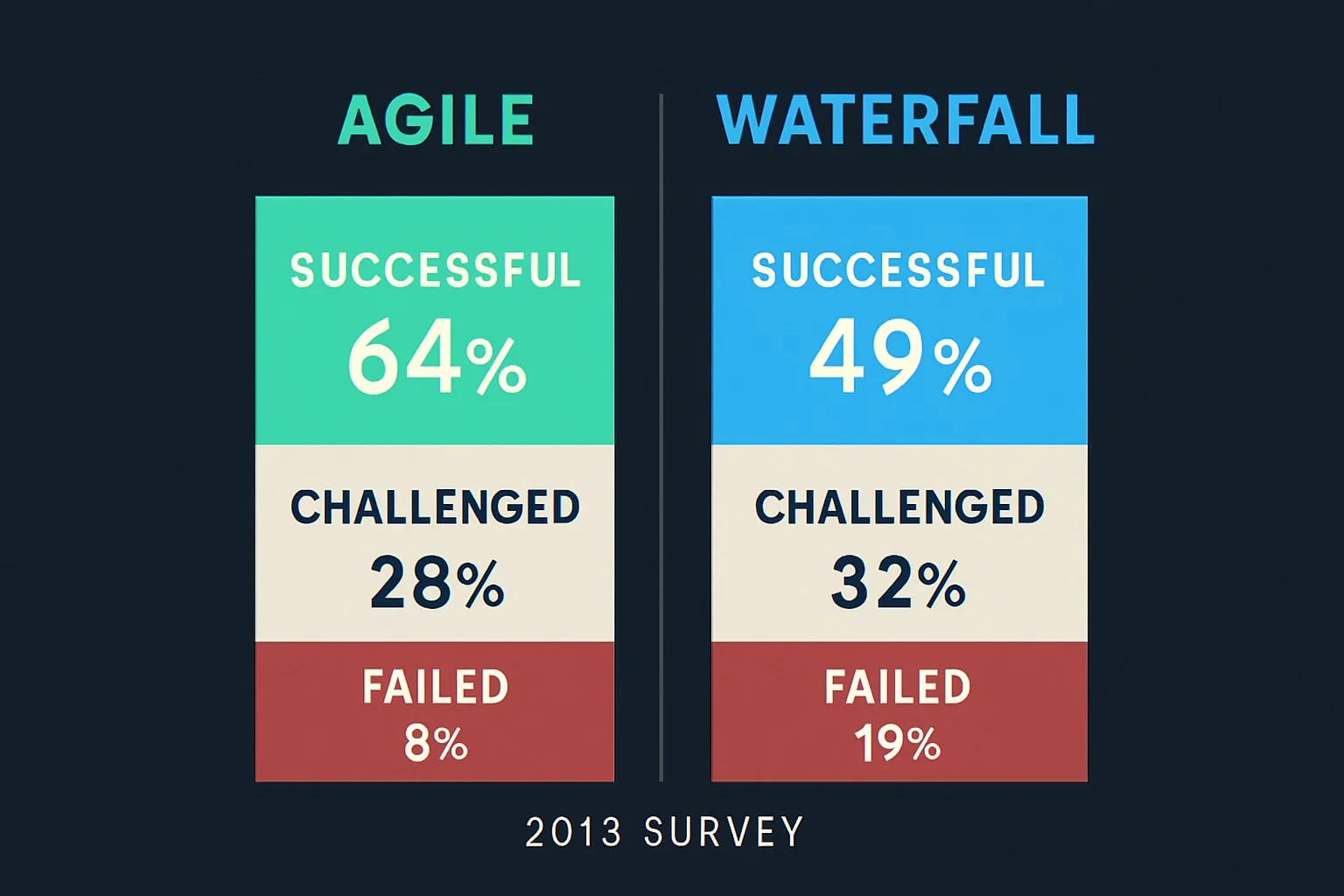
The two primary reasons agile outperforms waterfall in this context are:
1. Incremental delivery. Agile development breaks the project into sprints — typically two to four weeks each — with working features delivered at the end of every cycle. This creates a continuous feedback loop and allows the product to evolve in response to real usage rather than locked-in specifications.
2. Integrated testing and flexibility. Because testing is built into every sprint rather than deferred to the end, bugs and performance issues are caught early when they're smaller and cheaper to fix. The iterative structure also means the team can respond to changing requirements without derailing the project.
For enterprise SaaS in particular, agile's ability to accommodate feedback and pivot incrementally aligns well with the ongoing, relationship-based nature of the business model.
Aligning Marketing and Sales with the Development Cycle
Product development and go-to-market activities shouldn't run on separate tracks. Synchronizing marketing with the development cycle allows each feature release to become a targeted communication opportunity — reaching the right audience with a specific, relevant message at exactly the point when that feature becomes available.
Because agile releases happen in small increments, marketing campaigns can be similarly focused and efficient rather than built around a single large launch event. Each sprint completion is an opportunity to update messaging and deepen engagement with early users.
For vendors transitioning from an on-premises to a SaaS delivery model, it's also important to plan the transition carefully for existing customers: how does the new product interact with what they're currently running, and what support will be provided to make that migration smooth?
4. Learning From Early Users
With an MVP in the market, the focus shifts to gathering and acting on real-world usage data. Early adopters reveal how the product actually performs in practice — which often differs significantly from how it was expected to perform.
This stage tests the assumptions built into the original research and design. Do users experience the application as useful? Does it address the pain points it was designed to solve? What's missing? What's confusing? The answers to these questions directly shape the feature roadmap and inform pricing strategy.
Making the SaaS Value Proposition Tangible for Enterprises
After demonstrating functional value, the financial case for SaaS deserves explicit attention — particularly for small to medium-sized enterprises. The fundamental advantage is the conversion of capital expenditure into operating costs. Rather than a large upfront software purchase, enterprises pay a predictable monthly fee that covers the software, service, maintenance, and updates. This helps finance teams manage budgets more effectively, and provides the vendor with a reliable recurring revenue stream.
As the user base grows, early positive feedback becomes a sales asset. Over time, expanding the product's feature set increases switching costs and strengthens customer retention — the SaaS concept of "stickiness." Adding value continuously is both a product strategy and a commercial one.
5. Keep the Conversation Going
A SaaS product isn't a transaction — it's an ongoing service relationship. The commercial logic of SaaS depends on retaining customers over time, and retention depends on continued relevance. That means staying genuinely engaged with how customers are using the product, what problems they're still encountering, and where the product falls short.
Practically, this requires feedback mechanisms that are built into the platform itself rather than treated as a separate function. Three mechanisms that work well together:
- Automatic error reporting — surfaces issues in real time without relying on users to report them manually
- Built-in feedback channels — in-product feedback boxes that make it easy for users to flag suggestions or problems in context
- Remote usage tracking — analytics that map user pathways and behavioural patterns, identifying where users succeed, where they drop off, and where the experience breaks down
Ongoing engagement isn't just a customer-success activity — it's the mechanism by which the product continues to improve. The agile development cycle and the MVP approach established in earlier stages create the structural basis for this kind of iterative, user-informed development to continue indefinitely.
Building a successful enterprise SaaS product is achievable, but it requires more than riding a market trend. The process matters: thorough research, an MVP-first approach, agile development, real-world user feedback, and continuous customer engagement each play a distinct role. Applied together, they significantly improve the odds of building something that earns lasting enterprise adoption.