What is First-Party Data Onboarding and How Does It Work?
At the heart of every marketing and advertising campaign is data, and in the online world there are enormous volumes of it — with even more on the way thanks to the continued growth of the Internet of Things (IoT).
This abundance of information allows marketers and advertisers to better identify target audiences and deliver relevant ads at the right moment. But not all data carries the same weight, and among the various sources available, first-party data consistently ranks as the most valuable.
What is First-Party Data?
First-party data is any piece of data collected directly from a customer — both offline and online.
Using a telecommunications company as an example, consider what falls under each category:
In the offline world, first-party data would be the customer's account information — a name, a mailing address, a phone number.
In the online world, it would be data collected via the company's web-analytics tools — for instance, a record of that same customer visiting the company's website.
For years, the dominant approach was to enrich first-party data by acquiring and integrating third-party data alongside it. Third-party data wasn't as precise or reliable, but it helped companies identify broader customer behaviours and trends and extend their reach to new audiences.
That calculus has shifted. Marketers and advertisers are finding that the real returns come from first-party data, and according to research from Econsultancy and Signal, reliance on first-party data for advertising is growing as its value becomes clearer.
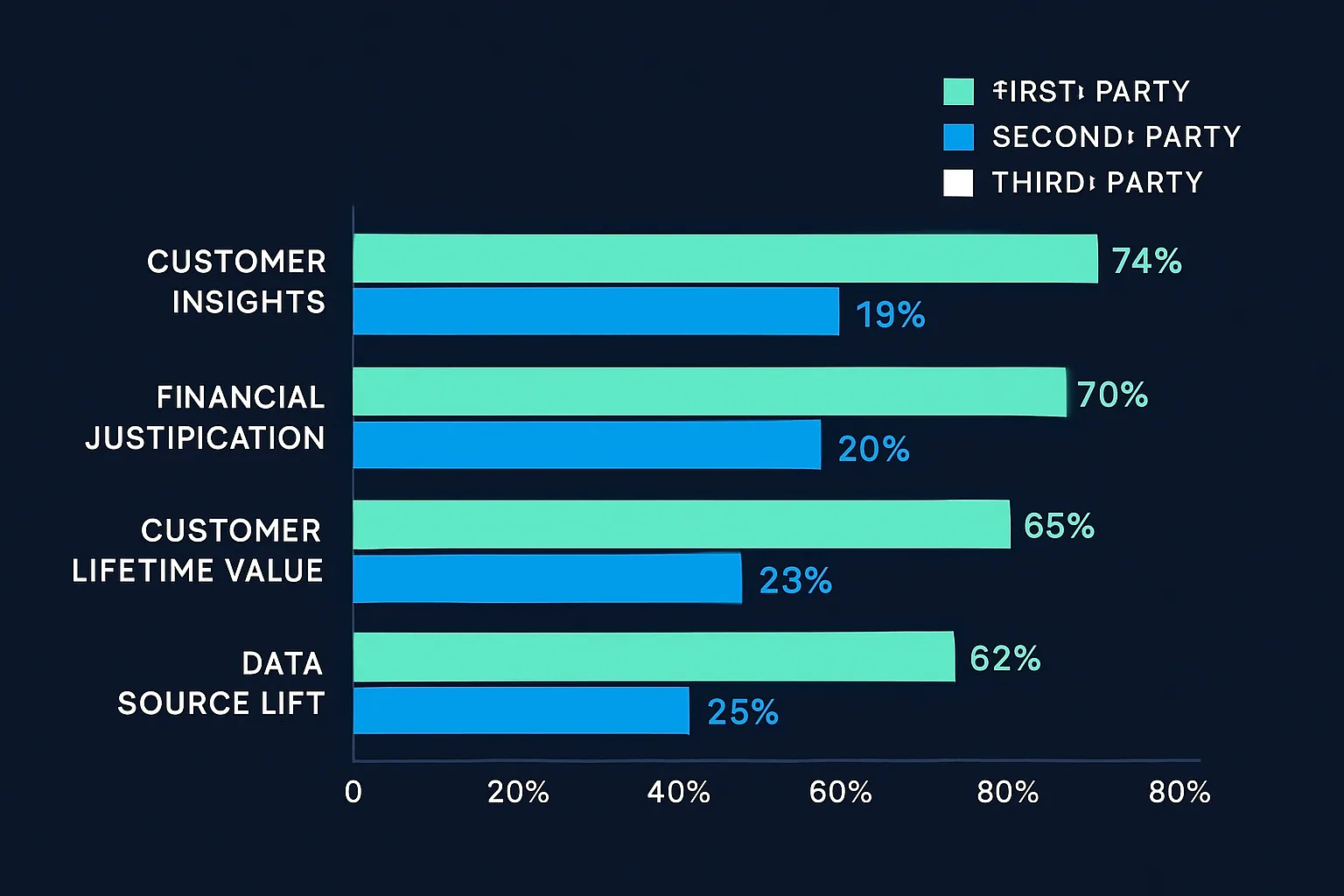
This growing recognition of first-party data's value is precisely what's driving the data-onboarding movement.
What is First-Party Data Onboarding?
In straightforward terms, data onboarding is the process of taking offline customer information and integrating it with online customer profiles.
A company might hold the following data in its offline database:
- Name
- Residential addresses
- Phone numbers
- Email addresses
- Date of birth
- Transactional records and other customer data stored in offline Customer Relationship Management (CRM) systems
That offline data can then be onboarded alongside data held in online databases, such as:
- Data from web-analytics tools and ad servers
- User account information (for example, account records from an online payment system)
- Any other online information collected about the customer, including fields that overlap with the offline record — name, email, residential address, and so on
To do this safely and effectively, companies need an onboarding platform. Some of the most widely used data-onboarding platforms in the industry include:
Common data-onboarding companies and platforms
How First-Party Data Onboarding Works
The specific mechanics vary from platform to platform, but the underlying process follows the same general steps:
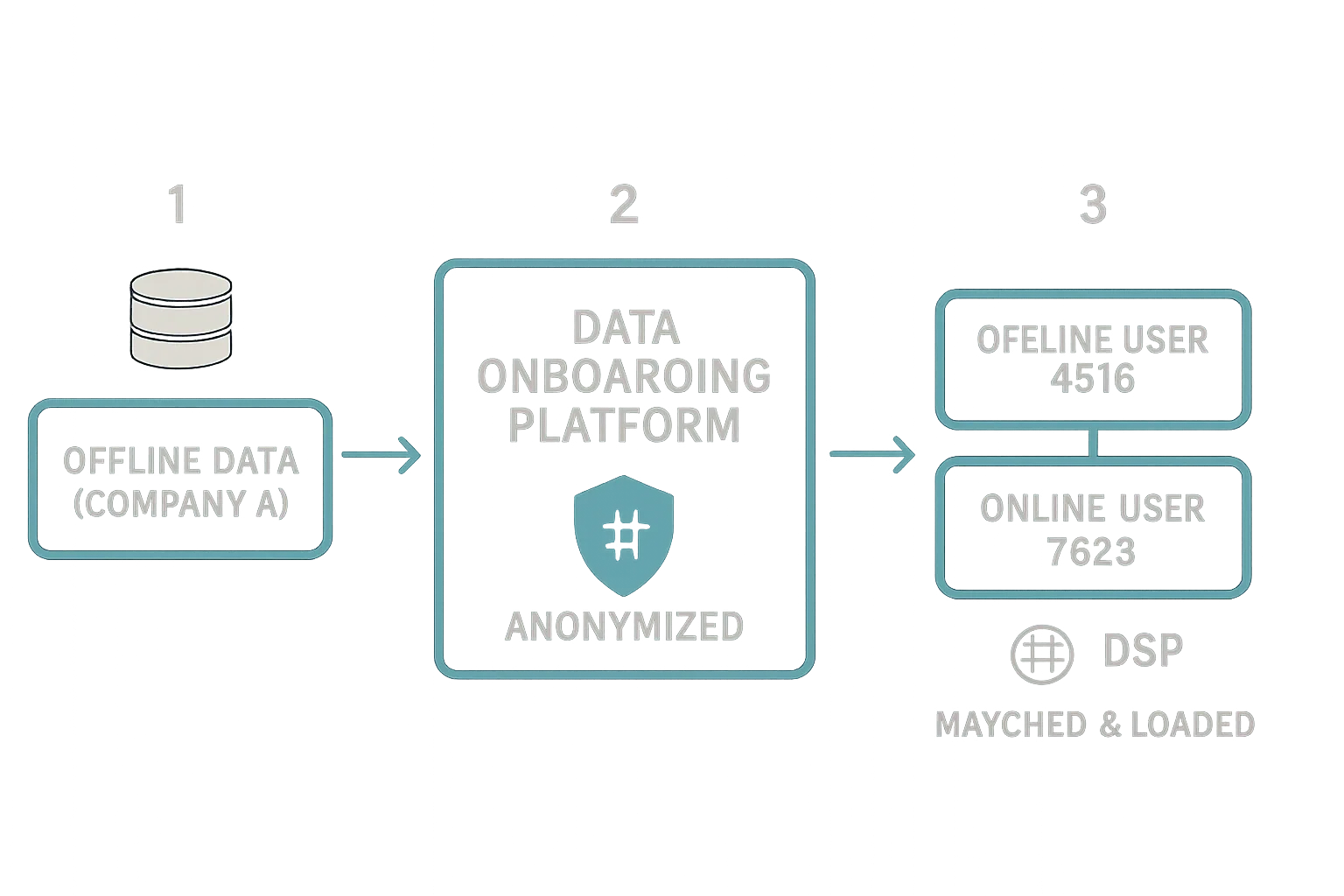
- Upload: The company uploads its offline first-party data to the onboarding platform.
- Anonymize: The platform applies an anonymization process — typically hashing, encryption, or generalization — to strip out any Personally Identifiable Information (PII) such as the customer's email address, name, physical address, or date of birth.
- Match: The anonymized offline data is matched with online data using common identifiers. For example, if a customer's email address exists in both the offline CRM and an online database, the platform uses that shared email as the linking key between the two records.
During this process, companies typically also receive additional identifiers — user IDs and cookie IDs — which can be matched against online data sources such as web-analytics tools. The cookie IDs originate from third-party demand-side platforms (DSPs) and are used to build audiences for ad targeting.
Data Onboarding With Google AdWords, Facebook Ads, and AdRoll
Enterprise-grade onboarding platforms like LiveRamp, Neustar, and iBehavior are designed to handle large volumes of data — typically the kind flowing out of a company's data-management platform (DMP). That scale means the onboarding process can be complex and may take several days to complete.
For companies that don't need that level of infrastructure, a handful of tools offer a simpler path to using offline data for online targeting.
Google AdWords
Through Google's Customer Match, companies and brands can upload a customer email list to AdWords and use it to target those customers — and similar audiences — across Google Search, YouTube, and Gmail.
Facebook Ads
Facebook's Custom Audiences works along similar lines. Companies can upload customer email lists to Facebook Ads for targeting on the Facebook platform, and can also place a tracking pixel on their website or app. Once deployed, that pixel tracks user behaviour and enables customized ads or offers to be shown to those users on Facebook.
AdRoll
AdRoll's core offering is retargeting — across Facebook, Twitter, the open web, and mobile. The platform also provides CRM data-onboarding functionality, allowing companies to bring their offline and online customer data together and use it for retargeting across all of those channels.
A notable advantage of these simpler tools is that none of them require a company to operate a full DMP. That makes data onboarding accessible to smaller businesses, enabling them to target audiences across a range of channels and devices without the overhead of enterprise data infrastructure.