The History of Digital Advertising Technology
Advertising Moves Online
In the early 1990s, companies, organizations, and Internet enthusiasts began building the first public websites. Advertisers quickly recognized the potential of this new medium and started experimenting with ways to reach audiences online.
The first recorded example of online display advertising appeared in 1994, in the form of a banner ad on a website called HotWired (now wired.com). Telecommunications giant AT&T purchased the placement to promote a campaign titled You Will.
first display ad on HotWired in 1994
AT&T's landing page for its You Will ad campaign.
Over the banner's three-month run, 44% of viewers clicked on it — a figure that looks extraordinary against today's benchmarks, where estimated click-through rates range from about 0.02% to 2%.
What is click-through rate (CTR)?
Click-through rate (CTR) is the number of clicks an ad receives divided by the number of times it is displayed (impressions). For example, a CTR of 2% means that for every 1,000 impressions, the ad received 20 clicks.
That single banner marked the beginning of what would become a massive global industry.
Direct Sales and the CPM Model
In the early days of online display advertising, buying and selling ad space was a direct, manual process — not unlike how media had always been transacted.
An advertiser would contact a publisher and purchase space on a cost-per-thousand basis, known as Cost Per Mille (CPM), where mille is Latin for thousand. Under this model, advertisers paid a fixed price for every 1,000 impressions (i.e., 1,000 views of the ad).
To place ads on a publisher's site, an advertiser would send an insertion order (IO) to the publisher's sales team. An insertion order defines the terms of the campaign and typically covers:
- Campaign objectives: Target audience, traffic goals, branding intent, etc.
- Line items with campaign execution terms: Banner sizes, placement locations, and which pages to display ads on.
- Business terms: The pricing model (CPM, CPC, etc.) and payment conditions.
Did you know?
The terms insertion order and line item have their roots in print advertising. Orders were placed for "insertions" of ads in newspapers, and rates were charged per line. For example, a single insertion of a three-line Business Notice in The New York Express in 1870 cost 60 cents.
Source: Pettengill's Newspaper Directory and Advertisers' Handbook, S. M. Pettengill & Company, 1870
This direct model worked at small scale but was entirely manual and left much of the Internet's targeting and optimization potential untapped. That changed when the first piece of advertising technology appeared: the ad server.
The Rise of the Ad Server
The first ad servers emerged around 1995, initially built to control the delivery and management of online ads. Their targeting capabilities were limited — they could only act on the HTTP header information passed along with a browser request, such as:
- The language set on the user's computer
- The URL of the page where the ad was loading
- The browser type and version
- The user's operating system
The first-ever ad server
The first ad server was created by a company called FocaLink Media Services, founded in 1995 by Dave Zinman, Andrew Conru, and Jason Strober.
The company was renamed AdKnowledge in 1998 and was acquired in 1999 by CMGi — an Internet holding company that owned a number of well-known tech properties during that era, including AltaVista as one of its flagship portfolio companies.
CMGi managed to survive the dot-com crash of the late 1990s and early 2000s, but eventually sold AltaVista in 2003 to Overture Services, Inc. Yahoo acquired Overture that same year.
Ad Networks and the Problem of Unsold Inventory
As the number of websites grew, so did the complexity of the direct sales model. Premium inventory — ad space sold directly between publishers and major advertisers — remained viable, but publishers increasingly found themselves with large volumes of unsold inventory.
At the same time, advertisers faced the burden of negotiating and signing individual insertion orders with every publisher they wanted to work with, then coordinating campaign execution across all of them.
Ad networks emerged to address both problems. In 1996, DoubleClick became one of the first ad networks, acting as a broker between advertisers and publishers.
A brief history of DoubleClick
DoubleClick was founded in 1995 by Kevin O'Connor and Dwight Merriman. Private equity firms Hellman & Friedman and JMI Equity acquired it in July 2005 for US$1.1 billion. Google then acquired it in March 2008 for US$3.1 billion — one of the defining transactions in AdTech history.
DoubleClick was one of the few online businesses to survive the dot-com bubble intact.
In 2018, Google rebranded its Google AdWords and DoubleClick product lines into three primary brands: Google Ads, Google Marketing Platform, and Google Ad Manager.
Ad networks worked by aggregating unsold inventory from multiple publishers and offering advertisers a consolidated, generally lower-cost pool of impressions.
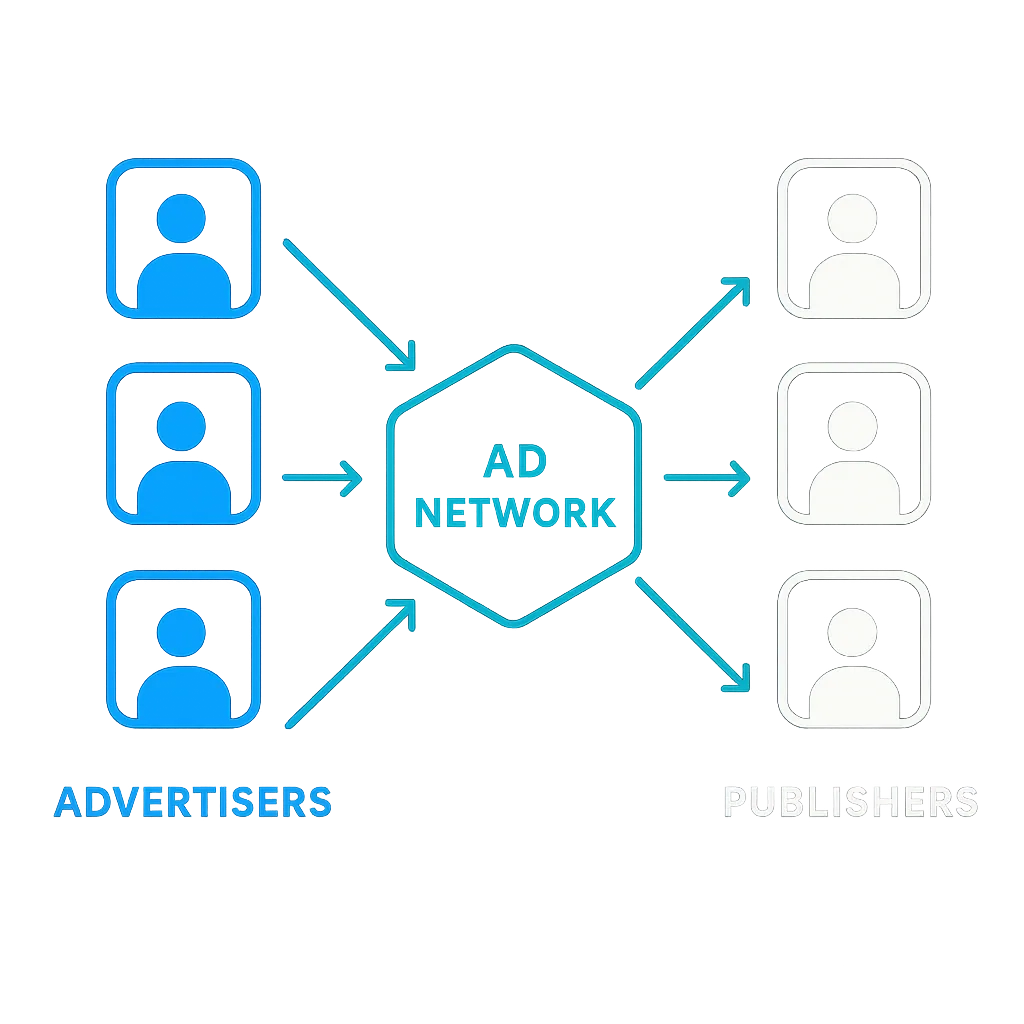
Ad networks created value for both advertisers and publishers.
For publishers, ad networks provided an effective way to monetize remnant inventory — which could represent anywhere from a small percentage to the majority of available impressions, depending on how many direct deals a publisher had. Networks also reduced the time and overhead associated with direct sales and offered supporting services such as campaign setup, optimization, and technical troubleshooting — activities collectively known today as ad trafficking.
For advertisers, ad networks offered cost savings and a more scalable way to reach audiences across many sites simultaneously.
The Waterfall Problem
Despite these benefits, ad networks introduced their own inefficiencies. Most networks only wanted to purchase certain parts of a publisher's inventory — the segments that matched their active campaigns — which meant publishers typically had to work with multiple ad networks to sell all available impressions.
Managing multiple network relationships meant more time spent evaluating partners, paying multiple commissions, and — critically — setting up the waterfall system. In a waterfall arrangement, a publisher's ad server would send requests to networks sequentially: first to the highest-ranked network, then the next if no fill was returned, and so on. This created slow page-load times and operational complexity.
Advertisers ran into their own problems. Relying on a single network rarely delivered sufficient reach, so buyers purchased from multiple networks — often buying the same audience more than once, without clear visibility into performance or which inventory was actually driving results.
Supply-Side Platforms and Ad Exchanges
To address these challenges, a new type of platform appeared: network optimizers, which are known today as supply-side platforms (SSPs).
Network optimizers allowed publishers to:
- Eliminate the time-consuming work of managing multiple ad networks independently.
- Improve page-load times by replacing sequential waterfall requests with a single optimization request.
- Increase revenue by matching inventory to the most appropriate ad network at any given moment.
- Maintain quality controls by blocking certain categories of advertisers — for example, those promoting tobacco or alcohol.
Shortly after, ad exchanges emerged to resolve further technical inefficiencies inherent in the network model — particularly the problem of multiple redirects — and opened the door to purchasing inventory on an impression-by-impression basis.
Ad exchanges were instrumental in the development of real-time bidding (RTB), the mechanism that would eventually underpin modern programmatic advertising.
A Timeline of Key Events in Digital Advertising
Below is a chronological overview of the most significant moments in the first decade and a half of digital advertising technology.
1994: Lou Montulli and John Giannandrea invent cookies while working at Netscape.
1994: AT&T displays the first ever banner ad on HotWired (now Wired).
1995: The first ad server is created by FocaLink Media Services, founded by Dave Zinman, Andrew Conru, and Jason Strober.
1996: Kevin O'Connor and Dwight Merriman found DoubleClick.
1996: Yahoo begins displaying search ads on its search engine.
2000: Google launches AdWords (now Google Ads) with a CPM pricing model; a cost-per-click (CPC) model is introduced in 2002.
2002: Applied Semantics creates contextual advertising technology. Google acquires the company in April 2003 and launches Google AdSense, enabling publishers to monetize content with pay-per-click (PPC) ads.
2006: Adblock Plus, one of the most widely adopted ad-blocking tools, launches.
2006: Mobile ad networks, including AdMob, begin selling ad space on mobile devices — a year before the first iPhone is released in 2007.
2007: Google acquires DoubleClick for $3.1 billion. Microsoft acquires AdECN for a reported $50–75 million. Yahoo acquires RightMedia for $700 million.
2007/2008: Real-time bidding (RTB) is introduced, allowing advertisers to bid on individual impressions via real-time auction. Demand-side platforms (DSPs), such as MediaMath, begin to emerge around the same time.
This was the landscape from which modern programmatic advertising grew — a series of platforms each solving specific pain points, gradually automating and scaling what had started as manual, relationship-driven media buying. The ecosystem that exists today is a direct extension of these early innovations, expanded many times over in complexity, scale, and sophistication.