How To Build a Demand-Side Platform (DSP)
A demand-side platform (DSP) is a piece of software that advertisers and ad agencies use to buy ad inventory in an optimally streamlined manner across multiple ad exchanges and supply sources. By leveraging algorithms and real-time bidding capabilities, DSPs give advertisers control and precision in reaching their target audiences.
While there are hundreds, if not thousands, of ready-to-use DSPs on the market, it sometimes makes more business sense for a company to build a custom DSP of its own.
The advantages can be substantial, but building a DSP demands significant time and financial investment that not every company will fully benefit from. For certain businesses, however, developing a proprietary DSP may be the only viable path to meeting their specific needs.
This article covers the process of designing and building a DSP — its features, architecture challenges, development phases, and real-world implementation considerations.
What Is a Demand-Side Platform (DSP)?
A demand-side platform (DSP) is an advertising technology (AdTech) platform that enables advertisers and agencies to purchase ad space on an impression-by-impression basis from publishers via ad exchanges and supply-side platforms (SSPs). That inventory can be purchased in real time through a single user interface.
With a DSP, advertisers can buy:
- Display ads: Banners and interactive ads that appear on websites and apps.
- Video ads: Pre-roll, mid-roll, and post-roll video ads that play before, during, or after online video content.
- Native ads: Ads that blend seamlessly with the form and function of the platform or website they appear on.
- Mobile ads: Ads displayed on mobile devices.
- Audio ads: Ads on audio streaming platforms, podcasts, and internet radio.
- Digital out-of-home (DOOH) ads: Ads on digital billboards — screens in public spaces, transportation hubs, and shopping centres.
- Connected TV (CTV) ads: Ads delivered through internet-connected smart TVs and streaming devices.
- In-game ads: Ads placed within video games.
The primary function of a DSP is to purchase ad inventory. Within the platform, ad operations (AdOps) teams can create, run, and manage many ad campaigns simultaneously across multiple SSPs and ad exchanges, increase ROI via optimization mechanisms, improve targeting by integrating the platform with data management platforms (DMPs), and analyze campaign performance through reporting and analytics modules.
How Does a DSP Work?
Advertisers and ad agencies can create, launch, and manage multiple ad campaigns across a variety of supply sources through a single user interface. Most companies have a dedicated team — known as ad operations (AdOps) — responsible for setting up and managing campaigns inside the DSP.
The mechanisms and components involved in buying ad impressions encompass real-time bidding (RTB) processes, integrations with SSPs and ad exchanges, and the use of bidders and algorithms to process data.
Here is a breakdown of the process in detail:
- An advertiser establishes campaigns, including targeting criteria and creatives, within the DSP.
- Ad exchanges and SSPs notify the DSP about available impressions.
- The DSP analyzes data associated with the impression.
- Based on relevance to the buyer's target audience, the DSP determines the value of the particular user who will see the ad.
- The DSP places a bid on the impression, reflecting the maximum amount the advertiser is willing to pay to display their ad to that user.
- The ad exchange or SSP collects bids from multiple DSPs and selects the highest bidder.
- If the DSP wins the bid, the ad is served to the user's device in real time.
- The DSP continuously monitors and optimizes campaign performance, adjusting bids to maximize ad effectiveness and return on investment (ROI).
- This process is repeated for each impression, allowing the DSP to reach and engage the desired audience efficiently.
The entire real-time bidding (RTB) process happens as the page is loading and is completed in roughly 100 milliseconds.
Who Can Benefit From Building a DSP
While any company can build a DSP, the businesses with the most to gain are advertisers, ad agencies, and AdTech companies. Developing such a platform presents significant business opportunities, including revenue growth, increased market presence, and — for AdTech companies in particular — the ability to offer comprehensive solutions to advertisers.
A custom DSP can also:
- Help companies reduce the commissions they pay to intermediaries.
- Give companies full control over the product roadmap and ownership of the technology — including the codebase and intellectual property (IP).
- Provide companies with more control over their data and the media-buying process.
AdTech Companies
Building a DSP allows AdTech companies to tap into the growing programmatic advertising market. By offering a DSP, they can provide advertisers with a comprehensive platform for managing ad campaigns, opening up new revenue streams through fees, commissions, and licensing models.
A custom DSP also gives AdTech companies full control over the technology and features offered to advertisers. The platform can be tailored to meet specific market demands — including unique targeting options, advanced optimization algorithms, and customized reporting and analytics capabilities.
An additional advantage for independent AdTech companies is the ability to develop strategic partnerships with specific SSPs, ad exchanges, DMPs, and verification partners. This expands their network, creates a differentiated offering, and broadens their customer base.
Advertisers and Ad Agencies
The main benefits for advertisers and ad agencies include enhanced control over advertising campaigns, precise audience targeting, transparent cost structures, and increased competitive advantage.
A custom platform can be aligned with unique objectives, preferences, and target audiences. This level of control enables advertisers and ad agencies to make real-time adjustments, experiment with different strategies, and incorporate algorithms to optimize campaigns for maximum effectiveness.
Granular targeting options allow them to reach the right audience at the right time, delivering personalized messages that resonate with their customers.
From a cost and transparency standpoint, developing a custom DSP eliminates reliance on third-party platforms, reducing costs associated with platform fees and intermediary markups.
Finally, building a custom DSP positions advertisers and ad agencies as innovators. They can differentiate from competitors by offering unique targeting capabilities, customized features, and seamless integration with their existing technology stack.
Key Features of a Demand-Side Platform (DSP)
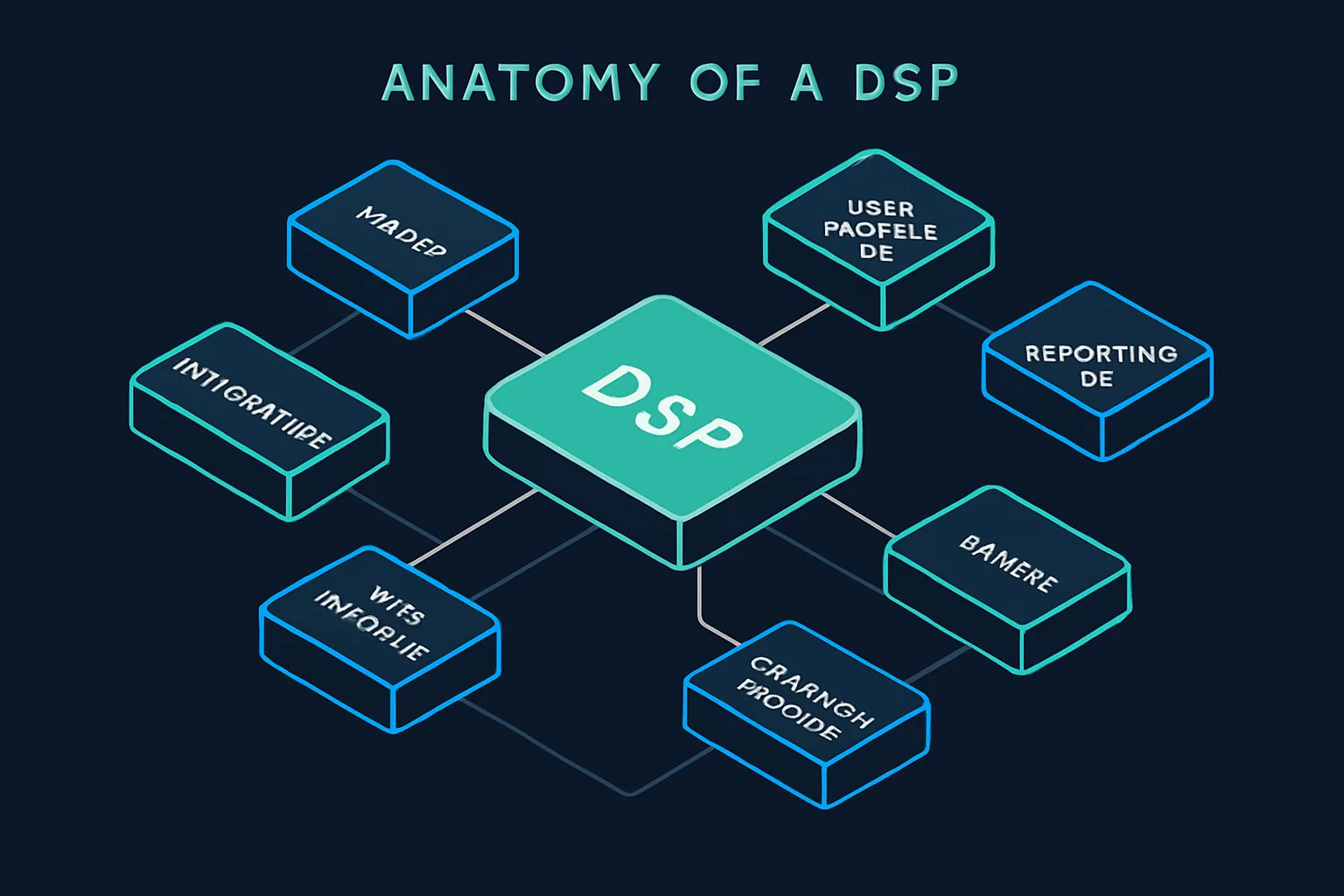
When developing a DSP, it is essential to focus on the most important features: budgeting (also known as an ad banker), the bidder, integrations, the user interface, the user profile database, the reporting module, the campaign tracker, and the ad server.
Optimization Features
Well-designed DSPs include modules to maintain ad campaigns, optimize ad targeting, and control spending. These are driven by algorithms and machine learning that analyze performance data, adjust bidding strategies, and allocate budget toward the most effective placements and audiences — automatically optimizing campaigns over time.
- The campaign tracker is the component responsible for collecting data on campaign performance.
- Targeting options allow advertisers and ad agencies to reach their desired audience precisely, based on demographics, location, behaviour, interests, and device types.
- The ad banker is the module that prevents overspending. It helps manage and control an advertiser's media spending during real-time bidding.
Integrations
To function correctly — that is, to access a wide range of ad inventory and data sources — a DSP must be integrated with SSPs, ad exchanges, and DMPs. These integrations allow advertisers to tap into diverse inventory options, reach various publishers, and leverage audience insights for precise targeting and retargeting.
Analytics and Reporting
DSPs provide comprehensive analytics and reporting capabilities to monitor campaign performance. This typically includes real-time reporting and customizable dashboards that visualize all relevant data.
Main Challenges When Building a DSP
Building a DSP is a complex undertaking involving many interdependent components, each with its own set of challenges: managing technological complexity, integrating multiple features, and maintaining high-speed performance under load.
Maintaining High-Speed Performance and Dependability
A DSP must be reliable and perform well under heavy loads, especially during peak traffic periods. Ensuring high performance and uptime requires robust architecture and efficient code, which can be challenging to design and implement.
Using microservices — where each part of the DSP operates independently — or cloud-based architectures that can scale up or down as needed are generally the most suitable solutions to these challenges.
Achieving Scalability
As the user base and data volume grow, the DSP must be able to scale accordingly to handle increased traffic and data processing demands. Designing with scalability in mind from the outset is critical to ensuring the platform can absorb growth without architectural overhauls.
Integrating with Other Platforms
DSPs must integrate with various ad exchanges, SSPs, and DMPs. These integrations must be implemented correctly and tested thoroughly to ensure the DSP can respond to bid requests within the required timeframes.
Optimal Ad Targeting
Implementing sophisticated algorithms for efficient ad targeting — delivering the right ads to the right users at the right time — is one of the more demanding technical challenges. The platform must analyze user data, context, and behaviour to make accurate predictions and decisions.
To process vast amounts of data in real time and predict user behaviour, personalize ads, and optimize bidding strategies, a range of technologies is typically employed: big data systems, real-time processing systems, machine learning algorithms, AI, cloud technologies, databases, security technologies, and web technologies.
How To Design and Build a DSP
Developing a demand-side platform is a multi-phase process. The following outlines the standard phases used to build DSPs and other programmatic advertising software.
Discovery
The Discovery phase establishes a clear project foundation:
- Define what the DSP needs to achieve and establish a clear product vision.
- Identify what is required to get the DSP off the ground, and surface potential technical roadblocks related to real-time bidding, ad targeting, and large-scale data processing.
- Address technical constraints upfront — ensuring the platform can scale with the business, comply with data privacy regulations, and support effective ad targeting.
Sprint 0
Sprint 0 translates discovery findings into a concrete plan:
- Identify unknowns in the project and develop approaches to resolve them.
- Select the key features for the initial version of the DSP — the minimum viable product (MVP) — and assemble a prioritized backlog of user stories defining those features.
- Choose the appropriate technology stack and design the architecture for efficient ad buying, real-time bidding management, and audience segmentation.
- Begin groundwork for the MVP or validate a specific aspect of the project with a proof of concept (PoC).
MVP Development
The MVP phase brings the platform to life:
- Front-end and back-end development proceeds in parallel with infrastructure setup, UI design, and thorough testing to ensure everything works as expected.
- The MVP is launched to a small group of users or stakeholders — typically advertisers and marketing practitioners.
- Feedback from early users shapes the next stage of development, with particular focus on user experience, ad-buying efficiency, and reporting requirements.
- Platform performance is monitored closely throughout, with any unexpected issues addressed promptly.
Post-MVP Development and Maintenance
After the MVP is stable and validated:
- Development continues in focused two-week sprints, adding and refining features such as advanced targeting options and more detailed analytics.
- Ongoing support and maintenance keeps software and infrastructure running reliably, with issues resolved quickly.
- Where necessary, the project is handed over to the client's internal team with full documentation and access credentials to enable independent management and maintenance.
DSP Implementation: Real-World Examples
Building a Scalable DSP for Programmatic Display Buying
One programmatic media-buying platform was designed to handle the scale demands of online display advertising. The core challenges involved processing billions of bid requests daily and surfacing performance data in real time.
Key implementation decisions included:
- Architecting the system with horizontal scalability in mind, enabling the platform to manage billions of bid requests daily despite running on a limited initial infrastructure.
- Using multiple software development solutions and tools — including Python, Twisted, Redis, Storm, and others — to deliver an ultra-fast bidding engine.
- Integrating with AppNexus and ad exchanges supporting OpenRTB protocols, such as Nexage, to provide marketers with access to major biddable display advertising inventory.
The platform was built from scratch, with an MVP introduced to a select group of beta testers whose feedback guided ongoing development. It was later showcased at TechCrunch Disrupt 2013 in New York, where it received significant industry recognition, and was subsequently acquired by Gravity4, a Silicon Valley AdTech company.
Optimizing a Mobile DSP for Location-Based Advertising
A mobile DSP leveraging location-based technology engaged an outside development team to optimize its infrastructure, expand inventory access, and minimize discrepancies between SSP partners. The primary challenges were scaling the infrastructure to increase the number of daily impressions the DSP could process and accessing a broader inventory pool.
Key outcomes included:
- Integrating the DSP with various ad exchanges and SSPs, increasing its capacity to handle bid requests per second, automating routine tasks, and improving report generation based on tracked events.
- Designing custom solutions to handle discrepancies between the DSP and its ad exchange/SSP partners — working directly with those partners to develop custom reporting mechanisms. This reduced discrepancies from approximately 50% to just 1%, meaningfully improving media spend efficiency.
- Implementing a service-level agreement (SLA) providing 24/7 monitoring, resulting in immediate responses to performance issues, proactive avoidance of potential problems, and frequent infrastructure optimizations.
Ad Banker: A Distributed Budget Management Tool for RTB
One notable component developed for DSP deployments is a distributed budget management tool — commonly referred to as an "ad banker" — built specifically for real-time bidding environments. The tool helps AdTech firms avoid budget overspend and can shorten the development timeline when constructing a DSP. Benchmark testing demonstrated that this type of tool can reduce budget overspending from 37.2% down to just 1.2%.
Building a custom DSP is a substantial technical undertaking, but for the right type of organization — whether an AdTech vendor, a large advertiser, or a media agency seeking full control over its programmatic stack — the investment can yield meaningful competitive and operational advantages. The key is entering development with a clear product vision, a scalable architecture plan, and a realistic roadmap that prioritizes the features that deliver the most immediate value.