How Real-Time Bidding (RTB) Changed Online Display Advertising
There was a time, believe it or not, when commercial advertising was outright banned on the Internet. It can be difficult to imagine an online world without banner ads, pop-ups, or sponsored content — but whether you find digital advertising intrusive or appreciate that it underwrites enormous amounts of free content, the rapid growth of the online advertising industry is impossible to deny.
The Internet has proven to be a powerful, highly effective, and extremely lucrative advertising medium. Over the past decade-plus, the U.S. market alone has achieved a series of notable milestones:
- 2011 — Online advertising revenues overtook cable television: $36.6 billion vs. $32.5 billion.
- 2013 — Online advertising revenues rose 17% to $42.8 billion, up from $36.57 billion in 2012.
- 2013 — For the first time, online advertising revenues exceeded both broadcasting and cable television revenues — individually, not combined.
- 2014 — Q3 revenues reached a then-historical high of $12.4 billion.
- 2014 — Mobile advertising revenue in the first half of the year climbed to $5.3 billion — a 76% increase over the same period in 2013.
Online advertising has evolved into a global, multibillion-dollar industry spanning everything from email marketing and search engine marketing (SEM) to display advertising, social media, and mobile. Among all these channels, display advertising has undergone arguably the most dramatic transformation — and shows no sign of slowing down.
Online Display Advertising
The growing accessibility of the Internet through the 1990s created a new opportunity for marketers. Where email had been the primary vehicle, a richer format was emerging: online display advertising.
The first recorded piece of online display advertising appeared in 1994 as a banner ad on HotWired, purchased by telecommunications giant AT&T to promote their You Will campaign. Over its three-month run, that banner achieved a click-through rate of 44% — roughly 42 percentage points above today's industry benchmark of around 2% for a successful campaign.
That single placement marked the beginning of what would become a highly lucrative trade.
Direct Sales: The Early Model
In the early days of online display advertising, the transaction between an advertiser (or agency) and a publisher (the website owner) was a direct sales process. Advertisers would contact a publisher and purchase ad space (inventory) on a cost-per-thousand-impressions basis — known as Cost Per Mille, or CPM, since mille is Latin for "thousand." Under this model, advertisers paid a set price for every 1,000 impressions (i.e., 1,000 views of their ad).

As the number of websites — and therefore publishers — grew, the once-straightforward direct sales process became increasingly complex and unwieldy. Premium ads (inventory bought directly from publishers by major advertisers) remained common, but publishers began finding that large portions of their available inventory went unsold, leaving them vulnerable to the effects of oversupply.
Ad Networks: Aggregating Remnant Inventory
To address this problem, advertising networks emerged. Ad networks act as brokers: they buy unsold — or remnant — inventory from publishers, process it through their own technology, aggregate audiences across multiple publishers, and then package and sell that inventory to advertisers.
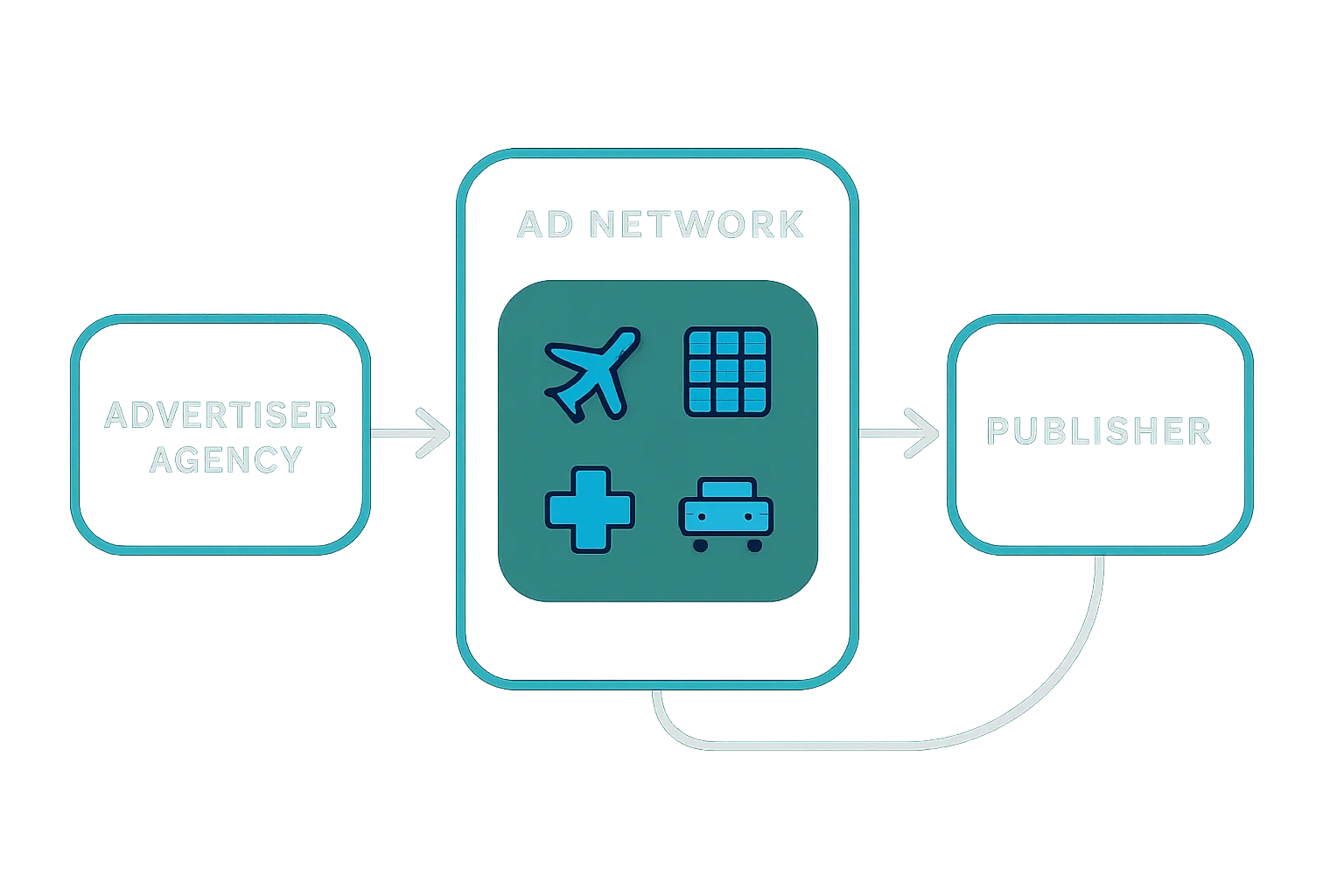
Both sides of the market benefit. Publishers gain a practical mechanism to monetize the 10%–60% of their inventory that would otherwise go unfilled, and they reduce the time and cost associated with selling individual placements. Advertisers, in turn, benefit from cost savings and greater reach — accessing large, aggregated audiences far more efficiently than direct deals would allow.
However, as the number of ad networks multiplied, new complications arose. Publishers discovered that no single ad network could reliably fill all of their remnant inventory, so they began working with multiple networks simultaneously. That introduced its own overhead: identifying the best-performing networks, managing multiple relationships, and paying commissions to several parties at once.
Advertisers encountered a parallel problem. Reaching their target audience through a single network became insufficient, so they too began buying from multiple ad networks and exchanges. The consequence was duplication — buying the same audience more than once — alongside poor visibility into which placements were actually performing, and difficulty pinpointing their most valuable inventory.
The industry needed a better solution.
Ad Exchanges and Real-Time Bidding
The next major shift in online display advertising was the arrival of ad exchanges and real-time bidding (RTB).
The simplest way to understand how ad exchanges work is to think of the stock exchange. Just as stock exchanges facilitate the buying and selling of equities, bonds, and other securities, ad exchanges manage and execute the buying and selling of ad impressions between publishers and advertisers. The liquidity of inventory — much like the liquidity of stocks — allows thousands of advertisers (or media buyers) and publishers to trade in real time on a shared marketplace.

Rather than purchasing impressions in bulk at a fixed CPM shown to a broad audience — which typically includes only a fraction of an advertiser's true target — advertisers can now bid on impressions one at a time, selecting only those that match the audiences they care about. This precision benefits publishers as well: when inventory is shown to users that advertisers genuinely want to reach, the price those advertisers are willing to pay goes up.
How RTB Works
Real-time bidding is the mechanism that makes all of this possible. The operational details of RTB are complex, involving many components working in concert, but the core process can be summarized as follows:
- Publishers make their ad inventory available on the ad exchange.
- Advertisers bid on individual impressions in real time, based on criteria such as audience characteristics, retargeting signals, and context.
- The advertiser who bids the highest amount for a given impression wins the auction.
- The winning creative is then rendered on the publisher's page.
This process — also referred to as programmatic media buying — repeats every time a webpage loads. The entire auction begins and concludes before the page finishes rendering, completing in approximately 100 milliseconds.
What began as a mechanism for offloading remnant inventory has since expanded: RTB is now used across all types of display advertising, including premium ad space.
Benefits of RTB
RTB has reshaped online display advertising for everyone involved. Beyond the widely cited advantages — improved targeting and retargeting, reduced inventory waste, higher per-impression revenues, and greater campaign control — RTB also unlocks a range of benefits through real-time analytics.
For Advertisers
Increased ad effectiveness: Performance analysis is a core component of any RTB campaign. Real-time analytics let advertisers quickly shift focus from underperforming ad groups to stronger ones. Critically, this can be done programmatically — algorithms make the adjustments automatically, without requiring manual intervention — enabling faster optimization at a scale that would otherwise be impossible.
Identifying fraudulent inventory: Ad fraud is a significant problem in display advertising, with estimates suggesting it costs advertisers approximately $6 billion annually. Real-time analytics, combined with dedicated fraud-detection technologies, help identify suspicious inventory — unusually high click-through rates, for instance, are often a reliable indicator that bots rather than humans are generating the traffic.
Campaign optimization: Real-time data allows advertisers to apply tactics dynamically across running campaigns. By monitoring which audiences and ad units are generating the best click-through rates, reach, and engagement at any given moment, advertisers can redirect spend and adjust creative on the fly — capabilities that simply didn't exist under traditional bulk-buying models.
For Publishers
Increased revenues: When inventory is accessible to a large pool of competing advertisers, demand — and therefore price — rises. More inventory gets sold, and it sells at higher rates than remnant channels previously allowed.
Optimized price floors: Real-time analytics give publishers the ability to adjust CPM price floors dynamically based on what advertisers are actually paying for particular audiences. For example, a travel publisher that sets a CPM floor of $1.50 might discover through real-time data that the market rate for their audience is running at $1.40. Armed with that information, the publisher can adjust the floor accordingly — capturing revenue that would otherwise slip away.
Where RTB Stands
U.S. RTB ad spending was projected to grow 31% to $5.94 billion and account for 25% of all online display advertising sales in 2015. Those numbers reflect a technology that has moved from a niche mechanism for clearing unsold inventory to a foundational layer of the entire display advertising ecosystem. For publishers, advertisers, and the platforms that serve them, understanding how RTB works is no longer optional — it's a prerequisite for operating effectively in modern digital media.