How Real-Time Bidding (RTB) Works
Imagine opening a web browser and navigating to a website. The page loads, and you notice a display ad on the right-hand side promoting a hotel you recently researched for an upcoming trip.
How did that website know you'd been looking at that particular hotel?
That's retargeting — and it's just one small piece of a much larger system known as the online display advertising ecosystem.
There are several ways a user can be served an ad when visiting a website, depending on what the site's owner (the publisher) has set up. The publisher might have a direct relationship with an advertiser, agreeing to display ads for a fixed price over a set period. They might sell inventory through an ad network on a cost-per-thousand (CPM) basis. Or they might use Real-Time Bidding (RTB) — an automated auction process that has fundamentally changed how display advertising is bought and sold.
The Main Components of the RTB Process
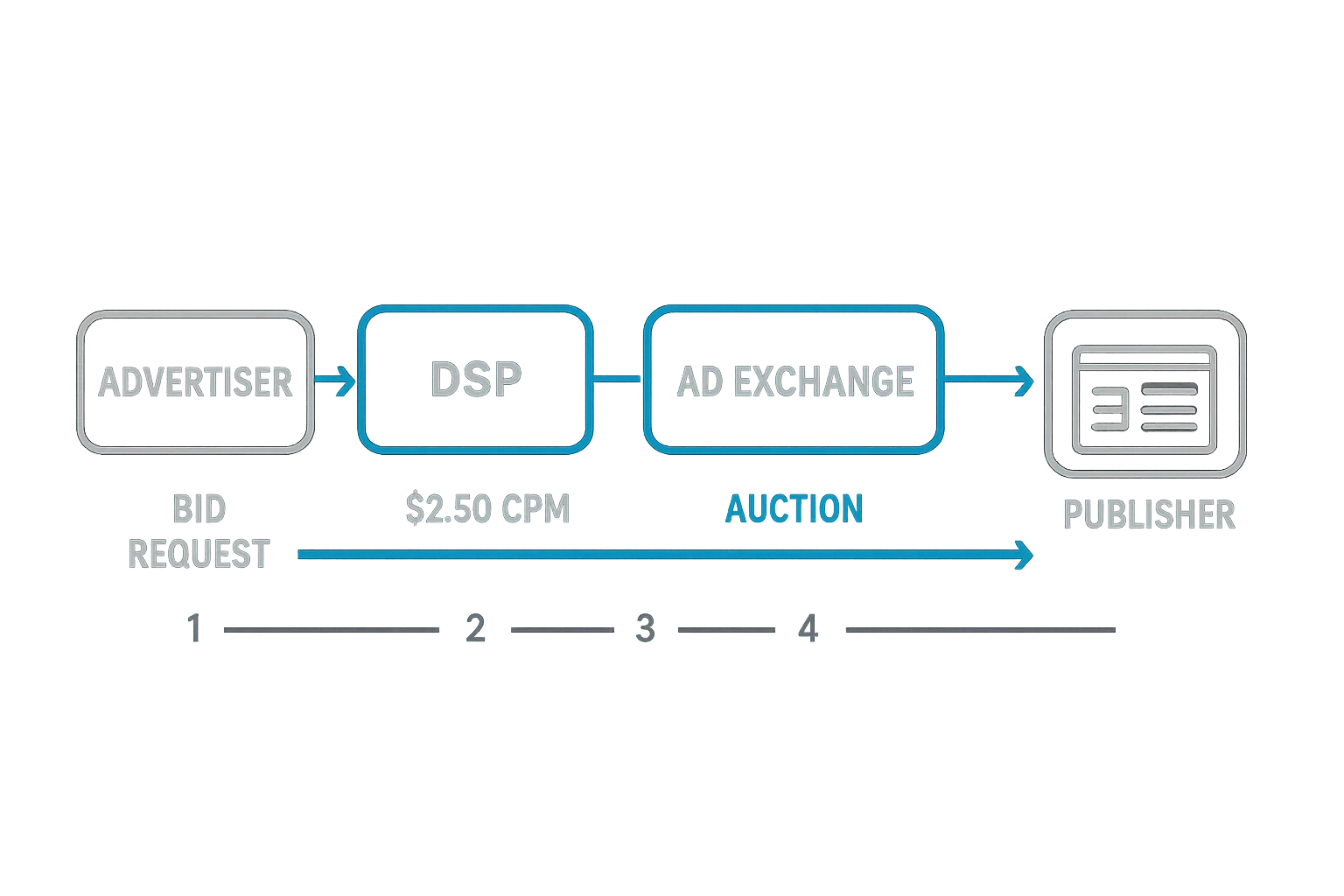
The RTB ecosystem involves several platforms and systems — including ad servers, data management platforms, and third-party data providers — but the core of the process comes down to five key parties: the publisher, the supply-side platform (SSP), the ad exchange, the demand-side platform (DSP), and the advertiser.
The Publisher
In display advertising, the publisher is the website that users visit. A publisher can be anything from a travel blog or news site to a large web application. When a publisher decides to monetize through display advertising, they make ad space — called ad slots — available on their pages. That available space is referred to as inventory.
The Supply-Side Platform (SSP)
The SSP is designed to help publishers sell their inventory across multiple ad exchanges in an automated, secure, and efficient way. Publishers don't strictly need an SSP to access ad exchanges, but the technology SSPs provide helps them maximize yield from their inventory and gain clearer insight into their audience.
The Ad Exchange
Ad exchanges are dynamic technological platforms that facilitate the buying and selling of available impressions between advertisers (buyers) and publishers (sellers) — functioning much like a stock exchange manages trades between investors and companies.
The Demand-Side Platform (DSP)
The DSP is the advertiser's counterpart to the publisher's SSP. It stores the display ads (also called creatives) that advertisers want placed on websites, and it provides a range of additional capabilities that benefit media buyers.
Key DSP features include:
Optimized media spending and conversions: Many DSPs use advanced technology and algorithms to target specific audiences, helping advertisers reach the right users at the right time.
Fraud avoidance: With an estimated $6 billion stolen from advertisers annually through online advertising fraud, DSPs actively work to identify and avoid malicious sites and inventory that generates fake traffic via bots.
Transparency: An increasing number of DSPs offer media buyers detailed, transparent reporting on media spend and campaign performance.
Reporting capabilities: Analytics and granular reporting tools allow media buyers to gain clearer insight into their campaigns, make data-driven adjustments, and maximize return on ad spend.
The Advertiser
At the other end of the transaction sits the advertiser — sometimes called the media buyer. Advertisers can be individual companies or agencies acting on behalf of multiple brands.
The Real-Time Bidding Process
The RTB process begins the moment a user lands on a website or web application. The publisher's site immediately notifies the supply-side platform that an impression is available.
The SSP collects information about the user — including location, browsing history, and where available, demographic data such as age and gender — and forwards this to the ad exchange.
The ad exchange receives that user data, connects to the relevant demand-side platforms, and relays the information. An auction begins: each DSP bids on the impression based on what it's worth to the advertiser it represents, guided by predefined targeting parameters the advertiser has set. The highest bid wins, and the winning creative is sent back to the publisher and rendered for the user.
This entire process repeats for every available impression on every page, every time a user visits, navigates to a new page, or refreshes.
From Available to Sold in Under 100 Milliseconds
One of the most remarkable aspects of RTB is the speed at which auctions occur. Each transaction takes approximately 100 milliseconds — one tenth of a second.
For context: it takes roughly 300 milliseconds to blink. RTB auctions complete in about a third of that time.
A few additional data points that illustrate RTB's scale and trajectory:
- In 2007, the three largest ad exchanges at the time — DoubleClick, AdECN, and RightMedia — were acquired by Google, Microsoft, and Yahoo! respectively, signalling how quickly the major platforms were moving to control programmatic infrastructure.
- IDC projected that by 2017, more than 40% of total mobile and online display advertising would be RTB-based. (IDC)
- Global spending on RTB was projected to reach $13.9 billion by 2016, making it the fastest-growing segment of digital advertising at that time. (Ad Exchanger / IDC)
RTB remains one of the foundational mechanisms of modern programmatic advertising. Understanding how the publisher, SSP, ad exchange, DSP, and advertiser interact — and how quickly that interaction happens — provides a solid basis for navigating the broader display advertising landscape.