Key Features of a Supply-Side Platform (SSP)
Supply-side platforms (SSPs) give publishers the tools to manage, sell, and optimize their ad inventory — connecting them with ad exchanges, demand-side platforms, and ad networks to reach a broader pool of buyers and extract more value from every impression.
This guide covers what an SSP is, how it works, and the core features that define a well-built platform.
Key Points
- A supply-side platform (SSP) is an advertising technology platform that enables publishers to manage, sell, and optimize their available ad inventory on websites, mobile apps, and other digital advertising channels.
- To connect publishers with buyers, SSPs integrate with various demand sources — DSPs, ad exchanges, ad networks, and agencies.
- The critical features of an SSP include yield optimization, demand source integrations, ad quality controls, header bidding, analytics and reporting, budgeting, frequency capping, and inventory and campaign management.
What Is a Supply-Side Platform (SSP)?
A supply-side platform (SSP) is an advertising technology platform that enables the management, sale, and optimization of publishers' available inventory on websites and mobile apps. By leveraging SSPs, publishers can tap into real-time bidding (RTB) media transactions, selling display, video, and native ad space to advertisers on an impression-by-impression basis.
Publishers use SSPs to streamline ad operations and maximize both their efficiency and revenue potential.
How Does a Supply-Side Platform Work?
SSPs offer several methods for selling a publisher's inventory, but the most common is through real-time bidding (RTB) auctions.
The illustration below shows how ad space is sold through an SSP via RTB.
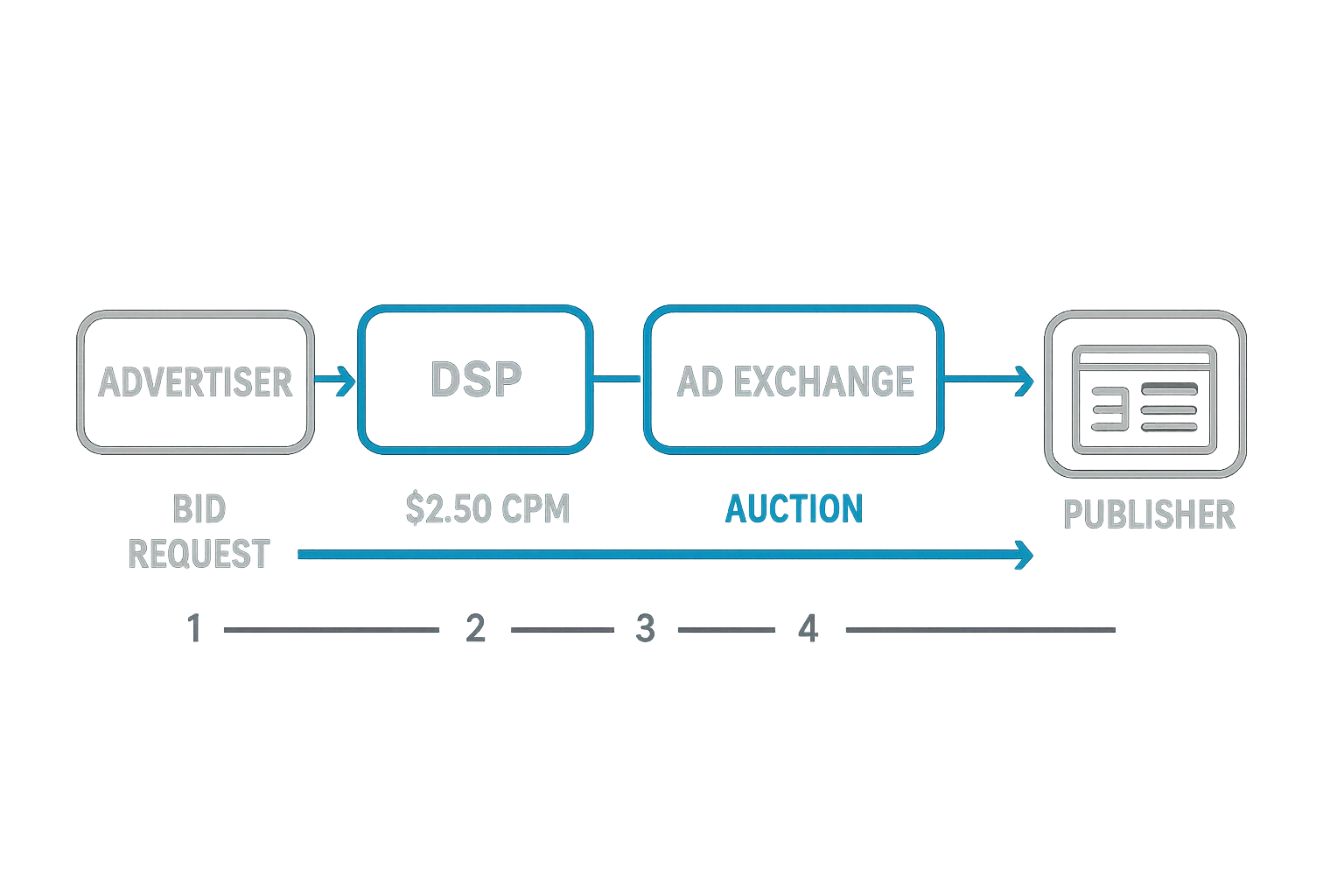
Here is how the process unfolds using real-time bidding:
- A publisher defines and organizes their available ad space, including formats (display, video, native), ad sizes, and targeting options.
- Each time the publisher's webpage loads, an ad request is sent to multiple ad exchanges — and sometimes directly to demand-side platforms — either from the webpage to an SSP or from the publisher's ad server to an SSP.
- Various DSPs submit bids on the impression being offered by the publisher.
- The winning bid is returned to the website, and the associated ad is displayed to the user.
Key Features of an SSP
When evaluating or building an SSP, it's important to identify the features that address specific operational use cases. Below are the main SSP functionalities that support effective programmatic advertising management and optimization.

User Interface
Publishers use the user interface to manage campaigns, review reports, handle payments, and access other platform capabilities. A well-designed UI is essential for operating an SSP efficiently and comfortably.
Analytics
Comprehensive analytics are fundamental for publishers to understand ad performance and make data-driven decisions. SSPs provide detailed reporting on key metrics including:
- Impressions
- Clicks
- Revenue
- Fill rates
Publishers can use these insights to optimize ad strategies, identify revenue opportunities, and assess the effectiveness of their inventory monetization efforts.
Reporting
SSPs give publishers visibility into who is bidding on their inventory, the prices at which it is being purchased, and the amounts paid by specific advertisers. This deeper view helps publishers better understand the value of their inventory to particular demand sources.
Custom Reporting
Custom reporting modules allow AdOps teams to generate tailor-made reports aligned precisely with their requirements. Typical configuration options include:
- Selection of pre-saved report templates
- Fixed or dynamic date periods
- Aggregation period settings
- Time zone specification
- Choice of metrics and dimensions
- Application of filters
Custom reporting modules commonly incorporate charts to improve the readability of the data.
Live Reporting
For near-real-time analysis, AdOps teams can use live reporting. This feature is typically constrained to predefined metrics and displays data up to three hours back, with a delay of up to one minute between the most recent data and the present moment. Live reporting is generally presented through charts and tables for easier interpretation.
Header Bidding
Header bidding (HB) allows publishers to offer their inventory to multiple demand sources simultaneously before making the ad call to the ad server. The SSP collects bids from those demand sources — typically via Prebid — and evaluates them based on factors such as bid price, targeting parameters, ad quality, and publisher preferences. The highest qualifying bid wins, and the associated ad is served to the user.
Most SSPs incorporate header bidding as a standard feature, given its direct impact on publisher revenue.
The benefits of header bidding in an SSP include:
- Increased revenue — publishers can select the best available bid across all demand sources.
- Improved fill rates — more competition means more ad space gets sold.
- Greater transparency — publishers gain visibility into bid prices and the performance of individual demand sources.
The header bidding feature of an SSP also allows publishers to manage their various header bidding wrappers and demand partners from a single interface.
Yield Optimization
Yield optimization is a variable pricing strategy that uses data analysis and optimization methods to improve fill rates and sell impressions at the highest achievable CPM. The feature typically draws on:
- Data analysis
- Floor price optimization mechanics
- Fill rate management
- First- and second-price auction logic
The optimization process accounts for factors such as historical performance, audience behaviour, market trends, and advertiser demand.
Ad Quality Controls
Ad quality controls encompass features such as ad verification, content categorization, and malware detection. Each plays a distinct role in maintaining safe ad serving for publishers — ensuring that appropriate ads are delivered to appropriate audiences, preserving brand integrity, improving user experience, and protecting against fraudulent or malicious ads.
Ad fraud remains a significant and growing problem. By the end of 2023, advertisers were projected to lose $100 billion to fraudulent activity.

Ad spending lost due to fraudulent ads. Source: eMarketer.com
Demand Source Integration
To connect publishers with a diverse pool of potential buyers, SSPs must integrate with DSPs, ad exchanges, ad networks, agencies, and direct advertisers. Developing the appropriate communication protocols is a foundational requirement for these integrations. Common protocols include:
- APIs
- Server-to-server integrations
- Software development kits (SDKs)
- Tag-based integrations
Budgeting
Budget settings in an SSP serve as an important optimization tool. They allow AdOps teams to establish limits on traffic volumes for connected publishers and demand sources. For example, AdOps can control the number of requests sent to each demand source based on received responses or revenue generated, ensuring an efficient ratio between revenue and cost.
Frequency Capping
Frequency capping in an SSP limits the number of ad impressions or requests passed to demand sources for a single user.
When applied to a publisher, it restricts how many times a particular ad is served to a specific visitor on a webpage within a defined period. This setting is useful both for safety purposes — such as when an unusually high volume of ad requests originates from the same user — and to prevent the same user from seeing the same ad repeatedly.
When frequency capping is applied to a demand source, it controls how often that source can win an ad request for the same visitor. This does not limit overall traffic from that visitor but prevents a single demand source from dominating ad requests from the same user within a given period. Once the cap is reached, the affected DSP simply does not return a bid response, promoting a more balanced distribution of wins across demand sources.
Ad Targeting
Ad targeting filters incoming requests based on specific criteria, avoiding the waste of sending requests to demand sources that have no interest in particular traffic segments. For example, a demand source that does not want to bid on EU traffic would not benefit from receiving those requests.
Common targeting criteria include:
- Domain
- App bundle
- App name
- IP address
- Country/Region
- Ad size
- Ad type
- Video formats and sizes
- Device
- Operating system
- Browser
- Content
- Key-values
Customizable Macro Support and Override
SSPs routinely interact with a wide variety of systems that do not always align perfectly. To manage this complexity, a well-built SSP should allow AdOps to manually adjust incoming values from supply sources before they are transmitted to the demand side. This means parameters such as app bundle or app name can be corrected or standardized, ensuring the most accurate data flows through the system.
A related capability is the ability to define the structure of query parameters on the endpoint URL directly within the user interface. This is particularly useful when partners have different technical requirements. AdOps teams can place placeholders in the URL, and the system fills them with the appropriate values from incoming requests — or with defined override values.

For instance, suppose an incoming call looks like this:
https://adserver-testing.com/vast/11111?w=[replace_me]&h=[replace_me]&cb=[replace_me]&ua=[replace_me]&uip=[replace_me]&app_name=[replace_me]&app_bundle=[replace_me]&d_model=[replace_me]&d_make=[replace_me]&app_store_url=[replace_me]&device_id=[replace_me]&vast_version=2
The macro override feature allows AdOps to customize the outbound URL as follows:
https://tv.springserve.com/vast/99999?w=[WIDTH]&h=[HEIGHT]&cb=[CB]&ip=[IP]&ua=[UA]&app_bundle=[APP_BUNDLE]&app_name=[APP_NAME]&app_store_url=[APP_STORE_URL]&did=[DEVICE_ID]&us_privacy=[US_PRIVACY]&schain=[SCHAIN]
The system replaces the placeholders ([WIDTH], [HEIGHT], etc.) with the relevant incoming or overridden values, simplifying ad serving management and accommodating the varying requirements of different partners.
Inventory and Campaign Management and Optimization
Inventory and campaign management features give publishers comprehensive control over diverse inventory types, including display, video, native, and others. Publishers can manage advertiser blocklists and allowlists, apply IAB content categories, and efficiently block undesirable ad types.
Inventory optimization focuses on extracting maximum value from available inventory and individual ad slots. Because no universal rules apply across all supply-demand connections, AdOps teams typically need to experiment with settings tailored to each specific pairing.
Optimizable settings typically include:
- Floor price
- Metrics-based optimizations, such as:
- Opportunity fill vs. request fill
- Score
- Response time
- Fill speed
- Score speed
- Opportunity score
- Opportunity fill speed
SSP vs. Ad Exchange
Ad exchanges and SSPs collaborate closely, but they serve different purposes. DSPs and SSPs can transact through ad exchanges, but most modern SSPs now include exchange mechanisms of their own, enabling DSPs to integrate with them directly and purchase inventory through RTB auctions. The OpenRTB protocol governs this DSP-SSP connection, as well as connections between SSPs, ad exchanges, and DSPs.
SSP vs. DSP
Both platforms operate within the programmatic advertising ecosystem, but they serve distinct groups of users.
A supply-side platform is used by publishers to manage and monetize their ad inventory. It connects publishers with demand sources — DSPs, ad networks, and ad exchanges — to sell their advertising inventory.
A demand-side platform is used by advertisers and agencies to purchase ad inventory across publishers and ad exchanges. DSPs allow advertisers to manage campaigns, target specific audiences, and optimize ad spend through real-time bidding and programmatic buying.
The table below summarizes the main differences between the two platforms.

Understanding these distinctions is important when designing integrations between the two sides of the programmatic stack — each platform has different priorities, optimization goals, and user needs, even though both rely on many of the same underlying protocols and auction mechanics.