The Benefits of Retail Media for Retailers and Advertisers
The US retail media market is valued at $45 billion, and it's reshaping how brands reach consumers and how retailers think about their revenue mix. This article explains the opportunities retail media creates for both advertisers and retailers, and covers the real challenges involved in building and operating a retail media network (RMN).
Key Points
- Retail media networks are capturing a growing share of marketing budgets as manufacturers and brands redirect spend toward engaging consumers close to the point of purchase.
- The deprecation of third-party cookies and the industry's pivot to first-party data is a primary force accelerating interest in retail media.
- Between 2024 and 2027, retail media is expected to be the fastest-growing advertising channel.
- The main benefits for advertisers include closer proximity to consumers, more accurate targeting, and closed-loop attribution.
- The main benefits for retailers include monetizing first-party data, improving inventory management, and generating a new revenue stream.
- Building an RMN requires substantial time, financial investment, and AdTech expertise — challenges that are easy to underestimate.
The Rise of Retail Media
Retail, in its traditional form, refers to the brick-and-mortar stores and e-commerce platforms where products are sold directly to customers. Retail media is something different: a relatively recent development that represents a convergence of commerce and advertising within the retail environment. Retailers hosting ads on their own properties — whether digital or physical — is the core concept.
Several forces are driving its rise. The most immediate is the desire to reach consumers at the precise moment they're deciding what to buy. Advertising within a retail environment, where purchase intent is already high, is fundamentally more valuable than reaching the same person earlier in their day on a general-purpose platform.
The end of third-party cookies in web browsers is another critical driver. As audience targeting on the open web becomes harder, the rich first-party data held by retailers — purchase history, browsing behaviour on their platforms, loyalty programme memberships — becomes considerably more valuable to advertisers.
Shopper convenience preferences are also reshaping the landscape. According to Prosper Insights & Analytics, around 19% of consumers surveyed expressed a preference for buying online and picking up in store, 18% used grocery delivery apps, and 16% made regular online purchases for home delivery. These shifting habits push retailers to strengthen their digital presence, creating more surface area for retail media placements.
From 2024 onward, and at least through 2027, retail media is expected to undergo exceptional growth, making the development of retail media partnership models — ones that bring together retailers, advertisers, and AdTech infrastructure — increasingly important.
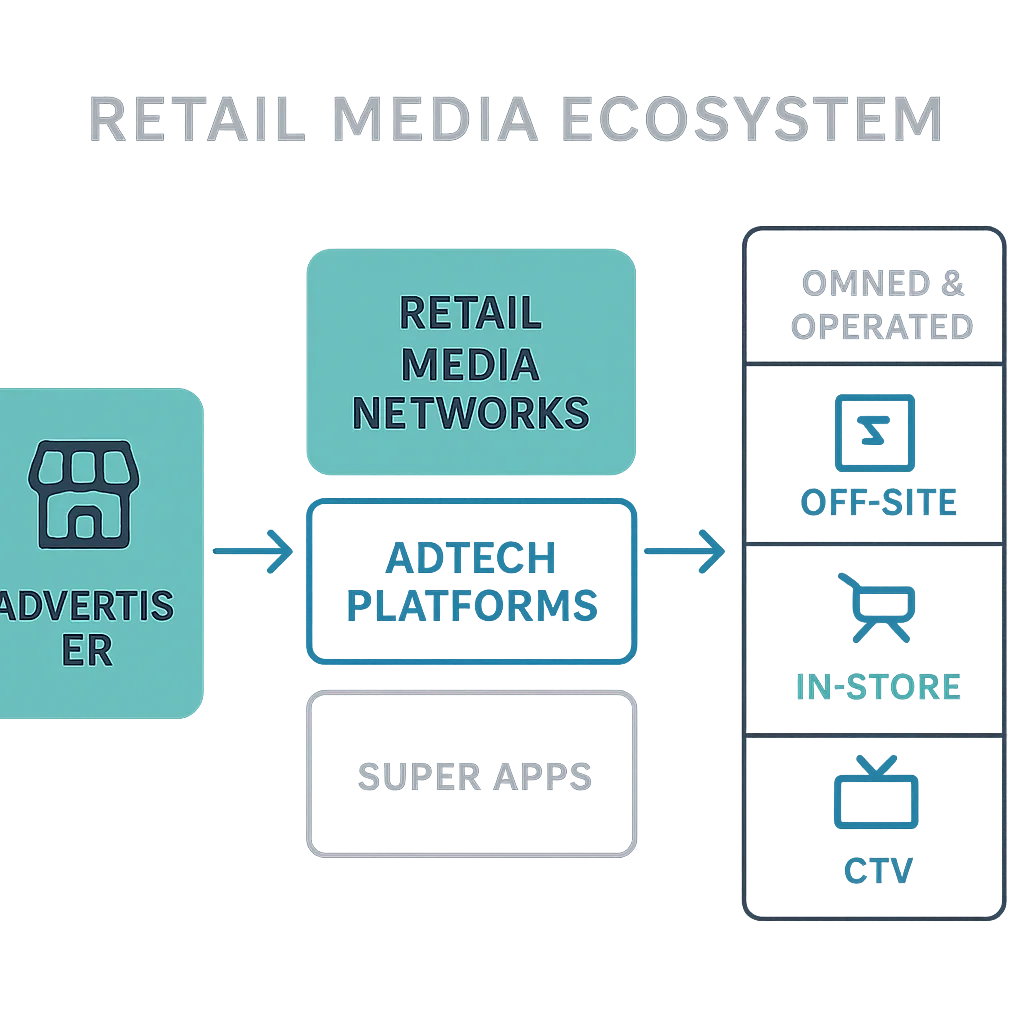
Benefits for Advertisers
Reaching Consumers at the Point of Purchase
Manufacturers and brands are redirecting significant investment into RMNs specifically because they offer access to consumers at the moment of purchase intent. According to McKinsey research, 73% of advertisers expect to increase their spending on RMNs within the next 12 months, and RMNs are anticipated to account for roughly 10–15% of total media expenditure. That level of commitment reflects genuine confidence in the channel's effectiveness.
Accurate Audience Targeting
RMNs use sophisticated data analytics to identify and reach the right shoppers. By drawing on first-party shopper data — purchase history, browsing patterns, product affinity signals — advertisers can target with a precision that general-purpose platforms struggle to match. Consumers are exposed to products that are genuinely relevant to their demonstrated interests, rather than being served ads based on probabilistic demographic or contextual proxies.
Closed-Loop Attribution
Perhaps the most structurally significant advantage retail media offers advertisers is closed-loop attribution. When ad impressions and sales transactions both occur within the same platform, the relationship between a given ad and a resulting purchase can be measured directly. Advertisers no longer need to rely on modelled attribution or cross-platform inference — the data is right there.
This makes it substantially easier to demonstrate that advertising spend is generating real commercial outcomes and to identify which campaigns or creative executions are driving conversions.
Benefits for Retailers
Monetizing First-Party Data
Amazon and Walmart dominate the retail media industry in large part because of the scale and richness of their first-party consumer data. But the same principle applies across the retail sector: any retailer with meaningful transactional and behavioural data on its customers holds an asset that advertisers will pay to access.
Numerous independent AdTech companies specialize in helping retailers unlock the value of that data for audience targeting, measurement, and attribution — without requiring the retailer to build everything from scratch.
Improved Inventory Management and Sales
AdTech integrated into a retail media operation can do more than serve ads. It can surface product availability information, allowing retailers to promote in-stock items and suppress advertising for products that are out of stock. The result is a tighter connection between advertising activity and inventory reality — better for the retailer's operational efficiency and better for the consumer experience.
A New Revenue Stream
Retailers frequently operate on thin product margins, and raising those margins isn't always commercially viable. Advertising revenue offers a different path. By building an advertising business centred on their first-party customer data, retailers can generate revenue that offsets the constraints of low-margin or fixed-margin product lines. This is one of the central economic arguments for retail media: it unlocks value that already exists within the business, without requiring changes to the core merchandising model.
Challenges in Building a Retail Media Network
Despite rapid growth in investment and interest, the retail media industry is experiencing real growing pains. Some challenges are business-strategic; others are technical.
Balancing Ambition with Pragmatism
In theory, any retailer with an engaged audience can build an RMN. In practice, developing the AdTech platform to power one is a substantial undertaking. Even experienced software development teams find that retail media infrastructure — ad serving, audience management, measurement, reporting, integrations with demand-side platforms — is complex to design and build correctly.
Retailers that underestimate this complexity tend to experience delays in launching, gaps in capability, and cost overruns. Managing ad purchases across multiple networks simultaneously adds further operational burden. The investment in time and resources required is significant, and the execution demands a level of AdTech-specific knowledge that most retail engineering teams don't have in-house.
Lack of Standardized Measurement
Even with closed-loop attribution available in principle, the absence of standardized measurement practices across the retail media industry remains a widespread concern. Different RMNs use different metrics, methodologies, and attribution windows — making it difficult for advertisers to compare performance across platforms or apply consistent benchmarks.
This fragmentation creates friction for advertisers and limits confidence in the channel. The expectation is that industry bodies like the IAB will eventually introduce measurement standards for retail media, as they have for other digital advertising formats, but that standardization is still developing.
Consolidation Pressure
The current environment has many retailers simultaneously trying to establish RMNs, which risks producing a fragmented landscape with hundreds of networks for brands to evaluate. That fragmentation is not sustainable. Smaller retailers at the margins are likely to face consolidation — being acquired by larger players or absorbed into aggregated network offerings.
For retailers building now, the implication is clear: getting the technology foundation right matters. The quality of internal and external integrations, the robustness of the data infrastructure, and the ability to fully utilize first-party data will determine which RMNs survive the consolidation phase and which don't.
The Walled Garden Tension
There is an inherent tension in retail media between exclusivity and openness. A walled garden approach — where data and inventory are tightly controlled and advertisers can only access them on the retailer's terms — can create a premium environment, but it risks alienating potential advertisers who prefer more open, interoperable platforms.
Striking the right balance between maintaining the value of proprietary data and offering advertisers enough flexibility and transparency to justify investment is an ongoing challenge. The right business and technology strategy can navigate this tension, but it requires deliberate design from the outset.
Retail media sits at the intersection of two durable trends — the growth of e-commerce and the declining availability of third-party audience data — which is a large part of why investment in the channel is accelerating so quickly. For advertisers, the value is in precision targeting and measurable attribution. For retailers, it's a structurally new revenue line built on data assets they already own. The challenges are real, but they are solvable with the right combination of technology, data strategy, and industry standards as they mature.