What Is AdTech? A Deep Dive into Advertising Technology
Advertising technology — AdTech — has fundamentally reshaped how brands connect with audiences and how advertisers and publishers interact with each other. Understanding what AdTech is and how it works is essential for anyone operating on either side of the digital advertising equation.
This guide walks through the why, the what, and the how: why AdTech exists, what needs it was built to address, which processes underpin it, and which platforms carry out those processes.
The Advertiser-Publisher Relationship and Why AdTech Exists
The most useful starting point is a simple question: why does AdTech exist at all?
At its core, advertising has always been about connecting two parties:
- Advertisers who want successful campaigns reaching high-value audiences
- Publishers who want to sell their ad inventory at the best possible price
That relationship predates the internet by centuries. What changed — dramatically — is scale.
Before digital media, an advertiser in one city might call a newspaper in the same market and place an order for a full-page ad. The transaction was local, manual, and direct. The internet removed those geographic boundaries entirely, enabling brands to advertise across hundreds of publisher websites simultaneously — and to reach only the visitors most likely to buy their product.
Publishers responded by generating enormous volumes of ad space. At the same time, the number of advertisers seeking to appear across multiple publishers grew rapidly. Direct, one-to-one sales relationships could not scale to meet this demand. Technical infrastructure was needed to connect thousands of buyers and sellers efficiently.
That is why AdTech exists — because it is necessary. Every platform and process in the AdTech ecosystem was built to serve either the advertiser or the publisher side of this relationship, or both.
Supply-Side (Publisher) Needs
Publishers with ad space to sell have a straightforward goal: generate revenue. But selling digital ad inventory creates a distinct set of technical and operational challenges.
1) Serve ads in real time
Every time a user opens a page or launches an app, there is an opportunity to serve an ad. Publishers need infrastructure capable of responding to each of those events instantly, at scale.
2) Manage direct campaigns
Publishers working in direct relationships with brands need to implement ads quickly, generate reports, and provide campaign performance insights to their advertising partners.
3) Maximize impressions sold
The internet lowered the barriers to becoming a publisher dramatically — bloggers, app developers, and traditional media outlets now compete for the same advertiser budgets. That competition creates a real risk that some impressions go unsold, particularly for non-premium publishers and non-premium placements.
4) Optimize ad inventory yield
Maximizing the volume of impressions sold is not the same as maximizing revenue. Publishers need to ensure they receive the best possible price for each individual ad slot — optimizing yield per impression rather than simply filling inventory at any price.
5) Gather audience insights
To attract advertisers willing to pay premium rates, publishers need to understand who is visiting their properties, how often, and what behaviours those visitors are exhibiting. Audience intelligence directly supports the ability to command higher CPMs.
6) Collect and monetize audience data
Selling ad space is not the only revenue lever available to publishers. Audience data — insights about site visitors and their behaviour — can be monetized by selling it to advertisers or data vendors who use it for targeting across other properties.
7) Gather data on ads served
Publishers need hard performance data: which ad networks or SSPs generate the highest yield, which ad formats perform best, and which data partners offer the greatest monetization value. This data informs future inventory strategy.
8) Maintain a quality user experience
Revenue generation through advertising should not come at the expense of the user experience on the publisher's site or app. Slow-loading ads, intrusive formats, or excessive ad density can drive users away — which ultimately undermines the value of the inventory itself.
Demand-Side (Advertiser) Needs
On the other side of the relationship, advertisers — and the agencies managing campaigns on their behalf — have their own set of requirements.
1) Serve targeted ad campaigns
The primary need for advertisers is reaching the people most likely to be interested in what they are selling. Campaign objectives vary, but the underlying requirement is consistent: get the right message in front of the right audience.
2) Measure campaign success
Knowing how many impressions were served, how many were visible, and how many led to conversions is fundamental to evaluating whether a campaign is working. Advertisers need reliable measurement infrastructure to answer these questions.
3) Track the customer journey
Customers interact with content at multiple stages of the decision-making process. Advertisers need to understand which touchpoints contributed to a sale, where the experience breaks down, and how to attribute conversions accurately across all the channels they use.
4) Save time and money
Advertising consumes significant budget and operational effort. Brands consistently look to reduce waste in media spend and avoid losing time on manual sales processes, campaign trafficking, and reporting.
5) Protect brand image
Appearing alongside inappropriate or brand-unsafe content is a genuine risk in open digital environments. Advertisers need controls and verification tools to ensure their ads run in suitable contexts — especially when moving beyond direct, premium publisher relationships.
6) Optimize ad spend based on data
Campaign performance data — conversions, revenue, return on ad spend (ROAS) — must feed back into active decisions. High-performing campaigns should scale; underperforming ones should be adjusted or cut before they consume budget unnecessarily.
AdTech Processes: How the Needs Are Met
The platforms that make up the AdTech ecosystem are built around a set of core processes. Those processes emerged directly from the needs described above.
1) Programmatic media-buying and selling
Programmatic advertising automates the process by which publishers sell inventory and advertisers buy it. Rather than direct contact between a sales team and a media buyer, both parties use technology platforms to place orders, purchase ad space, and serve the appropriate creative. This automation keeps pace with the speed of digital interactions and makes it practical for an advertiser in one country to buy inventory from a publisher on another continent without any manual insertion order.
2) Programmatic Direct (Automated Guaranteed)
Programmatic Direct allows advertisers and publishers to transact in an automated one-to-one relationship. The price per thousand impressions and the inventory volume are agreed in advance, giving both sides predictable cash flow. Publishers benefit from being able to offer premium inventory to trusted brands at set (often premium) prices while maintaining control over what appears on their pages. Advertisers benefit from inventory certainty and the assurance of appearing in known, brand-safe environments.
3) Real-Time Bidding (RTB)
RTB is the other principal form of programmatic advertising. Ad slots are auctioned on demand, typically through an ad exchange, with multiple advertisers competing simultaneously for each impression. RTB originated as a mechanism for publishers to sell remnant inventory — impressions that hadn't been filled through direct deals — and it continues to serve that function. It also benefits advertisers by setting prices through market demand, and helps publishers monetize audience data by connecting them with advertisers who want to target specific visitor profiles.
4) Header Bidding
Header bidding is an evolution beyond the older waterfall auction model. In a waterfall, demand sources are evaluated sequentially — the first one to meet the price floor wins, which means later demand sources never even see the impression. Header bidding removes that sequential prioritization and gives all bidders an equal, simultaneous opportunity to bid on the inventory. The practical result is that publishers are more likely to receive the highest possible price for each impression, and advertisers get a fair chance to reach their target audiences regardless of where they sit in a historical priority order.
5) Cookie-Syncing and Data Exchange
Publishers and advertisers each track their own audiences using cookies, but those cookies exist in separate systems. Cookie-syncing is the process by which different AdTech platforms share and reconcile those identifiers, enabling them to communicate about the same user. Without this, display advertising would rely on guesswork. Cookie-syncing allows publishers to communicate the value of their audiences to advertisers, helps advertisers buy only the impressions most likely to reach valuable customers, and enables the attribution and conversion tracking that campaign measurement depends on.
AdTech Platforms: The Components of the Ecosystem
With the needs and processes established, it becomes straightforward to understand what each major AdTech platform does and why it exists.
Ad Server
An ad server automates the placement of ad creatives into ad slots when a visitor loads a publisher's page. It handles both first-party use cases — where a publisher is managing direct advertiser relationships — and third-party use cases, where an advertiser is serving and measuring campaigns across multiple publishers simultaneously.
Beyond serving creatives, ad servers count impressions, redirect clicks to landing pages, and record conversions when a visitor completes an action. Without ad servers, every change to an ad creative would require a manual modification to a website's HTML — an unworkable approach at digital scale.
Supply-Side Platform (SSP)
When a publisher wants to make inventory available for programmatic bidding, an SSP is the tool that connects them to ad exchanges and the DSPs bidding on those exchanges. The SSP allows the publisher to set a price floor (the minimum acceptable bid), receives and evaluates incoming bids, and appends additional audience data about the visitor where available — helping advertisers assess whether that impression is worth bidding on.
SSPs enable publishers to move non-premium inventory quickly, reducing unsold impressions, while the competitive auction process maximizes the value extracted from each slot.
Content Delivery Network (CDN)
Ad creatives need to load in the brief window between a browser receiving ad markup from an ad server and the page being fully rendered for the user. A CDN hosts those creatives in geographically distributed nodes so they can be delivered with minimal latency, wherever the user is located.
Beyond enabling real-time ad serving, CDNs contribute to faster page loads and a smoother user experience. As programmatic video advertising has grown — with its much larger creative file sizes — the role of the CDN has become correspondingly more important.
Ad Networks
Ad networks, such as Google AdSense or Taboola, aggregate inventory from multiple publishers and make it available to advertisers as a single buying surface. Rather than negotiating directly with individual publishers, an advertiser can access a broad range of inventory through a single relationship. Ad networks support both open auction buying and guaranteed media buys.
For advertisers, ad networks extend campaign reach significantly. Used in conjunction with a DSP for buying execution and a DMP for audience data, ad networks allow for intelligent, data-driven decisions about which inventory to purchase within that aggregated supply.
Ad Exchange
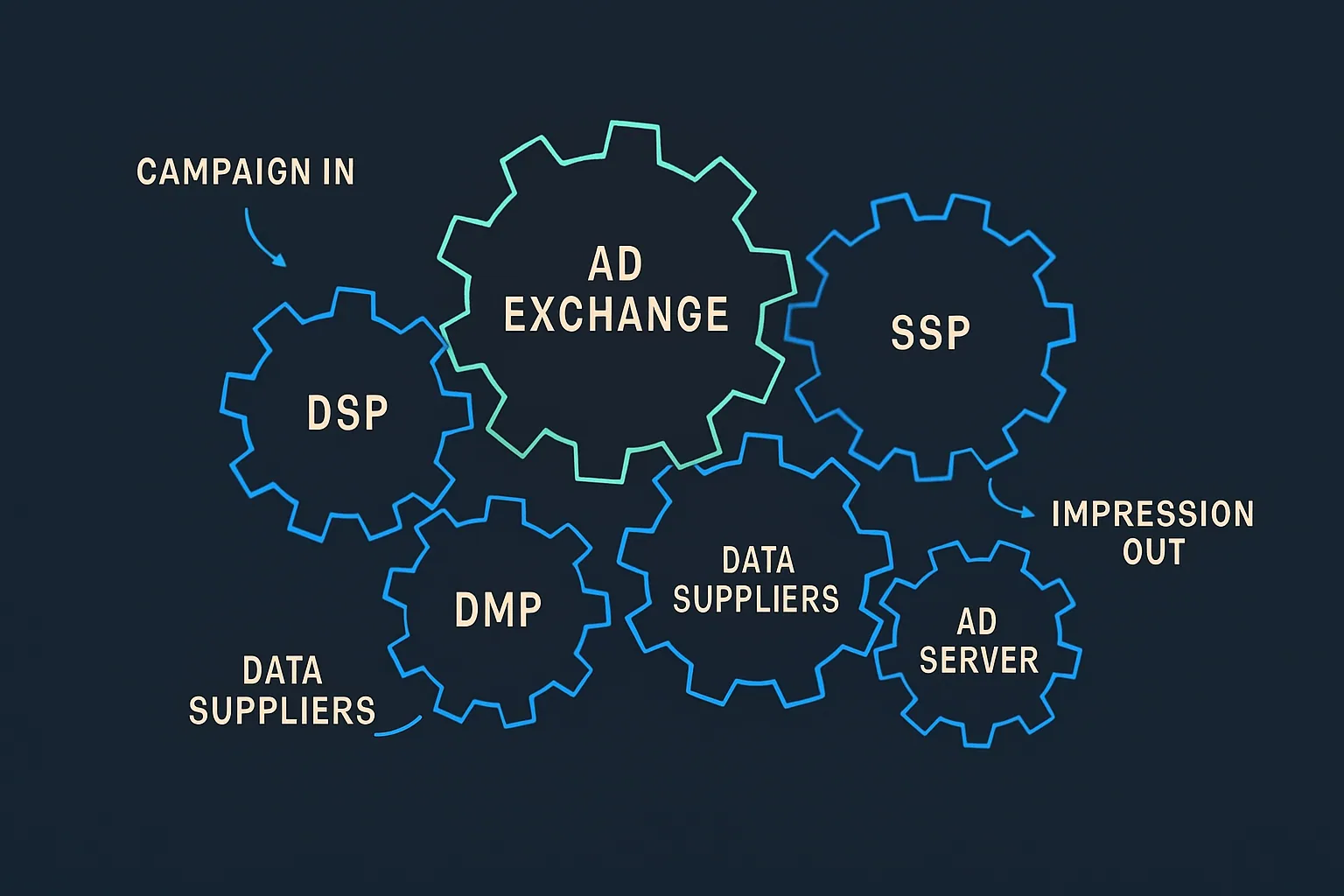
An ad exchange is the transactional layer that connects advertisers (operating through DSPs) with publishers (operating through SSPs). It is the marketplace where inventory is actually bought and sold. Ad exchanges also enable publishers to establish private marketplaces — restricted environments where only invited buyers can bid on premium inventory.
Exchanges give publishers an efficient mechanism for clearing remnant inventory at market-determined prices. For advertisers, they provide access to real-time, targeted campaigns informed by the audience data SSPs surface about each impression.
Agency Trade Desk
Ad agencies have long managed media buying on behalf of brand clients, and agency trade desks bring that function into the programmatic environment. A trade desk uses DSP-like technology to buy inventory, repackages it, and connects agency clients with publishers.
For brands that don't want to build in-house programmatic capabilities or invest in their own DSP, trade desks offer the benefits of sophisticated AdTech tooling — operated by trained staff — along with relationships with premium publishers that may not work directly with the brand. Trade desks handle targeting, budgeting, and campaign reporting on behalf of their clients.
Data Management Platform (DMP)
A DMP combines data from online and offline sources to create audience segments for ad targeting, tracks campaign performance data, and connects with ad exchanges to inform buying decisions. Both publishers and advertisers make use of DMPs, though for different purposes.
For publishers, a DMP enables the collection and segmentation of behavioural data about site visitors, which can then be sold through a DSP — converting audience insight into a revenue stream. For advertisers, DMPs allow the combination of first-party and third-party data to precisely define target audiences, measure which segments perform best, and analyze the customer journey across touchpoints.
Demand-Side Platform (DSP)
The DSP is the core tool on the advertiser side of the programmatic ecosystem. It connects advertisers to ad exchanges and ad networks, manages the bidding process, and integrates audience data from DMPs alongside supply-side signals about the user being targeted.
Without a DSP, advertisers would have no systematic way to evaluate the value of individual impressions before bidding, no access to the third-party audience data available through integrated data partnerships, and no unified view of their campaigns across channels and publishers. A DSP brings all of that together — giving brands access to global ad inventory through a single platform, without requiring direct coordination with ad operations teams at individual publishers.
Putting It Together
AdTech is complex, but that complexity is purposeful. Every platform, process, and data flow in the ecosystem traces back to a specific need on the publisher or advertiser side. Publishers need to sell inventory efficiently, maximize yield, understand their audiences, and maintain their user experience. Advertisers need to reach the right people, measure results, control brand safety, and optimize spend.
The programmatic infrastructure built around those needs — RTB, header bidding, cookie-syncing, SSPs, DSPs, DMPs, ad exchanges — represents decades of iterative problem-solving. As the needs of both sides continue to evolve (driven by privacy regulation, new channels, shifting measurement standards, and changes in identity infrastructure), the technology will keep evolving with them.