What Is an Ad Network and How Does It Work?
When print publishers first began moving online in the 1990s, they quickly needed a way to generate revenue. The most intuitive model was the one they already knew: advertising. Display ads offered a natural fit, and publishers could sell some of their ad space directly to advertisers. But direct sales carried a fill risk — some inventory would inevitably go unsold. That gap created demand for a platform that could absorb and monetize that leftover supply.
That's where the ad network came in.
What Is an Ad Network?
An ad network is a technology platform that acts as a broker between a group of publishers and a group of advertisers. Ad networks were among the earliest pieces of advertising technology to emerge — appearing in the mid-1990s when online advertising first began — and they've served the same fundamental purpose ever since: helping advertisers buy available ad inventory across multiple publishers simultaneously.
Despite what the name might suggest, "ad network" is used exclusively in the context of online advertising. The term doesn't apply to print, television, or radio.
Traditionally, ad networks collect unsold ad inventory from multiple publishers and offer that pooled supply to advertisers at prices well below what a publisher would charge in a direct sale. This kind of inventory is commonly referred to as remnant or non-premium inventory.
Today, however, some networks take a more curated approach. Rather than aggregating leftover supply, they cherry-pick and pre-buy inventory from top-tier publishers, then resell it at premium prices. This arrangement costs more for advertisers but offers better placement quality and brand-safe environments.
Ad Networks vs. Ad Servers: Understanding the Difference
Because ad networks and ad servers appeared in the industry at roughly the same time — and because the AdTech ecosystem contains a large number of overlapping platforms — the two are often confused with one another.
An ad server is a piece of advertising technology used by publishers, advertisers, ad networks, and agencies to manage, run, and report on advertising campaigns. There are two distinct types:
First-party ad servers (publisher-side) allow publishers to manage inventory on their websites, serve ads sold via direct deals, route remnant inventory to ad networks and supply-side platforms (SSPs), and report on performance.
Third-party ad servers (advertiser-side) are designed to help advertisers store creatives, measure campaign performance across multiple publishers, and verify metrics — such as impressions and clicks — against publisher-reported figures.
An ad network, by contrast, is not used to manage campaigns or store creatives. Its function is to transact media buys — connecting advertisers with publishers and facilitating the sale of inventory at scale.
An SSP (supply-side platform) is the technology alternative to an ad network, offering overlapping functionality but with access to different inventory types and delivery mechanisms. The distinction between the two is addressed in more detail below.
How Does an Ad Network Work?
Ad networks aggregate available inventory from publishers and package those impressions for sale to advertisers. Here's how the process typically unfolds:
- An ad network aggregates a large number of publishers to provide the required volume of inventory to advertisers, usually on an auction basis.
- Advertisers set up campaigns directly through the ad network's campaign-management panel, or configure pixels from a third-party ad server for verification and consolidated reporting — particularly useful when running campaigns across multiple networks and direct publisher deals simultaneously.
- The advertiser configures campaign parameters (targeting, budget, frequency caps, and so on), while the publisher installs the ad network's ad tags on their site — either directly into the page or through a first-party ad server.
- Once the campaign is live, the advertiser can rotate multiple creatives across the publisher's site through the campaign-management panel without needing to contact the publisher directly.
In the early days of online advertising, most publishers relied on a single ad network to sell remnant inventory. As the number of publisher sites grew, however, it became clear that one network wasn't sufficient — fill rates suffered as a result.
To address this, publishers began working with multiple ad networks, some focused on premium inventory and others on remnant supply.
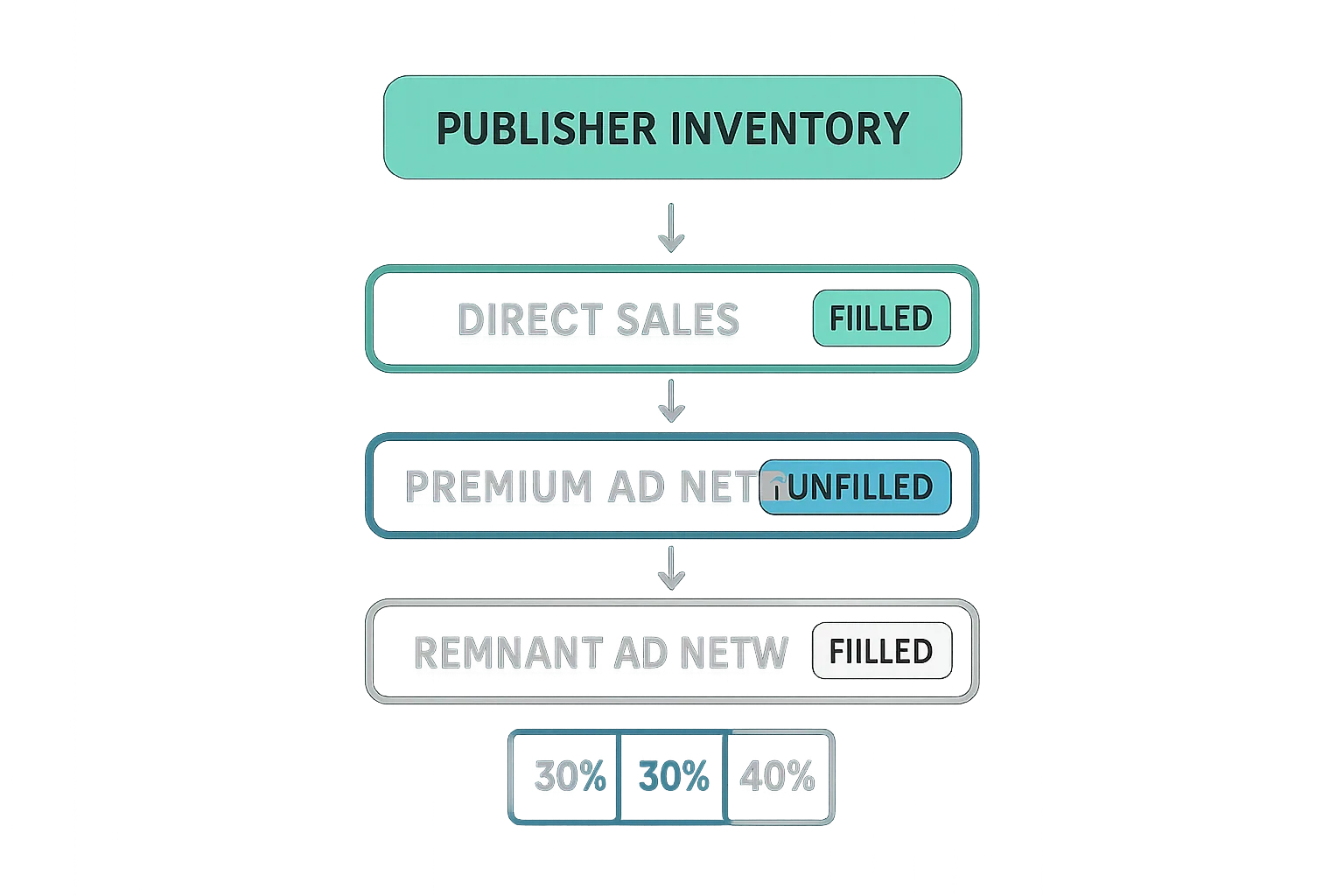
The practice of calling ad networks one after another in sequence to maximize fill rates is known as waterfalling.
How Ad Networks Benefit Publishers and Advertisers
Publishers
The most direct benefit for publishers is the ability to monetize inventory that would otherwise go unsold through direct deals. It's worth noting, though, that ad networks don't fully eliminate the risk of wasted impressions — achieving 100% fill remains a challenge regardless.
Advertisers
While ad networks primarily exist to help publishers offload remnant inventory, they deliver several concrete advantages for advertisers as well:
Scale: Advertisers can purchase inventory across many publishers through a single intermediary and consolidate campaign reporting in one place.
Time savings: A campaign is set up once, without the need to negotiate and sign individual insertion orders with each publisher.
Campaign reach and measurement: Reach is tracked across the entire campaign, and frequency capping is applied holistically rather than on a per-publisher basis.
Types of Ad Networks
The ad network market has segmented into several distinct categories, each serving different advertiser needs:
- Premium ad networks — Offer inventory from well-known, high-traffic publishers.
- Vertical ad networks — Topic-specific networks organized around industry categories such as business, technology, automotive, or fashion.
- Specialized or inventory-specific ad networks — Focus on particular formats or environments, such as mobile, video, or native advertising.
- Performance and affiliate ad networks — Typically operate on revenue share, CPC, or CPA pricing models rather than CPM.
In a traditional ad network, advertisers buy a packaged set of impressions on a CPM basis. Targeting options generally include IAB-standard categories such as:
- Geolocation
- Keywords (contextual)
- Time of day
- Browser type / OS
- And many others
How Ad Networks Have Evolved
Ad networks and SSPs have long competed for publisher relationships and advertising revenue. Over time, both types of platforms have begun adopting features from the other, which has progressively blurred the boundary between them.
On the ad network side, platforms are adding programmatic engines that optimize RTB supply — effectively upgrading beyond pure remnant inventory aggregation. Many are also connecting their publisher supply directly to selected DSPs to improve fill rates.
On the SSP side, platforms are implementing direct-buy capabilities that were traditionally the domain of ad networks — connecting supply and demand without relying on real-time bidding. This shift typically manifests as support for programmatic direct.
The practical result is a market where the distinction between an "ad network" and an "SSP" is increasingly a matter of emphasis rather than fundamental architecture.
Programmatic Direct
Programmatic direct is a non-RTB (non-auction, non-real-time) method for buying guaranteed ad impressions in advance from select premium publishers. It emerged as an alternative to traditional ad network buying that simplifies the transaction and reduces intermediary costs.
In practice, programmatic direct provides the core capabilities of an ad network — but through a dedicated self-service panel available to both publishers and advertisers. Impressions can be considered on an individual basis, meaning advertisers can target specific placements on a site rather than buying broad packages.
Beyond the standard targeting available in most ad servers and ad networks, programmatic direct often incorporates third-party data for more granular audience segmentation — similar to what's available in a private marketplace.
Sales representatives on the publisher side can negotiate inventory purchase deals with advertisers directly. This gives marketers stronger control over ad pricing, inventory quality, and placement selection. Both parties avoid the auction dynamics of RTB entirely.
Publishers can provide advertisers access to their inventory through a self-service platform like AdSlot, where buyers place purchase orders directly and can build creatives from within the same interface.
Ad networks remain a foundational component of the online advertising ecosystem, even as programmatic platforms have reshaped how inventory is bought and sold. Understanding where ad networks sit relative to ad servers, SSPs, and programmatic direct is essential context for anyone working in or building on top of the AdTech stack.