What is an Ad Server and How Does It Work?
Since the very beginning of online advertising more than two decades ago, a succession of technologies has been introduced to the AdTech ecosystem to solve problems faced by advertisers and publishers and to improve the overall media buying and selling process.
Platforms such as demand-side platforms (DSPs), supply-side platforms (SSPs), and ad exchanges have each shaped the online advertising landscape in important ways — but one piece of technology predates all of them, was built in the earliest days of online advertising, and remains just as relevant today: the ad server.
What is an Ad Server?
An ad server is a piece of advertising technology (AdTech) used by publishers, advertisers, ad agencies, and ad networks to manage and run online advertising campaigns. Ad servers are responsible for making instantaneous decisions about which ads to show on a website and then delivering them. Beyond that, an ad server collects and reports data — such as impressions, clicks, and conversions — so advertisers can monitor campaign performance and extract meaningful insights.
At the most basic level, an ad server is to ads what WordPress is to content. In the same way WordPress manages a website's editorial content, an ad server manages and displays online advertising content to the right user, on the right page, at the right time.

The First Ad Server
Ad servers first appeared in 1995, when the online advertising industry was still in its infancy. They were introduced to help publishers manage online ads and control how those ads were delivered.
Targeting capabilities in those early days were minimal. Advertisers could only target based on the limited header information that a user's browser passed along, including:
- The language set on the user's computer
- The URL of the page where the ad was loading
- The browser type and version
- The user's operating system
The first ad server is generally credited to FocaLink Media Services, a company founded in 1995 by Dave Zinman, Andrew Conru, and Jason Strober.
Since then, ad servers have evolved continuously alongside the broader ecosystem, expanding their feature sets to meet the growing demands of both advertisers and publishers. Several capabilities that began as core ad server features — targeting, budget control, and frequency capping — were eventually incorporated into newer platforms such as DSPs and SSPs as well.
The Role of an Ad Server
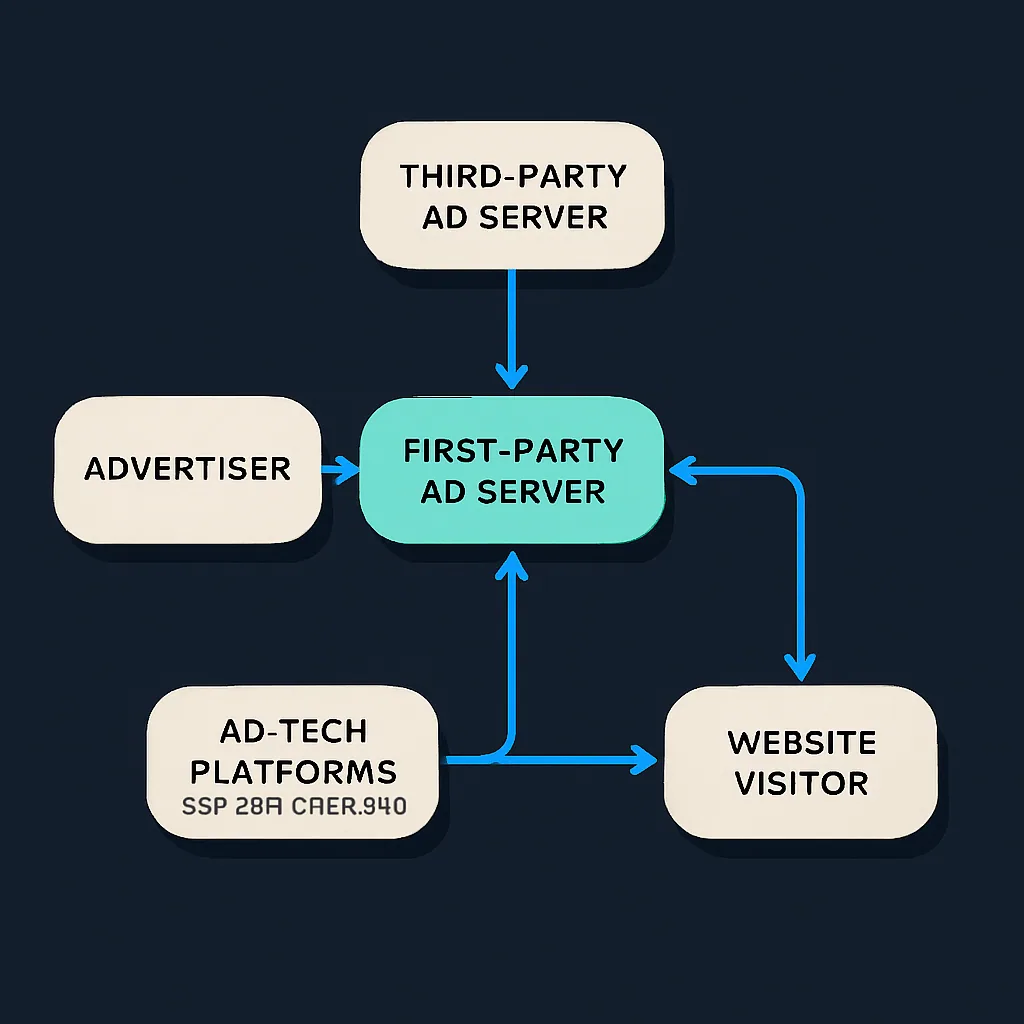
Ad servers can be used by publishers (in which case they are called first-party ad servers) and by advertisers (in which case they are called third-party ad servers).
While first-party and third-party ad servers are fundamentally the same technology, publishers and advertisers use them for somewhat different purposes.
First-Party Ad Servers
First-party ad servers allow publishers to manage ad slots on their websites and display ads that have been sold directly to advertisers via direct campaigns.
When no direct campaigns are available to fill a given slot, a first-party ad server acts as a management layer, deciding which ad code to serve — whether that code originates from a third-party ad server, an SSP, or an ad network.
The core responsibilities of a first-party ad server are:
- Targeting — deciding which ad to display based on nuanced targeting parameters
- Ad serving — delivering the selected creative to the user
- Reporting — collecting and surfacing data such as impressions and clicks
First-party ad servers are also used for inventory forecasting: estimating how much inventory of what type a publisher will have available for sale in the future, based on current campaigns and traffic projections.
Third-Party Ad Servers
A third-party ad server is the advertiser's tool for tracking campaigns across multiple publishers. An advertiser's ad tag is loaded by the first-party ad server, which means the third-party server's functionality is more limited — it is used primarily to collect campaign data and verify metrics such as impressions and clicks.
Third-party ad servers also support creative optimization: an advertiser can swap out the creative used in a campaign or run A/B tests on different creatives. However, targeting decisions remain on the first-party ad server side.
The defining purpose of a third-party ad server is aggregation and auditing. It consolidates all campaign information — reporting and audience data — across every publisher, ad network, and platform where a campaign is running, giving advertisers a single unified view. It also serves as an independent auditing tool to verify whether impressions were actually delivered as reported. Publishers and advertisers will sometimes report different impression numbers; a certain degree of discrepancy is considered normal in the industry. Critically, third-party ad servers give advertisers ownership and control of the audience data they collect.
How Does an Ad Server Work?
To understand how ad servers work, it helps to understand why they were built in the first place.
As the Internet gained mainstream traction in the early-to-mid 1990s, traditional print publishers began moving online. That shift created vast amounts of content and, alongside it, a new opportunity: display advertising. In those early years, the buying and selling of ads was entirely direct and manual — an advertiser negotiated with a publisher and the ad was placed. It worked at small scale, but as publisher inventories grew and more advertisers entered the picture, publishers needed a more efficient way to manage multiple campaigns simultaneously. That need gave rise to the first-party (publisher) ad server.
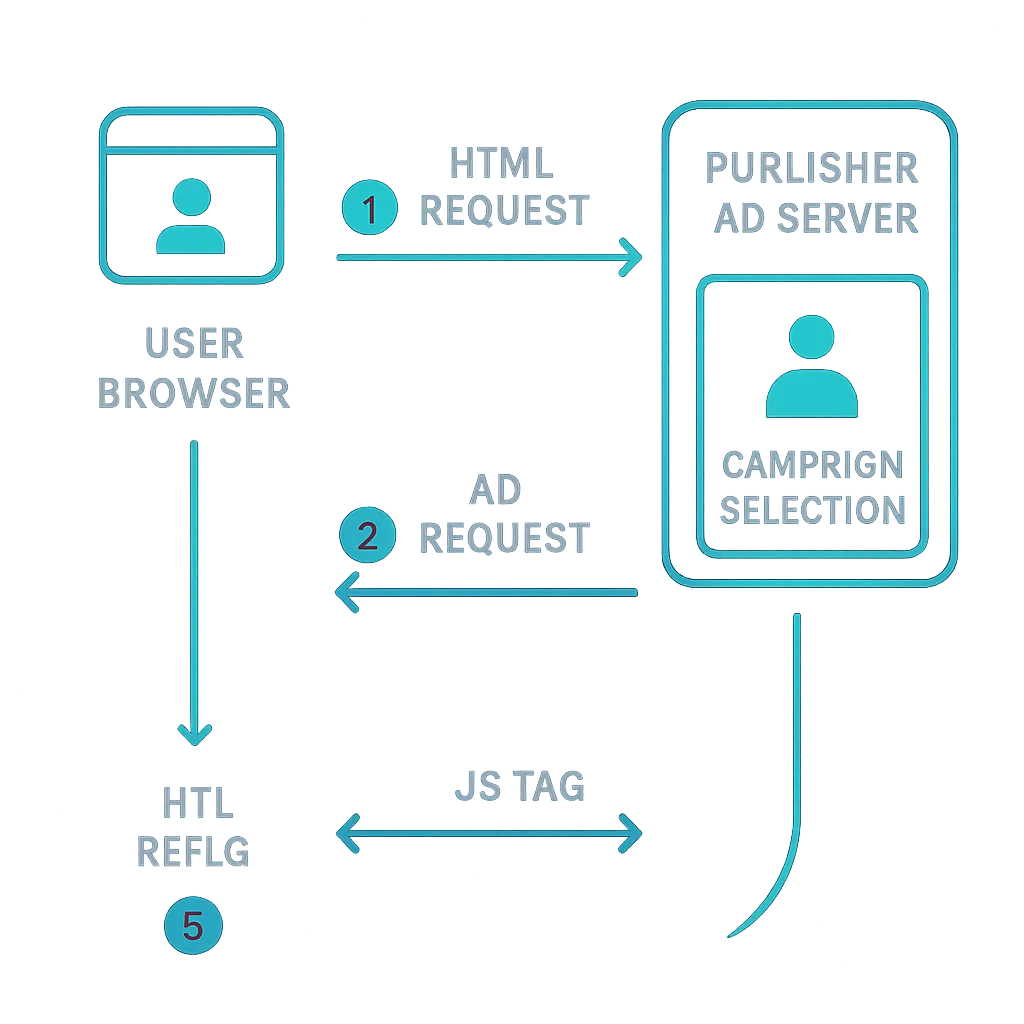
How a First-Party Ad Server Works
The diagram below illustrates the full ad-serving process for a first-party ad server:
After several years of publisher-side adoption, advertisers began facing their own challenge: how to host creatives and measure campaign performance — impressions, clicks, conversions — across multiple publishers in a consistent way. That need produced the third-party (advertiser) ad server.
How a Third-Party Ad Server Works
Third-party ad servers operate somewhat differently from first-party servers. The diagram below shows how a third-party ad server sits alongside a first-party ad server in a typical campaign workflow:
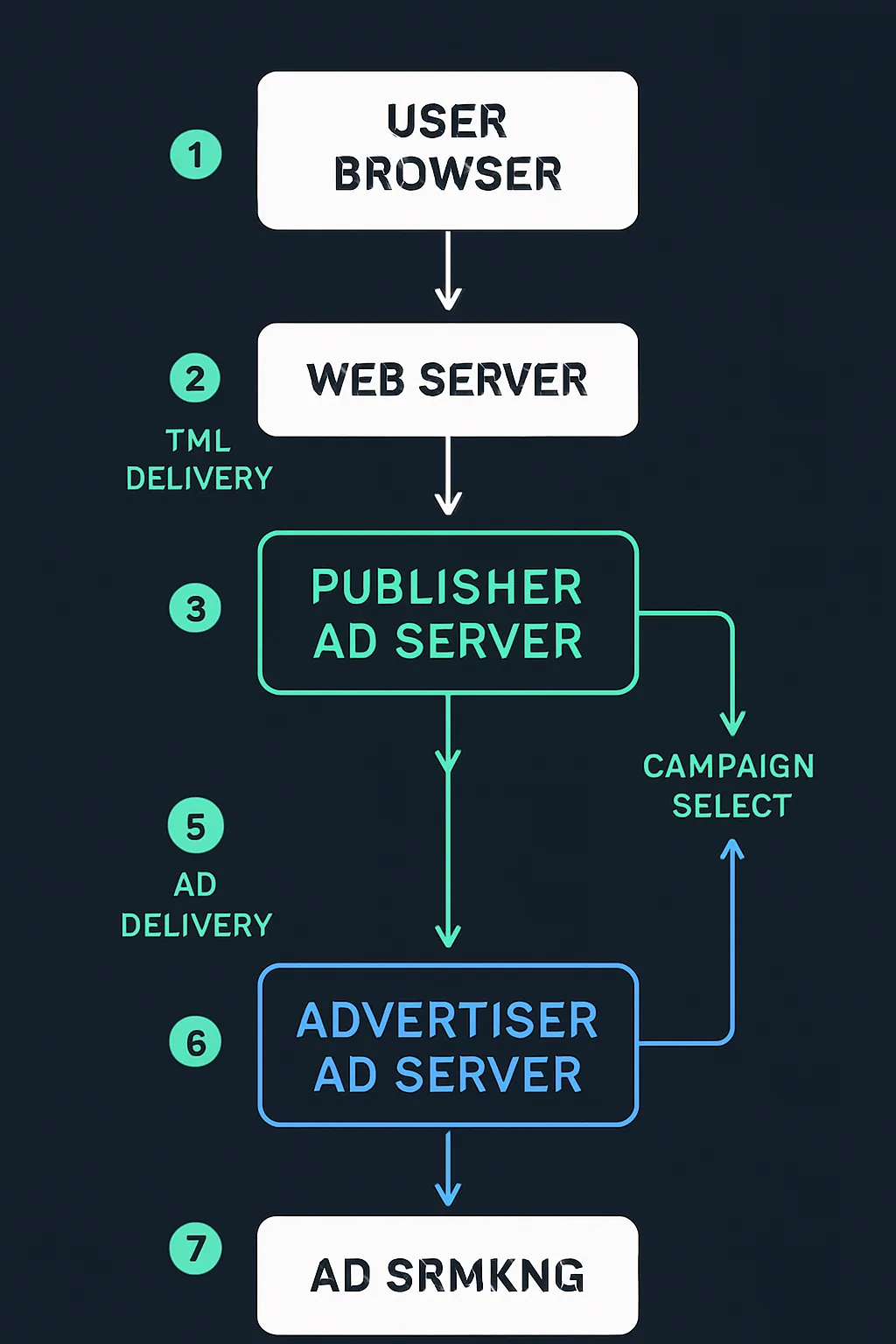
Third-party ad servers allow advertisers to:
- Store and manage their ad codes
- Set up tracking criteria for ad campaigns
- Track performance (impressions, clicks, conversions, etc.) for the entire campaign across all publishers in a single system
- Measure campaign reach while accounting for co-viewership across publishers
- Verify the reports provided by individual publishers
- Optimize campaigns based on aggregated data
Notable Ad Servers in the Online Advertising Ecosystem
Most leading ad server platform providers offer solutions for both advertisers and publishers.
Kevel provides infrastructure APIs for quickly launching custom ad platforms covering sponsored listings, internal promotions, native ads, and more.
AdButler is a full-stack ad serving solution for publishers and supply-side networks, offering a self-serve marketplace, custom development, real-human support, and advanced targeting.
Openx
Ad servers remain a foundational layer of the online advertising stack. Whether a publisher needs to manage direct campaigns and forecast inventory, or an advertiser needs a consolidated view of performance across dozens of media partners, the ad server — in its first-party or third-party form — is the tool that makes that possible. As the ecosystem continues to evolve, ad server functionality keeps spreading into adjacent platforms, but the core value proposition — delivering the right ad, tracking its performance, and giving each party reliable data — remains unchanged from what FocaLink set out to solve in 1995.