What Is Audience Extension and How Does It Work?
The online advertising industry has faced no shortage of headwinds in recent years — regulations like the GDPR, structural problems like banner burn and banner blindness, and the growing unreliability of cookies thanks to ad-blocking software and browser mechanisms like Intelligent Tracking Prevention (ITP).
Despite all of that, behavioural targeting remains one of the most widely used methods for reaching a desired audience. As the technology underpinning user-data collection has matured, it has enabled more sophisticated techniques — among them, audience extension. The process lets publishers generate more revenue from their traffic by enabling advertisers to reach those highly valued audiences well beyond the publisher's own site.
Audience extension is gaining traction quickly. Most major digital publishers and AdTech platforms now offer it, and for good reason: it benefits both sides of the transaction. Advertisers gain access to larger, better-matched audiences built on high-quality first-party data. Publishers can efficiently monetize their traffic and offer richer audience segmentation — without flooding their own pages with more display ads.
What Is Audience Extension?
Audience extension is a process that does exactly what the name implies: it extends digital audiences. More precisely, it transforms a publisher's site traffic into a targetable advertiser audience, meaning advertisers can reach those visitors not only on the publisher's website but anywhere else they browse on the web.
By broadening the reach of campaigns, audience extension lets advertisers prioritize quality over quantity of impressions.
Bottom line: Audience extension leads to higher conversion rates and a more efficiently spent advertising budget.
This comes down to two core advantages:
- Improved lift: Campaigns can be more precisely targeted at users who fit the advertiser's customer profile — based on demographics and demonstrated on-site behaviour — making conversions more likely.
- Bigger reach: Instead of repeatedly buying a limited pool of inventory on a single publisher's site, advertisers can serve ads across other sites where their most relevant audiences happen to be. Meanwhile, publishers don't need to sell their own inventory to generate revenue from their first-party data — leaving open the option of a fully ad-free on-site experience if they choose.
What Problems Does Audience Extension Solve?
Programmatic ad buying has long rewarded volume: more impressions, more reach. Over time, that focus on quantity over quality gave rise to some of the industry's most persistent problems — ad fraud, low viewability, and bot traffic.
High viewability doesn't automatically translate to better conversion rates. A growing number of advertisers are chasing lift and quality audiences, not raw impression counts.
Audience extension addresses this by scaling up the target audience in a smarter way — reaching users beyond the inventory any single publisher can offer, and doing so based on meaningful behavioural signals rather than sheer volume.
How Does Audience Extension Work?
Audience extension operates similarly to retargeting: it uses cookies to identify and track a user's activity as they move from site to site.
The process works as follows:
- A publisher's data management platform (DMP) creates a cookie for each new visitor and assigns them a cookie ID.
- The DMP syncs that cookie ID with supply-side platforms (SSPs), ad exchanges, and demand-side platforms (DSPs).
- When the user visits a different website, the platforms can identify them using the synced ID.
- Advertisers can then serve relevant ads to that user across whichever sites they visit.
A DMP Is the Beating Heart of Audience Extension
The technology central to audience extension is the DMP. Publishers use it to collect data about their website visitors and organize those visitors into audience segments. Those segments can then be synced with SSPs and DSPs, or shared directly in a one-to-one relationship between an advertiser and publisher.
In practice, audience extension allows publishers to prepare ready-to-use segments for advertisers — making it straightforward for advertisers to target users who have demonstrated interest in a particular topic, service, or location.
How Publishers Can Improve Inventory Revenue With a DMP
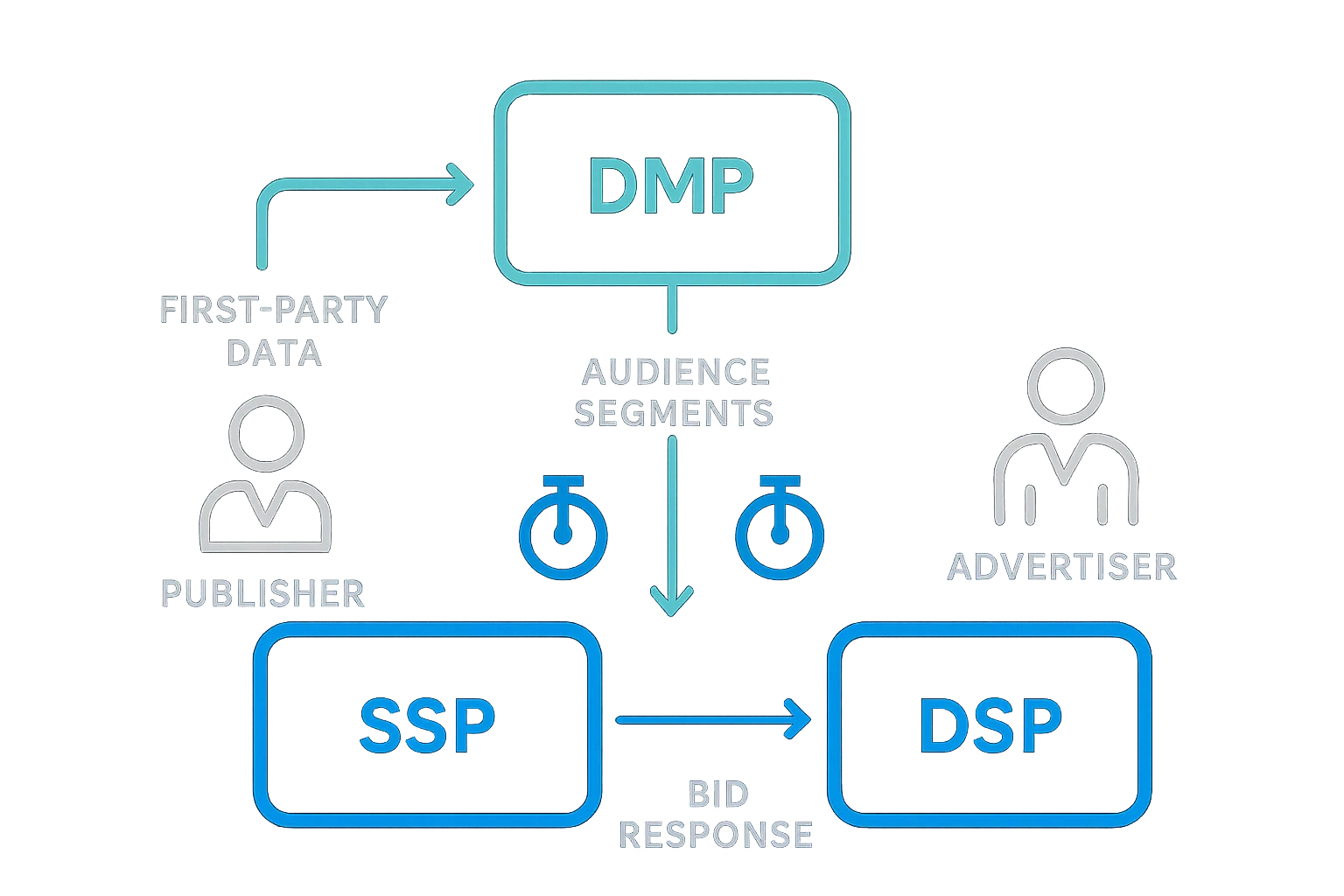
The publisher sends their first-party data to a DMP and builds audience profiles (segments), which can be enriched with third-party data. The publisher's SSP connects to the DMP, enabling the publisher to pass audience information to advertisers. When a user's profile matches an advertiser's campaign criteria, the advertiser sends a bid. If they win, their ad is displayed to that user.
Throughout this process, the DMP, SSP, and DSP all perform cookie syncing — or use an alternative ID solution — to identify the user and determine which audience segment they belong to.
How Publishers Can Perform Audience Extension With a DMP
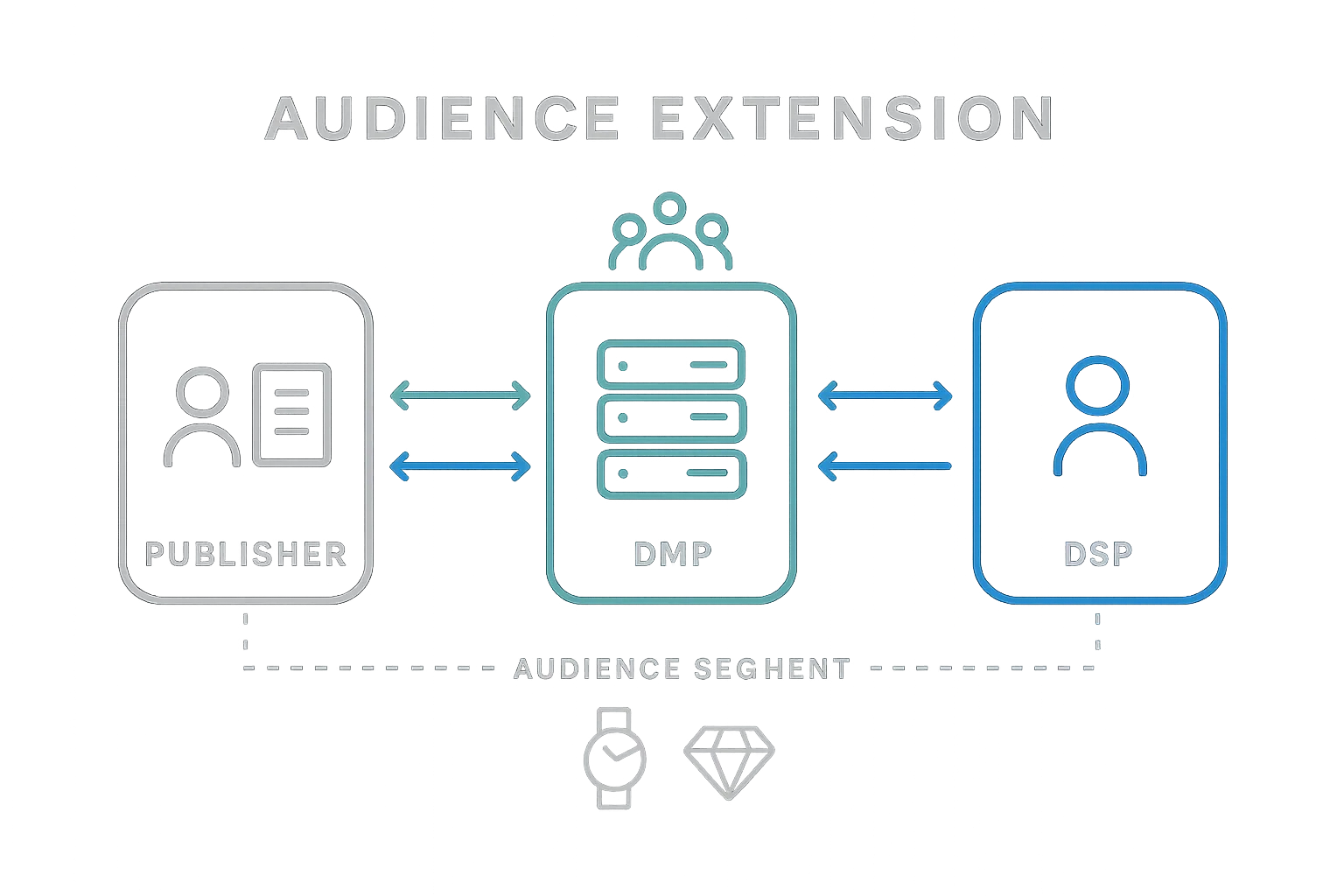
With audience extension, a publisher (say, a luxury-watch content site) creates audience segments in a DMP and makes them available to advertisers across different websites. By opening up their audiences this way, publishers also enable advertisers to target users who are similar to their actual visitors — through techniques like look-alike modeling and audience expansion.
What User Data Is Included in Audience Segments?
Audience segments can include a wide range of data points:
- Location
- Age
- Gender
- Interests (as defined by the IAB's content categories)
- Device type
- Operating system
- IDs created by AdTech platforms
- Website engagement (pages visited, videos viewed, etc.)
- Purchase history
To enable audience extension, a publisher places the DMP's JavaScript tag on their website. This tag generates a cookie for each new visitor. The DMP then syncs its cookies with DSPs, allowing advertisers to identify those users as they move across the web and serve them relevant ads.
Benefits for Publishers
The primary advantage for publishers is the ability to monetize audience data without needing to sell their own inventory, pile on more ad slots, or resort to engagement tricks like automatic page refreshes.
Importantly, audience extension isn't only valuable for large publishers. Smaller publishers that attract niche, sought-after audiences can also capitalize — even if their traffic volumes aren't large enough to draw direct advertiser relationships, their first-party data can still be monetized through audience extension.
For larger publishers running high-traffic properties, audience extension provides a useful feedback signal: by observing which audience segments attract the most advertiser demand, they can optimize their content strategy to attract more of those high-value visitors.
Benefits for Advertisers
Even when an advertiser is already seeing strong engagement — high click-through rates (CTRs) and conversion rates (CVRs) — on a particular publisher's site, audience extension offers a way to amplify that performance by reaching the same audience across the broader web. This approach directly addresses two well-documented problems:
Banner burn: Traditionally, publishers responded to advertiser demand by adding more ad slots. The result was pages cluttered with ads, creating a poor user experience. Instead of showing three ads for the same product on a single page, audience extension lets advertisers distribute those three impressions across three separate pages on different sites.
Banner blindness: When users are inundated with ads, they simply stop noticing them. By distributing ads across a variety of sites, audience extension creates fresh contextual associations in the viewer's mind. Combining this with regular creative rotation and A/B testing amplifies performance further.
Beyond solving these problems, audience extension gives advertisers access to the rich behavioural and interest data that publishers hold on their own visitors. Publishers have unparalleled insight into user interests and purchase intent. Advertisers can leverage this data to serve highly relevant ads to in-market audiences — improving the chances of conversion significantly.
Audience extension is available through a range of publishers and DMPs, as well as through the AdTech duopoly of Google and Facebook. Both tap into their vast stores of user data — interests, geolocation, age, and more — and expose audience extension capabilities to advertisers and publishers alike.
Audience Extension Example
Consider a company selling smartphone accessories. With audience extension, it could target audiences who regularly visit a well-known blog dedicated to Apple iPhones, then serve ads promoting its accessories across many other sites those users visit — car sites, news sites, social networks — regardless of whether those sites have anything to do with smartphones.
Alternatively, the advertiser could build a segment from its own site data: users who have viewed an iPhone product page multiple times in the past 30 days, and then reach them everywhere else they browse.
Audience extension increases campaign reach because the ads follow the audience rather than being pinned to a single property. It produces greater lift because the underlying publisher data includes granular information about user interests and preferences. This combination of breadth and precision is why audience extension has become an industry standard.
The Future of Audience Extension
Advertisers will continue pushing to reach their target audiences as effectively as possible, but the environment keeps shifting. The GDPR, banner blindness and banner burn, ITP, and other browser mechanisms blocking third-party cookies all present ongoing challenges.
The core issue is that audience extension — at least in the web browser context — is deeply reliant on third-party cookies. As those cookies become less reliable and ultimately face deprecation, the future of audience extension (along with many other cookie-dependent AdTech processes) will depend on the industry's ability to develop and adopt durable identity alternatives. First-party data strategies, ID resolution frameworks, and privacy-preserving targeting methods are all emerging as part of the answer, though no single solution has yet achieved the ubiquity that third-party cookies once had.