What is Waterfalling and How Does it Work?
Ad networks were among the first technology platforms introduced to the online display-advertising ecosystem, designed primarily to help publishers sell inventory that hadn't moved through direct buys — commonly referred to as remnant inventory.
The problem quickly became apparent: when a single ad network couldn't fill all of a publisher's remnant slots, those spaces went empty and revenue was left on the table. To improve fill rates and recover those opportunities, a technique known as waterfalling emerged.
What is Waterfalling?
Waterfalling — also called a daisy chain or waterfall tags — is the process by which a publisher attempts to sell remnant inventory by routing impressions through multiple demand sources, one at a time, in a defined sequence.
It comes into play after a publisher has been unable to sell premium ad slots through direct deals between its sales team and advertisers.
The name reflects the mechanics: demand sources are initiated one at a time, one after another, cascading downward like a waterfall until the impression is sold.
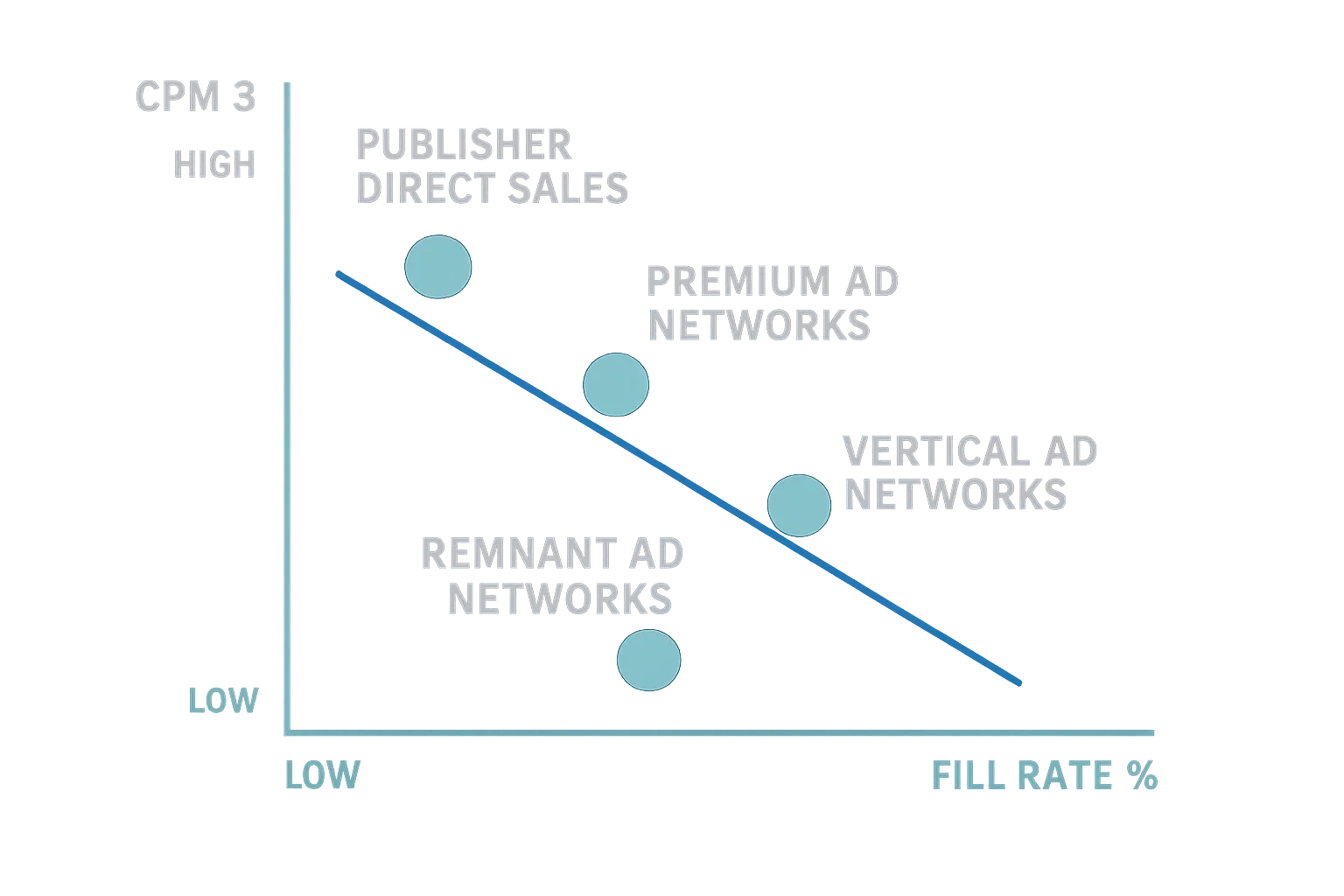
In the diagram above, the publisher's first attempt is always via direct sales, since those arrangements generally command the highest cost-per-mille (CPM). If direct sales don't fill the slot, the impression is passed down the chain through various ad networks until it finds a buyer.
The key trade-off: while the daisy-chain structure ensures inventory eventually gets sold, the CPM — calculated as an average — tends to decrease the further down the chain an impression travels.
How is Waterfalling Implemented?
The ad operations team sets up each ad network with a tracking tag that fires if and when an impression goes unfilled. This configuration typically lives in a field labelled something like Fallback Ads, Passbacks, Redirects, or Default Ads, depending on the platform.
Passback settings must be configured for every ad network in the publisher's waterfall. In practice, this means the ad ops team configures the first network (say, a premium ad network) to "passback" to the next in line (a vertical ad network), and so on down the chain.
How Does Waterfalling Work?
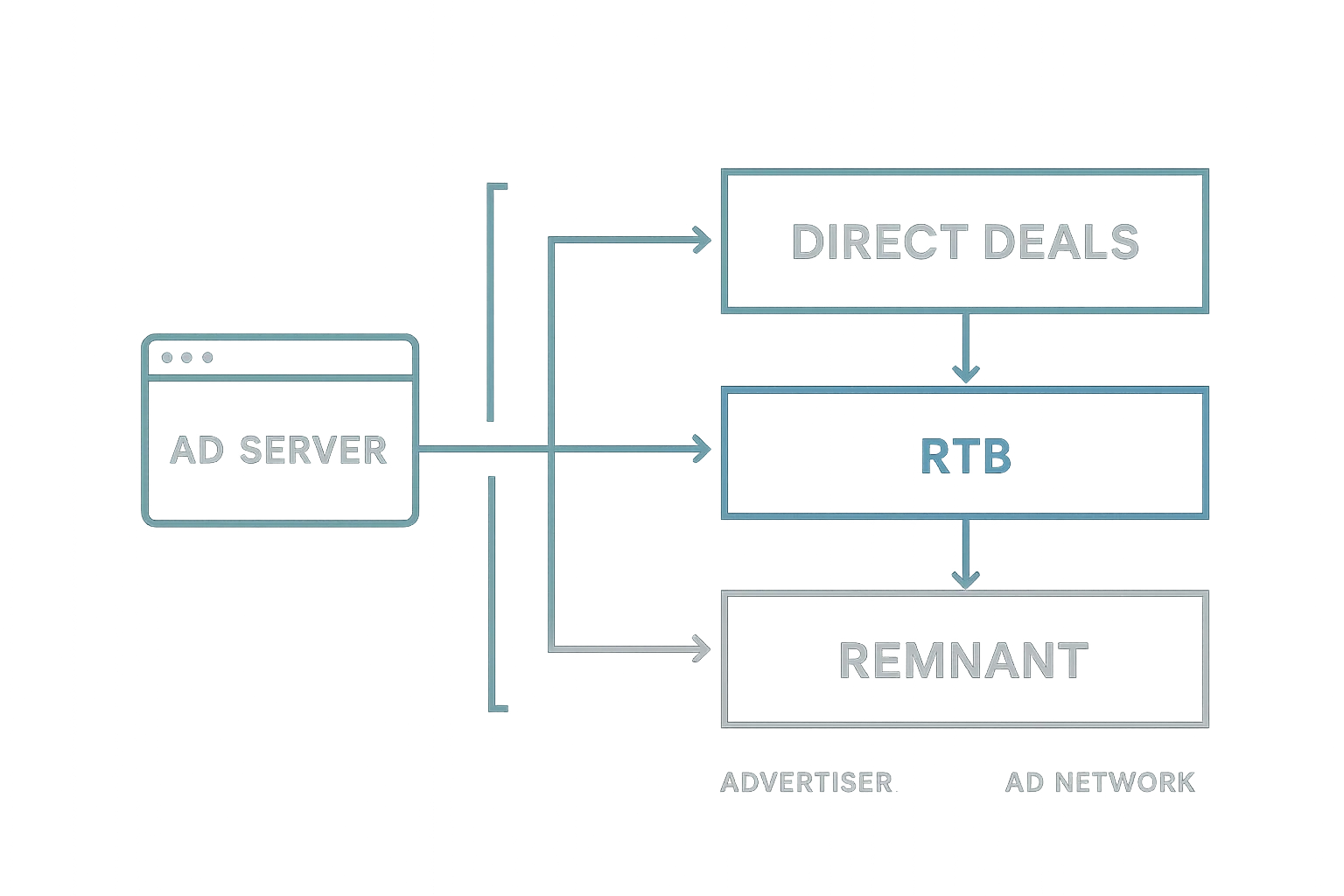
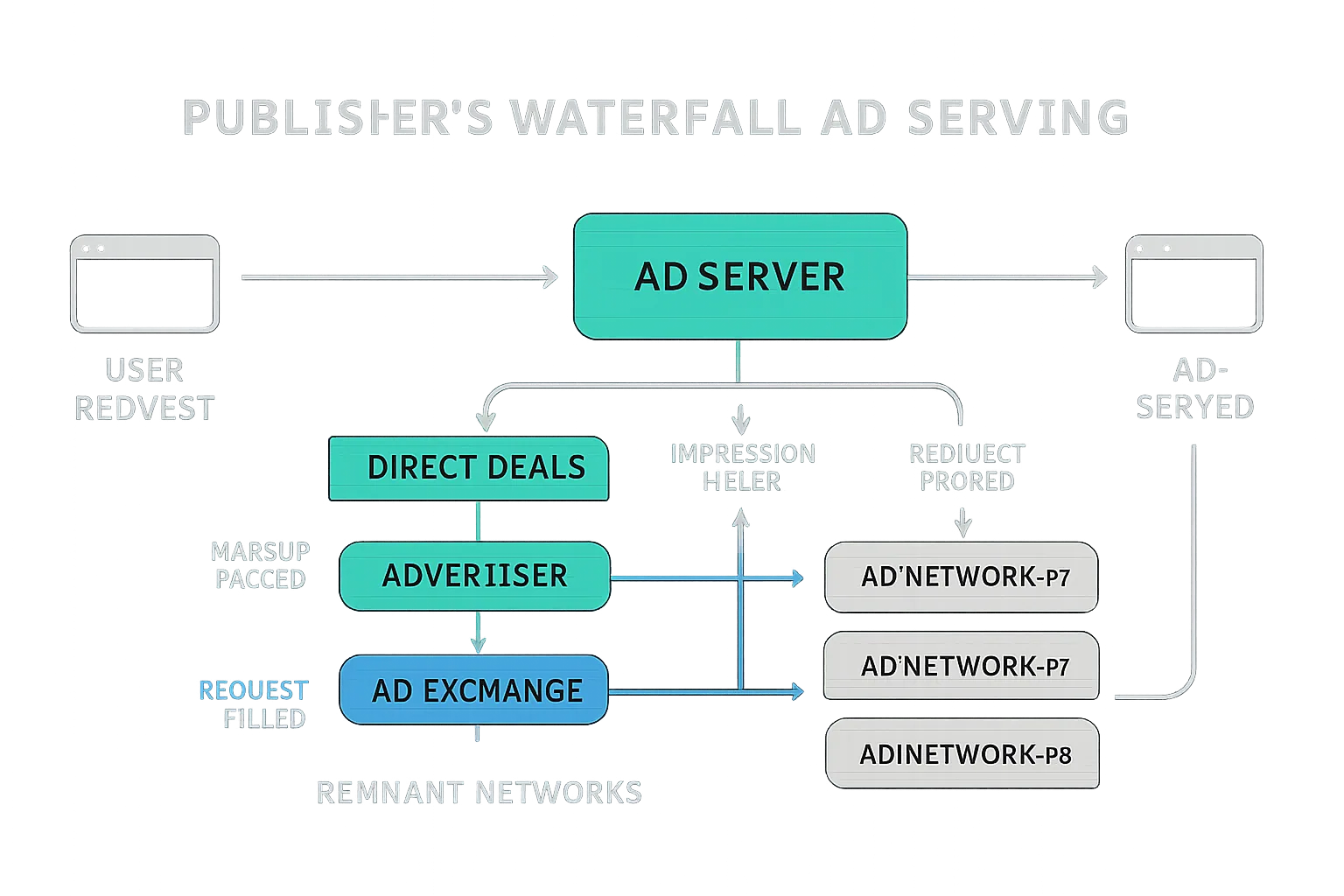
If a publisher's direct-sale slots go unfilled, its ad server fires the first ad network's tag. From there, a few different outcomes are possible.
Scenario 1
Ad Network #1 is able to fill the impression. It returns an ad to the user's browser, which renders and displays it.
Scenario 2
Ad Network #1 can't fill the request, so it loads the tag for Ad Network #2. That also fails, so the tag for Ad Network #3 is loaded — and this time the impression is filled, an ad is returned, and it displays in the user's browser.
Why do ad networks fail to fill an impression?
There are several common reasons a demand source passes on an impression:
-
No suitable ads available: The ad networks receive contextual and audience signals from the publisher's ad server (URL, geolocation, user demographics, etc.) and make a decision on whether the impression matches their active campaigns. If no campaign targeting aligns — for example, all active campaigns target men aged 20–30 interested in sports, but the available user is a 40-year-old woman interested in cooking and gardening — the network won't bid.
-
Floor price mismatch: If the publisher's floor price exceeds what a demand source is willing to pay, that source will pass. This is less common at the top of the waterfall, since demand sources are typically ranked from highest average payer to lowest.
-
Impression capping: Advertisers frequently cap how many times a given user sees their ad within a set period. If a user has already hit that cap — for instance, three exposures in 24 hours — the ad network won't serve the ad even if targeting criteria are otherwise met.
-
Timeouts or technical failures: If a demand source takes too long to respond to the ad request, it gets timed out. Technical failures can produce the same result.
Scenario 3
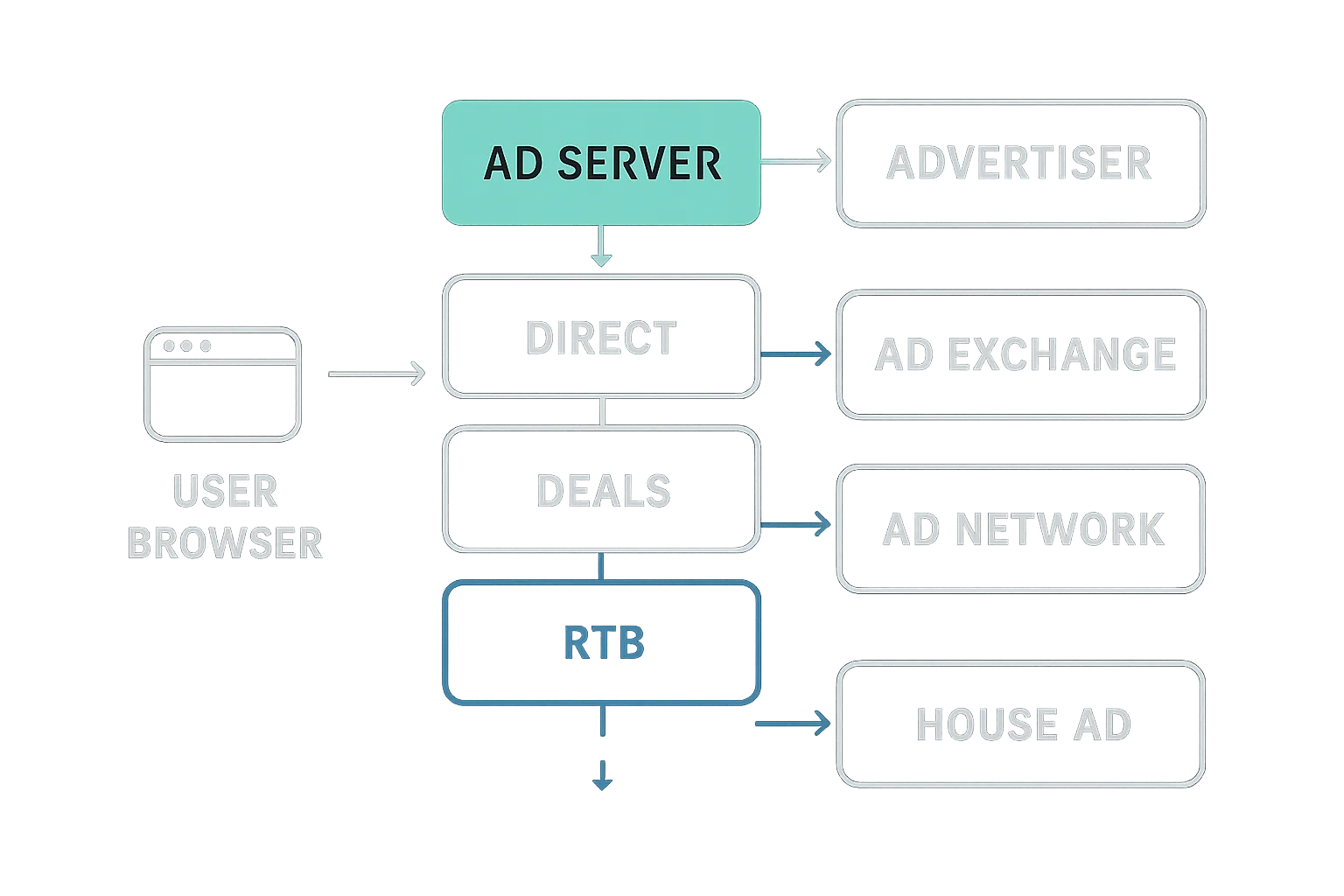
All demand sources in the chain fail to fill the impression. The publisher activates its fallback option — typically a house ad promoting its own products or services.
How Does the Ad Server Decide Which Ad Network to Call First?
The sequencing of ad networks in a waterfall is generally governed by a ranking system configured by the publisher.
The standard approach is to rank demand sources by highest average historical yield — that is, the average revenue each source has generated for the publisher historically, ranked from highest to lowest.
The fundamental flaw in this approach is that historical averages don't reflect real-time market conditions. It's entirely possible that the third-ranked demand source would bid more for a specific impression than the top two — if the available inventory at that moment happens to match their targeting criteria particularly well. By the time the third source is reached (if it's reached at all), the opportunity may already be gone.
In effect, publishers using pure waterfall ranking are systematically underselling their inventory.
This limitation — the inability to determine the true real-time value of an impression — is precisely what drove the development of header bidding.
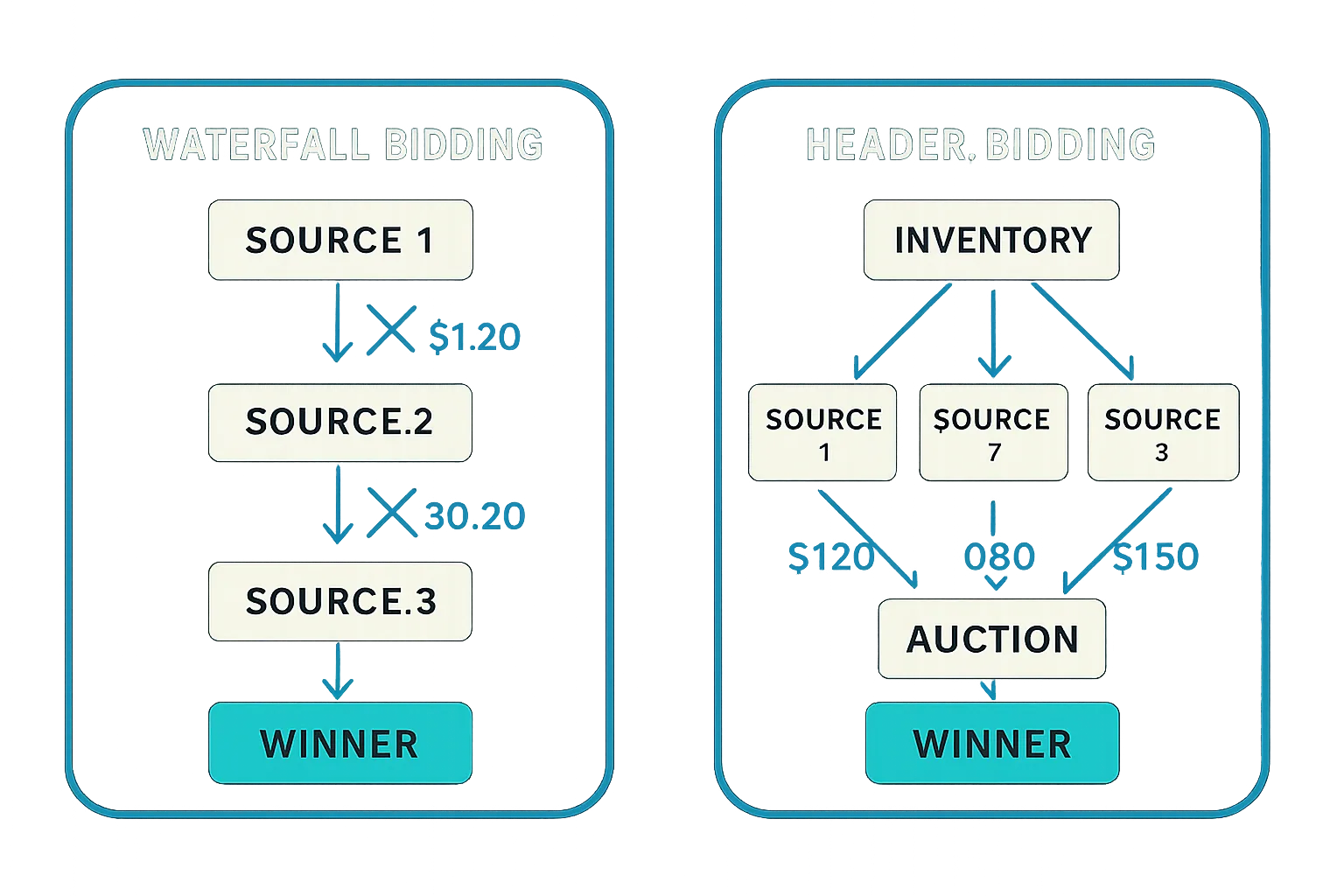
As illustrated above, header bidding auctions expose inventory to multiple demand sources simultaneously, enabling publishers to capture closer-to-true market value for each impression.
Can Supply-Side Platforms (SSPs) Also Use Waterfalling?
Waterfalling was originally applied to ad networks, but publishers eventually began applying the same process to supply-side platforms (SSPs) as well.
This has attracted scrutiny, however. When SSPs are slotted into a daisy chain, ad exchanges connected through those SSPs may end up bidding on the same impression multiple times as it travels along the chain — a dynamic that raises questions about auction integrity and efficiency.
Advantages and Disadvantages of Waterfalling
Advantages
Sells remnant inventory: The primary value of waterfalling is straightforward — it gives publishers a structured mechanism for monetizing inventory that would otherwise go unsold.
Easier to implement than header bidding: Setting up a waterfall essentially requires configuring passback tags on each ad network. Compared to the technical overhead of implementing header bidding, waterfalling has a lower barrier to entry and requires less specialized knowledge.
Disadvantages
Low yield: Because demand sources are ranked by average historical yield rather than current market price, publishers are always working with average CPMs rather than true CPMs. Historical data can help predict what a given ad network will likely pay — and floor prices can be negotiated — but the actual clearing price on any given impression is never certain. The waterfall can be configured optimally on average, but "optimal on average" is not optimal for every impression. A vertical ad network might outbid a premium ad network for a specific impression, but if it sits lower in the waterfall, it may never get the chance.
Latency: Each tier in the waterfall takes time to load. The longer the chain, the more time elapses, and the greater the risk that the user navigates away before an ad is ever displayed.
Errors and timeouts: Any network in the chain can fail to load its fallback tag or time out entirely, resulting in lost revenue with no graceful recovery.
Manual configuration burden: Many ad networks require passback settings to be configured directly within their own systems, making it cumbersome for ad ops teams to manage, reconfigure, or update the waterfall structure over time.
Waterfalling served publishers well as an early solution to remnant inventory monetization, and for smaller operations it remains a workable approach. That said, the structural disadvantages — particularly around yield and latency — have led a growing number of publishers to migrate toward header bidding, which addresses most of waterfalling's core limitations by allowing simultaneous, real-time competition across all demand sources for every impression.