3 Root Causes of Software Development Project Failure
IT has long been recognized as one of the fastest-growing industries in the global economy, which makes optimized project execution all the more critical. Yet failure remains common. Across the broad spectrum of IT work, pinpointing exact root causes can be difficult — but when failure patterns are analyzed at scale, the same culprits surface repeatedly.
According to the 2013 CHAOS Manifesto by the Standish Group, only 39% of IT projects succeeded in 2012.
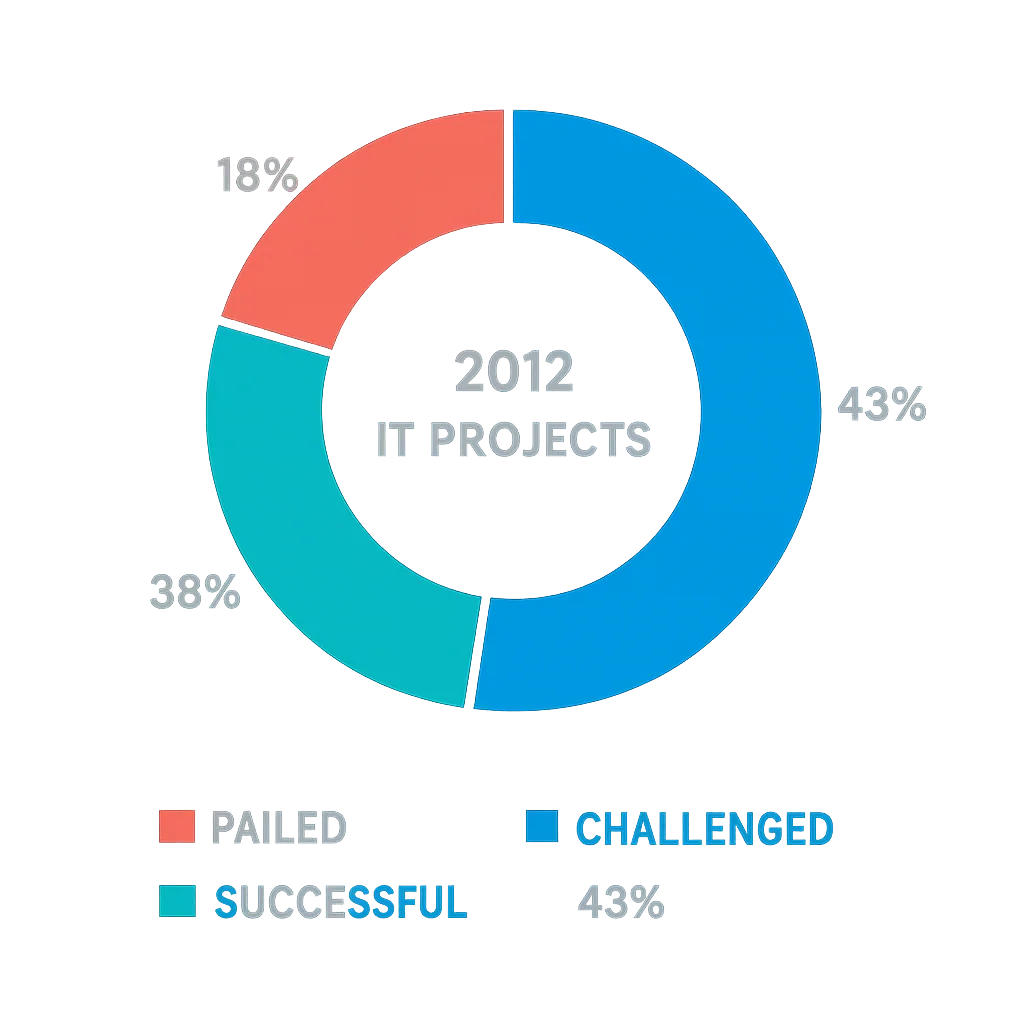
While every project fails in its own particular way, most failures trace back to one or more of three core areas: poor budgeting, a lack of communication and transparency, and resistance to change.
Poor Budgeting
Money plays an outsized role in whether a project succeeds or collapses — that much is obvious. What's less obvious is the range of financial missteps that can sink even well-intentioned efforts.
Early-stage startups and entrepreneurs typically operate under tight financial constraints. Some receive seed funding, but attracting the larger capital needed to fund a full development cycle is difficult: most venture capitalists want a working or near-complete product before committing significant resources. That leaves early teams working with limited runway.
One of the most common responses to that constraint is choosing the cheapest development option available. This is almost always a mistake — and often the most expensive one in the long run. Very low-cost offers rarely deliver quality code, and code quality is foundational. An application's ability to handle load, perform reliably, and be extended over time depends entirely on how well its codebase was constructed. If the underlying code is poor, the application will eventually become inoperative. Worse, when the project is handed off to a different development team, significant budget gets consumed just cleaning up the defective codebase before any new work can begin.
Budget problems don't always stem from a shortage of funds, however. Even projects with adequate financing can run into trouble based on how those funds are managed. The most common structural cause here is the Fixed Bid payment model.
Under a fixed-bid arrangement, a project is priced as a lump sum. This might sound like financial certainty, but it actively undermines the elements most critical to project success. Transparency, communication, and the client-developer relationship all deteriorate under fixed-bid structures, because the incentives of both parties diverge sharply: developers are motivated to complete the project as quickly as possible to retain unspent hours as margin, while clients want maximum value delivered for the agreed price. These goals are fundamentally misaligned.
The fixed-bid model also makes it difficult to see exactly where money is being spent. Because the project is evaluated as a whole rather than tracked phase by phase, there's little visibility into how individual components are progressing or what they're actually costing.
Lack of Communication and Transparency
Open communication across the planning, development, and deployment phases is one of the most reliable predictors of project success — and a breakdown in that communication is one of the fastest ways for a project to go wrong.
Both the client and the development team need to work closely together to ensure that requirements, priorities, and expectations are clearly shared and understood throughout the process. When communication is poor, developers fill in the gaps with assumptions. When clients are not actively involved, they lose influence over the direction of their own product.
The result is an application that diverges significantly from what the client actually needed. It's worth remembering that a failed project isn't only one that crashes or can't be deployed. If the delivered application doesn't meet the client's requirements or produce the intended results, it has failed — regardless of whether it technically runs.
Resistance to Change and Redirection
Change is a constant in software development. Roadblocks appear regularly during construction, but so do new approaches that lead more efficiently to the desired outcome. Course corrections aren't always a sign that something went wrong; they're frequently a sign that the team is learning and adapting.
The ability to respond to change depends heavily on which project management methodology is in place. The two most widely used models in software development are Agile and Waterfall (the traditional, sequential approach).
Agile methodologies are designed around flexibility. They actively accommodate — and encourage — change and redirection at any point in the development cycle. Waterfall, by contrast, is a linear process: each phase is completed before the next begins, and there is no mechanism to revisit earlier stages once they're done. In a field where requirements evolve and technical realities shift constantly, that rigidity is a significant liability.
Teams and organizations that resist change — whether due to contractual constraints, methodology choices, or cultural inertia — are far more likely to end up delivering something that no longer matches the problem it was meant to solve.
Understanding these three failure patterns — financial mismanagement, communication breakdown, and inflexibility — is the starting point for structuring development projects that can actually succeed. Each one is addressable with the right processes, payment structures, and methodologies in place before work begins.